
 Français
  English
  Русский
  Español
  Deutsch
  Português
  العربية
  Italiano
When Installed Base Becomes the Growth Challenge
Across many veterinary markets today, hematology analyzers are already widely installed in clinics. For one veterinary diagnostics distributor operating across several EMEA markets, this reality created an unexpected commercial challenge.
For years, the distributor had built a successful business supplying hematology analyzers to small animal clinics. But by 2025, the market had reached a familiar stage of maturity: most clinics already owned diagnostic equipment. Many of these analyzers had been installed years earlier and were still used for routine CBC testing. In most cases, they were traditional 3-part differential systems.
Although these instruments remained operational, they offered limited diagnostic depth compared with newer technologies. As a result, the distributor faced a difficult dynamic: high equipment penetration, but limited motivation for clinics to upgrade.
Searching for a New Upgrade Path
Rather than focusing on incremental improvements, the distributor began looking for diagnostic technology that could fundamentally change conversations with clinics.
The goal was to introduce a system that would offer veterinarians a clear clinical and operational reason to reconsider their existing analyzers.
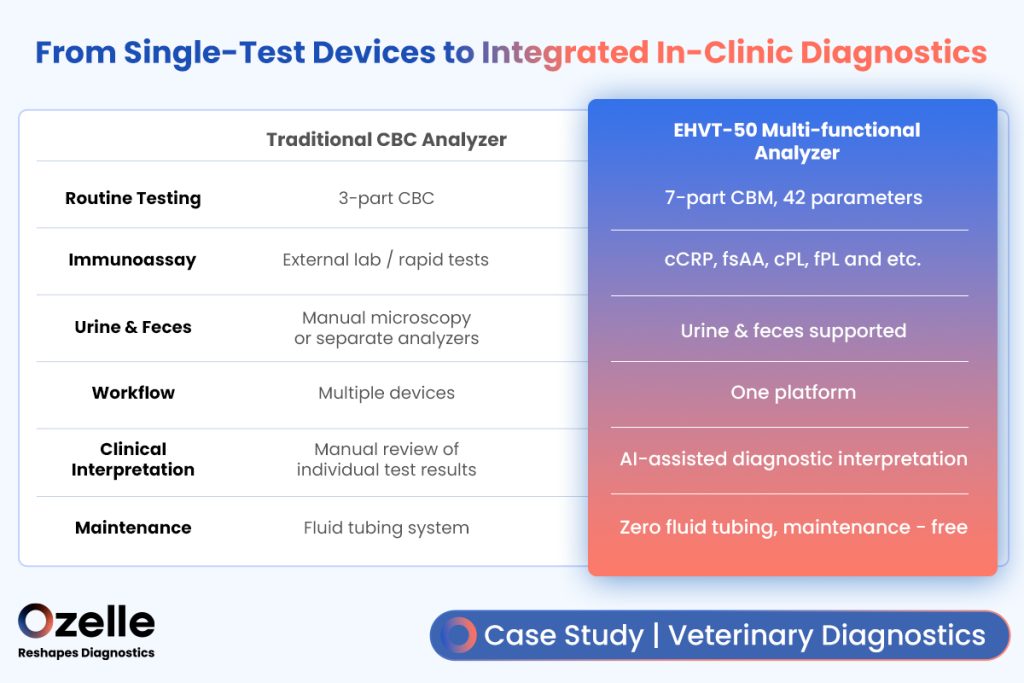
This search eventually led to Ozelle’s Analyseur vétérinaire multifonction EHVT-50. Unlike conventional hematology analyzers, the EHVT-50 integrates multiple diagnostic capabilities into a single in-clinic system, including:
- hematology with AI-assisted morphology analysis
- immunoassay testing such as canine cCRP and feline SAA for inflammatory assessment
- canine cPL and feline fPL for pancreatitis evaluation
- canine cT4 and feline fT4 for thyroid disorders
- integrated urine and fecal diagnostics
To evaluate how this integrated approach would perform in daily clinical practice, the distributor placed evaluation units in several partner clinics.
What Veterinarians Identified as Key Limitations
Discussions with veterinary partners revealed several recurring challenges with existing diagnostic workflows.
- Limited diagnostic insight: Traditional 3-part CBC analyzers provide basic leukocyte differentiation but offer limited visibility into cellular morphology and inflammatory patterns.
- Maintenance complexity: Many conventional analyzers require regular tubing cleaning, calibration, and other maintenance procedures—tasks that can be difficult to manage in busy clinics.
- Fragmented diagnostic workflows: When veterinarians require additional tests such as inflammatory markers, pancreatic markers, or thyroid screening, samples are often processed using separate instruments or referred to external laboratories. This fragmented workflow can delay diagnostic decisions until later in the day or even the following day.
Demonstrating an Integrated Diagnostic Workflow
When the distributor began demonstrating the EHVT-50 veterinary multi-functional analyzer, veterinarians initially responded to its simplified operational design. The analyzer’s Zero Fluid Tubing architecture removes many of the maintenance requirements associated with traditional hematology analyzers, reducing issues such as tubing blockages and daily cleaning routines.
More importantly, the system allowed clinics to perform multiple diagnostic tests within the same platform and consultation workflow. Instead of relying on separate diagnostic instruments—or sending samples to external laboratories—clinics could perform CBC analysis alongside immunoassay testing directly within the same visit.
For many veterinarians, this represented a meaningful shift in how diagnostics could be incorporated into everyday clinical decision-making.

Early Clinical Experience
One clinic participating in the distributor’s evaluation program had previously relied on a basic hematology analyzer for routine CBC testing. When cases required additional investigation—such as suspected pancreatitis, inflammatory disease, or endocrine disorders—samples were typically referred to external laboratories. This often delayed diagnostic confirmation.
After introducing the EHVT-50 veterinary multi-functional analyzer, the clinic began performing several of these additional tests directly during consultations. By combining CBC analysis with immunoassay markers within the same system, veterinarians were able to clarify diagnostic questions during the same patient visit in many cases.

Early Signals of Renewed Upgrade Demand
Within months of placing evaluation units in partner clinics, the distributor began observing something that had not occurred for several years. Clinics that had long continued using older hematology analyzers were now actively discussing equipment replacement. Several customers chose to replace their existing 3-part systems rather than maintain multiple diagnostic devices.
Within the first year after introduction, the distributor reported that the EHVT-50 had become one of the fastest-adopted diagnostic upgrades among its veterinary clinic customers. For the distributor, the result was more than a successful product launch. It marked the beginning of a renewed upgrade cycle in a market that had previously appeared stagnant.
Implications for Veterinary Diagnostics Distributors
In many veterinary markets, hematology analyzers are already widely installed. Future growth may therefore depend less on first-time instrument placements and more on enabling clear upgrade pathways for existing clinics.
Introducing diagnostic systems that expand clinical capabilities while simplifying workflow can help distributors reopen upgrade discussions with clinics that might otherwise continue operating legacy equipment for many years. In this case, an integrated multi-functional diagnostic system did more than replace equipment. It helped create a new cycle of diagnostic modernization.