
 Русский
  English
  Français
  Español
  Deutsch
  Português
  العربية
  Italiano
If you’re running an established clinical lab or hospital laboratory, you’ve probably asked this question more than once: Is the higher cell counter price for a 7-part hematology analyzer really justified? Your current 3-part analyzer gets the job done — it counts white blood cells, red blood cells, and platelets. It’s familiar. It’s paid for. So why upgrade?
The honest answer depends entirely on what your lab needs to deliver — and what it’s silently missing. In this article, we break down the real differences between 3-part and 7-part hematology analyzers, compare the Ozelle EHBT-25 and EHBT-50 side by side, and help you calculate whether the investment makes clinical and financial sense for your operation.
What Does “3-Part” vs. “7-Part” Actually Mean?

The number refers to how many types of white blood cells (WBCs) the analyzer can differentiate in a single blood sample.
A 3-part differential separates WBCs into three broad groups:
- Lymphocytes
- Mid-size cells (monocytes + eosinophils + basophils grouped together)
- Granulocytes (neutrophils)
A 7-part differential, by contrast, breaks WBCs into at least seven distinct populations, including mature and immature subtypes that a 3-part device simply cannot distinguish. This matters enormously in clinical practice, because many critical conditions — early-stage infections, bone marrow stress, hematological malignancies — are flagged first in WBC subpopulations that a 3-part analyzer lumps together or misses entirely.
The Hidden Cost of “Good Enough” Diagnostics
Many labs stick with 3-part analyzers because the cell counter price is lower upfront. But the real cost question isn’t what you pay for the device — it’s what you pay for missed diagnoses, repeat tests, and unnecessary specialist referrals.
Consider a few common clinical scenarios where a 3-part result is insufficient:
- Bacterial vs. viral infection differentiation: A 3-part analyzer cannot distinguish elevated neutrophils (NST — band neutrophils — bacterial infection marker) from mature neutrophils (NSG). A physician relying on a 3-part result may prescribe antibiotics for a viral infection, or miss a bacterial sepsis risk entirely.
- Left shift detection: Elevated NST (Neutrophilic Stab Granulocytes) indicates bone marrow stress and release of immature neutrophils — a critical early warning sign. This marker is invisible on a 3-part analyzer.
- Atypical lymphocytes and platelet aggregation: Conditions like ALY (atypical lymphocytes) and PAg (platelet aggregation), detectable on the EHBT-50’s CBM (Complete Blood Morphology) technology, require a morphology-capable device to flag.
Every one of these gaps creates either a missed finding or a downstream cost — a peripheral blood smear review, a repeat test, or a misguided treatment pathway.
EHBT-25 vs. EHBT-50: Head-to-Head Comparison
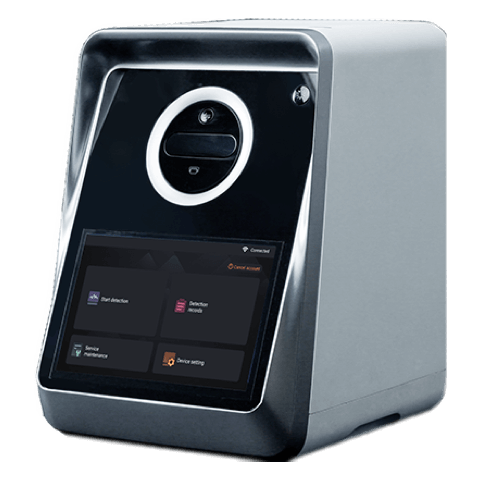
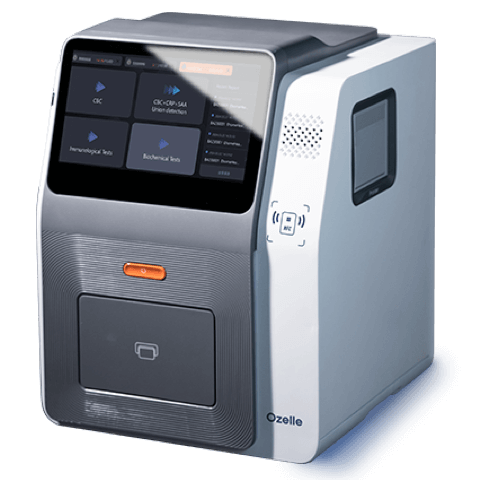
Ozelle offers both a 3-part and a 7-part cell morphology hematology analyzer. Here’s how they compare across the dimensions that matter most to lab decision-makers:
| Характеристика | EHBT-25 (3-Part CBM) | EHBT-50 (7-Part CBM) |
| Дифференцировка лейкоцитов | 3-Part (LYM, MID, GRA) | 7-Diff + Extended: NST, NSG, NSH, ALY, PAg, RET |
| Total CBC Parameters | Standard CBC | 37 Parameters including NLR, PLR, reticulocytes |
| Морфология клеток искусственного интеллекта | Yes (3-Part CBM) | Yes (Advanced CBM, 40M sample model) |
| Иммуноферментное тестирование | Not available | 27+ items: CRP, SAA, PCT, cTnI, TSH, HbA1c, etc. |
| Biochemistry Testing | Not available | Glucose, lipids, liver, renal panels |
| Объем образца | Capillary / venous | 30 µL capillary / 100 µL EDTA tube |
| Пропускная способность | Routine diagnostics | 10 тестов/час |
| Техническое обслуживание | Maintenance-free (individual kits) | Maintenance-free (individual kits) |
| Дисплей | Touch screen | 10.1-inch touch screen, 800×1280 resolution |
| Возможность подключения | LIS/HIS | LIS, HIS, WiFi, LAN, USB, SIM, RTC |
| AI Diagnostic Report | Basic CBC report | Full AI-assisted interpretation with pathology imaging |
| Лучшее для | Entry-level clinics, basic routine CBC | Hospitals, clinical labs, emergency depts, multi-function settings |
The EHBT-25 is an excellent, reliable device for high-volume basic CBC screening. But the EHBT-50 is built for labs that need answers beyond a count — labs where a CBC is the starting point, not the endpoint.
What the 7-Part EHBT-50 Actually Delivers That Changes Clinical Workflow
Extended Cell Classification
The EHBT-50’s AI CBM (Complete Blood Morphology) engine, trained on over 40 million clinical samples, identifies not just the standard five WBC types but also critical subpopulations — including NST (band neutrophils indicating infection stress), NSH (hypersegmented neutrophils indicating dysregulated maturation), and PAg (platelet aggregation). These are flags that, in a 3-part device, would either be missed or require a manual blood smear review by a qualified hematologist.
All-in-One Multi-Panel Testing
Unlike the EHBT-25, the EHBT-50 combines hematology, immunoassay, and dry biochemistry analysis in a single run. A clinician can simultaneously order a CBC + CRP/SAA for infection typing, a CBC + HbA1c + Glucose for a diabetes panel, or a CBC + NT-proBNP for heart failure screening — all from a single 30 µL capillary blood sample. For a lab that currently sends these tests to different stations or external referral centers, this alone can transform turnaround time and reduce per-patient cost.
AI-Powered Diagnostic Reports
The EHBT-50 generates clinical interpretation reports that go far beyond raw numbers. Using a large-model AI trained on 40 million real blood samples, the device provides differential probability rankings for conditions like bacterial infection, viral infection, and autoimmune disease — with visual cell maps and flagging of morphological abnormalities like schistocytes, echinocytes, and teardrop cells. This is not a replacement for physician judgment, but it is a powerful support layer that reduces the cognitive burden on clinicians and accelerates decision-making.
Understanding the Cell Counter Price: Total Cost of Ownership
When evaluating cell counter price, the device purchase price is only one component. The EHBT-50’s design philosophy directly targets total cost of ownership reduction:
| Cost Factor | Traditional 7-Part Analyzer | Ozelle EHBT-50 |
| Техническое обслуживание | Regular reagent system cleaning, technical service | Zero — maintenance-free individual test kits |
| Reagent Waste | Bulk liquid reagents, expiry risk | Individual single-use cartridges (2-year shelf life at room temp) |
| Cross-contamination risk | High (shared reagent channels) | Eliminated — one kit per test, sealed waste storage |
| Cold chain requirement | Often required for reagent storage | Not required — room temperature transport and storage |
| Staff Training | Significant setup and operation training | Minimal — 4-step graphic interface, no sample pre-treatment |
| LIS/HIS Integration | Varies; often add-on cost | Native WiFi, LAN, USB, LIS/HIS support |
| Repeat test rate | Higher (morphology flags require manual review) | Lower (AI CBM auto-classifies abnormalities) |
When you factor in eliminated maintenance contracts, reduced reagent waste, lower repeat-test rates, and the consolidation of immunoassay and biochemistry testing that would otherwise require separate devices, the EHBT-50’s effective per-test cost can be substantially lower than its sticker price implies.
Who Should Upgrade — and Who Should Wait?
Upgrade to a 7-part analyzer if your lab:
- Handles patients with suspected infections, hematological conditions, or chronic disease panels
- Currently sends routine blood smears for manual differential review
- Wants to consolidate CBC, immunoassay, and biochemistry testing onto one platform
- Needs to reduce turnaround time for emergency or acute care decision-making
- Is expanding services to include thyroid panels, cardiac markers, or diabetes monitoring
The EHBT-25 may still be the right fit if your lab:
- Focuses exclusively on high-volume routine CBC screening without clinical interpretation demands
- Has strict budget constraints and basic CBC results satisfy referring physician needs
- Is a community screening site or health fair deployment where extended differentials are not required
For labs sitting in between — growing private clinics, expanding hospital outpatient departments, or labs seeing more complex patient populations — the EHBT-50 represents a strategic investment rather than a luxury upgrade.
Ozelle’s IoT Platform: The Value That Continues After the Sale
One frequently overlooked dimension of the cell counter price conversation is post-sale platform value. Ozelle’s Smart IoT Platform connects every EHBT-50 device to a centralized Operations Management System, enabling remote device monitoring, consumables tracking, sample management, and AI workbench analytics.
This means lab managers get real-time visibility into device utilization, test volumes, and result quality across multiple locations — capabilities that traditional hematology analyzer vendors charge extra for, or don’t offer at all. For hospital networks or multi-site laboratory groups, this platform value can be significant in the total cost calculation.
FAQs: Upgrading Your Hematology Analyzer
Q1: What is the main clinical reason to upgrade from a 3-part to a 7-part hematology analyzer?
A 7-part analyzer detects critical WBC subpopulations — such as band neutrophils (NST), hypersegmented neutrophils (NSH), atypical lymphocytes (ALY), and reticulocytes (RET) — that a 3-part device cannot differentiate. These parameters are essential for detecting early infections, bone marrow stress, and hematological abnormalities before they progress.
Q2: Does the EHBT-50 require a dedicated laboratory space?
No. The EHBT-50 is compact (350×400×450 mm) and weighs only 15 kg, making it suitable for hospital laboratories, private clinics, emergency departments, pharmacies, and even mobile units or ambulances. Its maintenance-free, liquid-free design eliminates the infrastructure requirements of traditional high-complexity hematology analyzers.
Q3: How does the EHBT-50 reduce cell counter operating costs compared to conventional systems?
The EHBT-50 uses single-use, all-in-one cartridges with a 2-year shelf life at room temperature, eliminating the need for bulk liquid reagents, cold chain logistics, and scheduled maintenance. All waste is stored inside the cartridge, reducing bio-safety risks and disposal costs. There are no additional consumables beyond the test kit itself.
Q4: Can the EHBT-50 replace a separate immunoassay analyzer and biochemistry analyzer?
For point-of-care and mid-complexity lab settings, yes. The EHBT-50 combines CBC, 27+ immunoassay markers (CRP, PCT, TSH, cTnI, HbA1c, etc.), and biochemistry panels (glucose, lipids, liver/renal function) in a single device. For high-volume hospital reference labs requiring hundreds of immunoassay tests per day, it functions as a powerful complement rather than a full replacement.
Q5: What AI capabilities does the EHBT-50 offer beyond standard hematology analyzers?
50+ Million Cell Images Generated Daily: Continuous cellular imaging from real diagnostic workflows
100+ Billion Cell Data Points Accumulated: One of the largest morphology datasets in hematology diagnostics
It auto-classifies cell morphology, flags abnormal morphological patterns (e.g., schistocytes, echinocytes, teardrop cells), generates differential diagnosis probability rankings, and produces clinical interpretation reports — all within 6 minutes per sample.
Q6: Is the Ozelle EHBT-50 CE-certified?
Yes. The EHBT-50 is CE-marked and manufactured under ISO 13485:2016 quality management certification. Ozelle holds over 500 technology patents across AI diagnostics, optical systems, and smart detection algorithms.
Q7: Where can I learn more or request a quote for the EHBT-50?
You can explore full product specifications and contact the Ozelle team directly at https://ozellemed.com/en/.
The Bottom Line
The cell counter price question is never just about the number on the invoice. It’s about what a device costs you every day it’s running — in missed diagnoses, repeat tests, manual review time, reagent waste, maintenance contracts, and separate equipment for immunoassay and biochemistry testing.
The Ozelle EHBT-25 is a capable, maintenance-free 3-part CBM analyzer for labs with straightforward CBC needs. But for clinical labs and hospitals that serve complex patient populations, need faster diagnostic answers, and want to consolidate testing onto a single intelligent platform, the EHBT-50’s 7-part differential, AI morphology engine, all-in-one multi-panel testing, and zero-maintenance design represent a fundamentally different category of investment.
The price jump from a 3-part to a 7-part analyzer looks different when you account for everything the old device was quietly costing you. For many labs, the real question isn’t whether they can afford to upgrade — it’s whether they can afford not to.
To explore the full Ozelle hematology analyzer lineup and find the right fit for your lab’s needs, visit https://ozellemed.com/en/.