
 Русский
  English
  Français
  Español
  Deutsch
  Português
  العربية
  Italiano
Introduction: Why CBC Blood Test Machine Price Matters for Clinic Budgets
For small and community clinics, the price of a CBC blood test machine is not just a line item—it directly influences capital planning, operating budgets, and the range of tests that can be performed in‑house. Clinics often need to launch or expand laboratory services with limited upfront investment while still providing reliable blood tests for anemia, infection, and chronic disease management. At the same time, they are under pressure to keep turnaround times short and maintain consistent, reproducible results in day‑to‑day practice.
Against this backdrop, the question is no longer just “How much does a CBC machine cost?” but “What level of diagnostic capability and test menu can a clinic realistically bring in‑house with a given budget?” This is where compact multi‑functional CBC platforms, including the Ozelle EHBT‑50 Mini Lab, come into the discussion as one of the options for clinics that are considering a broader investment in blood testing. Understanding how CBC blood test machine price is structured—and how a more consolidated platform might influence long‑term equipment and reagent spending—helps clinics make more informed planning decisions.

Typical CBC Blood Test Machine Price Ranges
CBC blood test machines (hematology analyzers) are generally grouped into three price tiers in the global market, depending on functionality and target segment.
Price bands by category
| Категория | Typical Use Case | Approx. Price Range (USD) | Notes on Value |
| Entry‑level CBC | Small clinics, GP offices | 5,000–25,000 | 3‑part diff, basic CBC only, limited automation and parameters. |
| Mid‑range 5‑/7‑part | Clinics, small hospitals | 30,000–80,000 | Extended WBC differential, better accuracy, some AI support. |
| Premium AI platforms | Larger labs, reference centers | 80,000–150,000+ | Full morphology imaging, advanced AI, designed for higher‑volume centralized labs. |
Within this landscape, mid‑range AI‑enabled CBC platforms that also consolidate multiple test types typically fall around the 35,000–65,000 USD band, depending on configuration and country. Systems in this range are often evaluated not only on analyzer price but also on how they influence total cost of ownership and the breadth of in‑house testing they support.
The Cost Structure Behind CBC Machine Pricing
Focusing only on the equipment price can understate the real financial impact of a CBC analyzer over its lifecycle. Total cost of ownership (TCO) usually includes several components.
Key cost drivers:
- Capital expenditure: Purchase price of the analyzer and any accessories.
- Consumables: Reagents, cartridges, calibrators, and quality control materials.
- Техническое обслуживание и сервис: Service contracts, spare parts, and potential downtime costs.
- Staff time and training: Hands‑on operation, manual steps, repeat tests, and onboarding new users.
In traditional setups, clinics that want CBC, immunoassay, and chemistry capabilities may need at least three separate devices, with a combined capital cost often in the 65,000–130,000 USD range. In such scenarios, each device generates its own maintenance contract and consumables profile, which can make budgeting and inventory management more complex.
By contrast, a compact multi‑functional CBC blood test machine can consolidate part of this investment into a single platform, especially in environments where test volumes are moderate and the menu fits the device’s capabilities.
The Ozelle EHBT‑50 Mini Lab: Overview
The Ozelle EHBT‑50 is a compact 7-part differential, multi‑functional Mini Lab that integrates hematology, immunofluorescence immunoassay, and dry chemistry into one bench‑top analyzer. It is designed for facilities that need more than a basic CBC analyzer but do not plan to deploy a full central laboratory line.
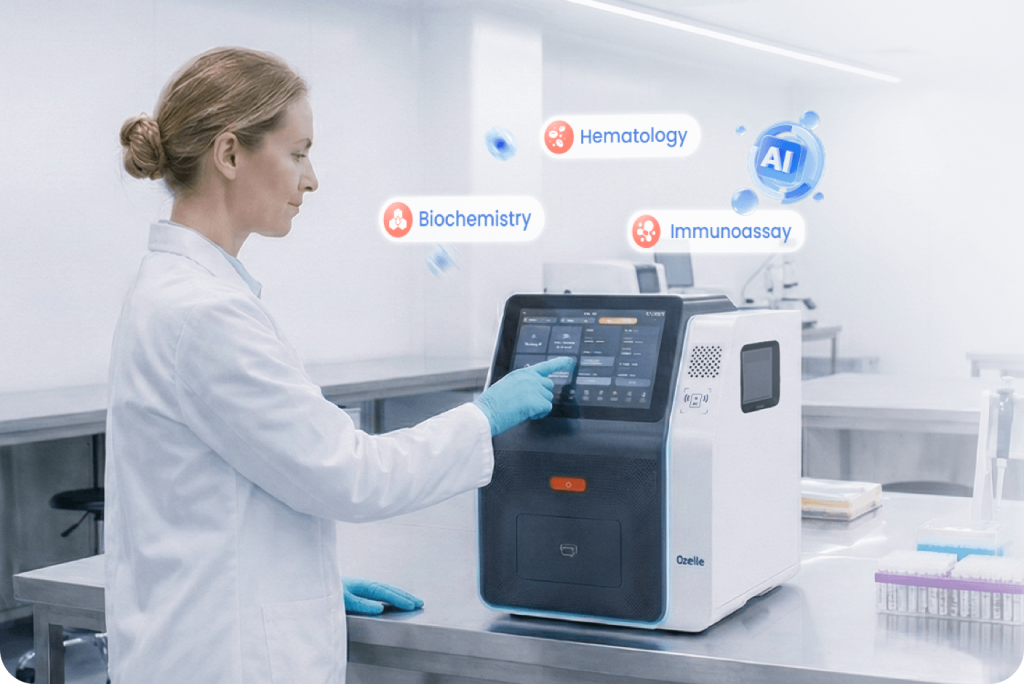
Key capabilities:
- 7‑part CBC with Complete Blood Morphology (CBM) and around 42 reportable parameters, including NST, NSG, NSH, NLR, PLR, ALY, PAg, RET, and others.
- Integrated testing modules supporting inflammatory, metabolic, endocrine, and cardiac-related assays.
- Dry chemistry for core biochemistry items including glucose, liver, and kidney function panels.
- Typical CBC turnaround time is approximately 6 minutes per sample.
- Compact design with a 10.1‑inch touch screen and automated workflow, suitable for small lab spaces.
The EHBT‑50 can therefore serve as a central point for a clinic’s routine blood testing, providing CBC plus key immunoassay and chemistry panels in a single workflow. For more details about the EHBT‑50, including specifications and test menus, see the official product page on Ozelle’s English website: https://ozellemed.com/en/ehbt-50/.
EHBT‑50 vs Separate CBC, Immunoassay, and Chemistry Analyzers
A common question when looking at CBC blood test machine price is whether a clinic should choose a compact multi‑functional platform like the EHBT‑50 or install separate analyzers for CBC, immunoassay, and biochemistry. The answer depends on test mix, volume, and long‑term plans, but a structured comparison can support the decision.
From a capital investment perspective, the EHBT‑50 is generally positioned in the upper mid‑range segment of CBC analyzers. In scenarios where a clinic would otherwise install separate CBC, immunoassay, and basic chemistry analyzers, deploying a single compact multi‑functional platform can reduce overlapping capital expenditure and simplify service and consumable management, improving the cost–benefit profile of the investment.
Layout and workflow considerations
Beyond price, a compact multi‑functional system can influence:
- Space utilization: One footprint instead of multiple analyzers, which can be important where lab space is limited.
- Utilities and IT: Fewer power and network points, and a single LIS/HIS integration path rather than multiple interfaces.
- Training and SOPs: One user interface and set of procedures instead of several, which may reduce training time and standardize processes.
These factors are often part of a broader operational analysis rather than a simple price comparison, but they contribute materially to the overall business case.
How the EHBT‑50 Can Influence Long‑Term Operating Costs
Over the life of the analyzer, operating costs typically exceed the initial purchase price. The EHBT‑50 incorporates several design elements aimed at making ongoing costs easier to manage, particularly for clinics with moderate test volumes.
Consolidated consumables and inventory
By integrating hematology, immunoassay, and chemistry into a single workflow, the EHBT‑50 allows clinics to work with cartridge‑based or kit‑based consumables optimized for the platform. This approach can help reduce waste in lower‑volume settings where large reagent bottles on traditional analyzers may expire before they are fully used.
Maintenance and service profile
The compact Mini Lab is designed as an automated, bench‑top system with a focus on straightforward operation and low routine maintenance. In practice, this can translate into:
- Fewer separate maintenance contracts compared with a multi‑device setup.
- Simplified spare parts and service coordination.
- Reduced risk of downtime due to multiple instrument dependencies.
Exact service cost will vary by region and agreement, but consolidation onto one platform can make service planning more predictable.
AI‑supported CBC and morphology
The EHBT‑50 uses AI-powered Complete Blood Morphology (CBM) to provide detailed cell classification and automated flags for abnormal findings. For clinics that do not have full‑time hematology specialists, this can support more standardized morphology assessment and abnormal-cell flagging and help prioritize smear review workflows in routine samples. Over time, this may lower indirect costs related to repeat testing, external consultations, or extended turnaround times.
Example: How CBC Blood Test Machine Price and Payback Can Be Assessed
To see how CBC blood test machine price connects to financial outcomes, consider a simple example of a community clinic that is evaluating an EHBT‑50 as its main in‑house blood testing platform.
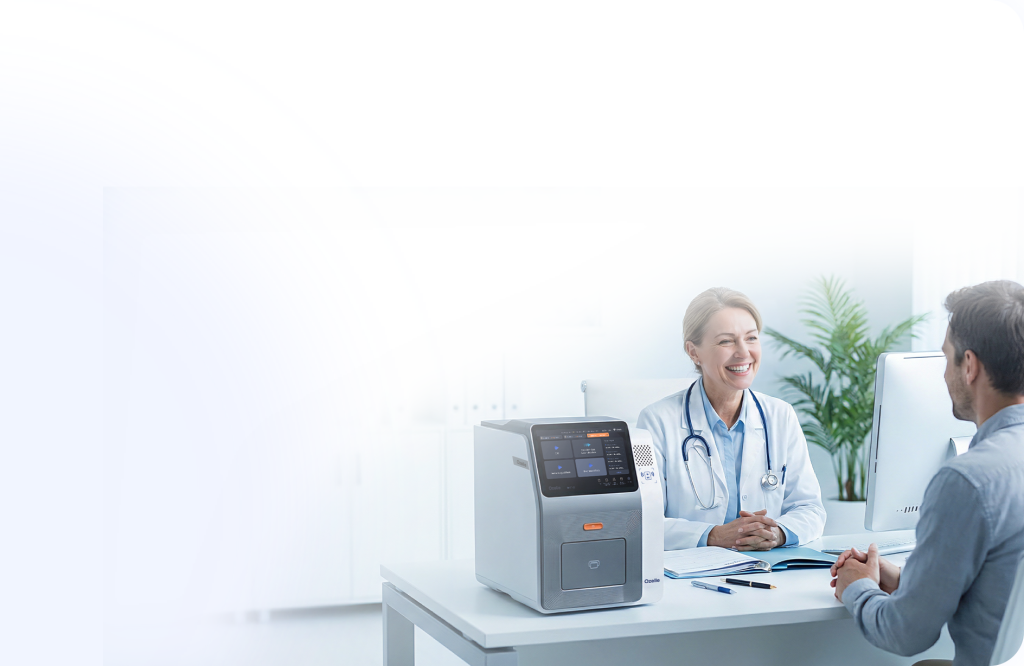
Illustrative assumptions:
- Daily blood panel volume: 15 patients (CBC plus selected markers).
- Working days: 22 days per month (≈264 per year).
- Average billing per panel: equivalent of 25–30 USD, depending on local pricing.
- EHBT‑50 purchase price: around 50,000 USD, aligned with the mid‑band of its range.
Approximate annual gross revenue from blood panels:
- 15 tests/day × 25 USD × 264 days ≈ 99,000 USD per year.
After deducting consumables, staff costs, and overhead, many clinics in similar situations can target a payback period in the range of one to two years for a mid‑range compact multi‑functional analyzer. The exact timeline depends on local tariffs, reimbursement structures, and how much existing outsourced testing is brought in‑house.
Key EHBT‑50 Specifications
When looking at CBC blood test machine price, it is important to see whether the technical specifications match the clinic’s workload and clinical needs.
| Характеристика | EHBT‑50 Mini Lab Specification | Implication for Clinics |
| Возможности CBC | 7‑part differential with ~42 parameters (NST, NSG, NSH, NLR, PLR, ALY, PAg, RET, etc.). | Supports more detailed infection and hematology assessment than basic 3‑part analyzers. |
| Integrated tests | CBC, immunoassay, dry chemistry; designed to cover core routine panels. | Enables a wide range of in‑house tests on a single compact analyzer. |
| Тип образца | Capillary and venous whole blood. | Offers flexibility for adults and pediatric cases, and for outpatient workflows. |
| Объем пробы | Around 30 µL capillary / 100 µL EDTA tube. | Suitable for low‑volume samples and fragile patients. |
| Result time | Around 6 minutes per sample for CBC. | Supports same‑visit decision‑making in many outpatient scenarios. |
| Interface | 10.1‑inch touch screen, one‑click automatic workflow. | Simplifies user training and day‑to‑day operation. |
| Возможность подключения | LIS/HIS integration, LAN/WiFi/USB/SIM options depending on configuration. | Eases integration with existing information systems and remote monitoring. |
These specifications can be used directly in internal comparison tables when different models and brands are being evaluated side by side.
FAQs About CBC Blood Test Machine Price for Small Clinics
What types of facilities is the EHBT‑50 best suited for?
The EHBT‑50 is primarily designed for small to mid‑volume settings such as community clinics, outpatient centers, day‑surgery facilities, and smaller hospitals that want to expand in‑house blood testing without building a full core laboratory. Its compact footprint and integrated test menu make it practical for sites with limited space and staff.
Can the EHBT‑50 work with both finger‑stick and venous samples?
Yes, the EHBT‑50 supports capillary (finger‑stick) and venous whole blood samples, with typical sample volumes around 30 µL for capillary and 100 µL for EDTA tubes. This flexibility is useful for pediatric cases, frail patients, and outpatient workflows where venous access may be less convenient.
How does the EHBT‑50 help standardize results across different operators?
The analyzer uses automated sample handling, pre‑set testing workflows, and AI‑driven morphology analysis to minimize operator‑dependent variability. Standardized cartridges, fixed reagent protocols, and a guided user interface help different operators follow the same process, which supports more consistent results over time.
Is the EHBT‑50 suitable for clinics without a dedicated lab technician?
The EHBT‑50 is designed as a compact, automated system with a one‑click workflow and on‑screen prompts, making it feasible for use in clinics where nurses or general staff handle basic testing after initial training. AI‑assisted morphology and built‑in quality checks can support clinical decision‑making even when there is no full‑time hematology specialist on site.
How does the EHBT‑50 connect to existing information systems?
Depending on configuration, the EHBT‑50 can connect via LAN, WiFi, USB, or SIM and supports LIS/HIS integration for electronic result transfer. This reduces manual data entry, helps prevent transcription errors, and makes it easier to align CBC testing with the clinic’s broader digital workflow.