
 Русский
  English
  Français
  Español
  Deutsch
  Português
  العربية
  Italiano
Переход на диагностику в точках оказания медицинской помощи (POC)
В 2025 году внутренняя гематологическая диагностика превратится из “роскоши и удобства” в основополагающий стандарт лечения, который напрямую влияет на клинические результаты и прибыльность практики. Мировой рынок ветеринарной диагностики, оцениваемый в $2,96 млрд в 2025 году, по прогнозам, достигнет $6,55 млрд в течение десятилетия, что отражает стремление всего сектора к быстрому тестированию в условиях стационара. Для современных ветеринарных клиник возможность сделать полный анализ крови (CBC) менее чем за 10 минут перестала быть просто целесообразной - она стала основным фактором дохода и конкурентным преимуществом.
Этому ускорению способствуют три сходящиеся воедино силы: ожидания клиентов получить немедленные диагностические ответы, клиническая необходимость выявлять предоперационные риски и острые инфекции до того, как пациент покинет смотровой кабинет, а также существенное финансовое преимущество, которое дает тестирование в клинике по сравнению с услугами централизованной референс-лаборатории. Клиники, выполняющие всего 50 тестов в день, могут получить около $90 000 ежегодной экономии, если будут использовать собственный анализатор, а не привлекать внешние лаборатории.
Данное руководство содержит прозрачное сравнение четырех наиболее значимых игроков рынка -IDEXX, Zoetis, Seamaty и Ozelle - и позволяет владельцам и руководителям клиник рассчитать рентабельность инвестиций (ROI), понять истинную стоимость владения и определить оптимальный вариант работы.
Критерии отбора: Как мы ранжировали анализаторы
Ветеринарные гематологические анализаторы значительно отличаются друг от друга по базовым технологиям, интеграции рабочих процессов и общей стоимости владения. Эффективная оценка требует систематического анализа по нескольким параметрам.
Основные технологические опции
Импеданс (традиционный фонд): Использует электрический ток для определения размеров клеток при их прохождении через заряженную диафрагму. Эта проверенная технология надежно подсчитывает эритроциты, но испытывает серьезные трудности с дифференциацией лейкоцитов, в частности с отличием эозинофилов от нейтрофилов, когда объемы клеток перекрываются. Системы на основе импеданса по-прежнему пригодны для базового скрининга, но им не хватает глубины диагностики, которая все чаще требуется в клинической практике.
Лазерная проточная цитометрия: Измеряет сложность клеток, внутреннюю плотность, зернистость и дольчатость ядер, используя рассеяние лазерного света под разными углами. Этот многомерный анализ позволяет точно подсчитывать количество эозинофилов, определять ретикулоциты и надежно работать с такими проблемными образцами, как сгустки кошачьих тромбоцитов, гемолизированная или ледяная кровь. Платформа ProCyte компании IDEXX и некоторые модели Seamaty используют этот подход.
Цифровая морфология ИИ (новый рубеж): В новейших разработках, примером которых является компания Ozelle, используются высокоскоростные камеры и искусственный интеллект, обученный на миллионах клинических образцов, для визуального фотографирования и классификации отдельных клеток. Такой подход имитирует ручную морфологическую экспертизу патологоанатома - традиционный золотой стандарт, - но выполняется автоматически и документирует результаты визуальными изображениями, которые могут просмотреть врачи.
Ограничения на выборку и рабочий процесс
Требования к объему пробы представляют собой критическое операционное ограничение, особенно в педиатрических и гериатрических группах населения, где сбор проб сопряжен со значительными трудностями. Анализаторы, требующие менее 30 мкл, обладают большей гибкостью по сравнению с приборами, требующими 100 мкл. Системы отбора проб с закрытыми пробирками (с протыканием крышки) предпочтительнее систем с открытыми пробирками, поскольку они исключают риск пролива и биологическую опасность в условиях большого объема.
Эффективность рабочего процесса не ограничивается только скоростью. Возможность “загрузи и работай” - возможность поместить пробирку с образцом и уйти, пока анализатор автономно завершает анализ - очень важна для клиник с нехваткой персонала и конкурирующими требованиями. Интеграция с системами управления практической информацией (PIMS) и беспрепятственный двунаправленный поток данных в электронную медицинскую карту определяют, станет ли анализатор средством экономии времени или бременем для ввода данных.
Общая стоимость владения (TCO)
Цена оборудования составляет лишь 30-40% от пятилетней стоимости владения; расходные материалы и техническое обслуживание доминируют над реальными эксплуатационными расходами. Бизнес-модель “бритвы и лезвия”, когда поставщики размещают дорогое оборудование по дешевке в обмен на премиальные цены на реагенты, требует тщательного анализа. Системы на основе упакованных реагентов обеспечивают удобство, но их стоимость в расчете на один тест значительно выше, чем у систем на основе жидких реагентов. Архитектура технического обслуживания, в частности необходимость ежедневной очистки анализатора, ежемесячной калибровки или заключения сервисных контрактов на ремонт гидравлической системы, существенно влияет на эксплуатационные расходы и риск простоя.
Топ-4 ветеринарных гематологических анализаторов: Подробный анализ
IDEXX ProCyte One: эталонный стандарт для клиник премиум-класса
Основная технология: Лазерная проточная цитометрия + оптическая флуоресценция с 5-мерной классификацией клеток
ProCyte One - самый распространенный гематологический анализатор в высокоэффективной ветеринарной практике. Двойной технологический подход, сочетающий анализ рассеянного лазерного излучения и оптическую флуоресценцию, позволяет выявлять и подсчитывать ретикулоциты и отличать кошачьи сгустки тромбоцитов от эритроцитов - две постоянные проблемы в ветеринарной гематологии.
Операционная деятельность
Результаты выдаются за пять минут или меньше, что делает IDEXX лидером по скорости в сегменте точечных анализов. Анализатор обеспечивает 24 параметра цельной крови, включая истинную дифференциацию лейкоцитов из пяти частей (нейтрофилы, лимфоциты, моноциты, эозинофилы, базофилы), количество ретикулоцитов в процентах и абсолютных числах, а также сложные индексы, включая средний объем клеток и ширину распределения эритроцитов.
Встроенная смарт-камера автоматически проверяет целостность образцов, сканируя QR-коды на упаковках с реагентами на предмет срока годности, определяя тип пробирки и состояние крышки, а также отмечая потенциальные проблемы до начала анализа - это устраняет распространенный источник ошибок оператора.
Финансовая модель
Структура ценообразования IDEXX “оплата за прогон” представляет собой продуманную философию бизнеса: клиники избегают больших предварительных капитальных затрат в обмен на оплату за каждый тест, обычно составляющую от $9,25 до $9,50. Эта модель позволяет увязать расходы практики непосредственно с объемом диагностики, хотя в долгосрочной перспективе она приводит к более высоким затратам для клиник с большим объемом исследований по сравнению с альтернативными вариантами приобретения оборудования. Ежемесячное выставление счетов на основе фактически проведенных исследований обеспечивает прозрачность денежных потоков, но требует постоянного взаимодействия с поставщиком через IDEXX SmartService Solutions, которая отслеживает использование и автоматически пополняет запасы.
Клинические преимущества
Технология оптической флуоресценции позволяет решить одну из самых сложных технических проблем ветеринарной гематологии: кошачьи тромбоцитарные сгустки. Кошки имеют биологическую склонность к агрегации тромбоцитов, из-за чего анализаторы на основе импеданса ошибочно подсчитывают тромбоциты или ошибочно идентифицируют их как эритроциты. Подход IDEXX определяет характеристики гранул тромбоцитов оптически, что позволяет точно подсчитать количество тромбоцитов даже в образцах, склонных к образованию комков. Сочетание HD-лазера и оптической флуоресценции в анализаторе также позволяет выявлять ретикулоциты - незрелые эритроциты, подсчет которых крайне важен для оценки реакции костного мозга у пациентов с анемией.
Лучше всего подходит для: Многопрофильные врачебные практики с высокой интенсивностью работы, где скорость (результаты за ~5 минут) и немедленная диагностическая уверенность оправдывают высокую стоимость каждого теста. Больницы скорой помощи с быстрым потоком пациентов и специалистами, обученными интерпретировать сложные гистограммы, представляют собой идеальные варианты использования. Широкая интеграция в экосистему IDEXX (VetConnect PLUS создает исторические тренды гематологических профилей пациентов) привлекает дальновидных специалистов, стремящихся получить диагностическую документацию, ориентированную на клиента.
Основные характеристики:
- Время получения результата: 5 минут или меньше
- Параметры: 24 (показатели цельной крови)
- Дифференциал: 5 частей
- Объем пробы: ~30 мкл
- Пропускная способность: Самая высокая в классе (возможно ~100+ образцов/день)
- Обслуживание: Практически не требуется, кроме замены пакетов/фильтров
- Поддержка: Круглосуточная сеть с быстрой логистикой замены
Zoetis VetScan HM5: гибкая рабочая лошадка для смешанной практики
Основная технология: Импеданс + химическая дифференциация
Модель VetScan HM5 уже много лет сохраняет свое присутствие на рынке, обеспечивая простую и надежную гематологию без сложностей и дороговизны лазерных систем. Для подсчета клеток используется импедансная технология, но она дополняется химической дифференцировкой - селективным лизисом клеточных популяций - для повышения точности классификации лейкоцитов сверх базовой импедансной дискриминации.
Технические характеристики
Анализатор производит 22-параметрический полный анализ крови с пяти- или трехкомпонентным дифференциальным анализом за 3-4 минуты. Прямое измерение эозинофилов (а не оценка, что характерно для импедансных анализаторов) обеспечивает точную оценку паразитарной инфекции - клинически важную для врачей, занимающихся смешанными животными и управляющих гельминтозами. Потребность в образцах - 50 мкл для пятикомпонентного дифференциального анализа и 25 мкл для трехкомпонентного дифференциального анализа - является умеренной и подходит для большинства пациентов, в то же время оставаясь приемлемой для педиатрических случаев.
Производительность обработки достигает 16-20 образцов в час в пятикомпонентном режиме, что делает его подходящим для небольших и средних клиник, проводящих 30-80 анализов в день. Сенсорный интерфейс отображает гистограммы клеток, которые проверяют количество дифференцировок и помогают с первого взгляда определить редкие заболевания.
Система реагентов и техническое обслуживание
Система реагентов HM5 ’smart pack“ обеспечивает простоту: комплекты трубок для реагентов и адаптеры для образцов защелкиваются без сложных процедур настройки. Анализатор выполняет автоматическую внутреннюю очистку с минимальным ежедневным вмешательством оператора. В отличие от систем, требующих ежедневной ручной промывки или очистки отбеливателем, VetScan поддерживает базовую функциональность благодаря встроенным автоматизированным циклам. Анализатор требует проведения холостых измерений каждые 12 часов для установления базовой производительности и выявления любого загрязнения жидкостей - простая процедура контроля качества, занимающая около двух минут.
Лучше всего подходит для: Независимые клиники для мелких животных, клиники для смешанных животных и сельские ветеринары, которые отдают предпочтение надежной базовой диагностике перед продвинутым морфологическим анализом. Совместимость с различными типами образцов, включая перитонеальную и синовиальную жидкости для оценки инфекций, привлекает врачей, занимающихся травмами, хирургическими операциями и острыми инфекционными заболеваниями, где быстрое подсчет клеток позволяет принимать немедленные решения о лечении.
Финансовый профиль
Стоимость оборудования составляет примерно $4,995 - существенные, но управляемые капитальные вложения, более выгодные, чем у лазерных систем премиум-класса. Стоимость расходных материалов на тест конкурентоспособна по сравнению с IDEXX, несмотря на модель покупки. Более низкий первоначальный барьер позволяет небольшим практикам оправдывать проведение тестов своими силами на основе более скромных объемов (15-20 ежедневных тестов могут выйти на безубыточность в течение 18-24 месяцев).
Основные характеристики:
- Время работы: 2-3 минуты (согласно заявлениям производителя, общее время работы составляет 3-4 минуты)
- Параметры: 22
- Дифференциал: 5 частей или 3 части
- Объем пробы: 50 мкл (5 частей), 25 мкл (3 части)
- Производительность: 16-20 образцов/час
- Species validation: 15 different species
- Data storage: 5,000 records with trending capability
Seamaty SMT-50: The Compact Innovator for Budget-Conscious Practitioners
Core Technology: Laser Scattering + Impedance (3-Angle Laser Scatter)
Seamaty has fundamentally disrupted the veterinary hematology market by shrinking five-part laser differentiation technology into an exceptionally compact unit (approximately shoebox-sized), challenging the conventional assumption that “laser means large and expensive.” The SMT-50 represents the company’s premium 5-part model and demonstrates that advanced optical analysis need not command premium pricing.
Technology and Performance
The analyzer employs three-angle laser scatter technology—measuring how laser light reflects from cells at multiple angles to assess size, complexity, and granularity—combined with impedance counting for complete cellular assessment. The result is legitimately five-part differential analysis at a price point accessible to independent clinics, mobile veterinary units, and startup facilities that would otherwise invest in older impedance-only equipment.
Sample volume requirements of approximately 20µL represent the lowest in the field, making the SMT-50 exceptionally suited for feline medicine, exotic animal practice, and pediatric cases where sample collection is inherently challenging. The “maintenance-free” design philosophy emphasizes simplicity: the analyzer incorporates no complex liquid pipelines requiring daily flushing, no elaborate calibration routines, and no service contracts for hydraulic repairs.
Throughput and Workflow
Processing capacity reaches 60 samples per hour—exceptional throughput for a compact unit. While individual result time may extend to 6-10 minutes depending on operator workflow, the parallel processing capability enables practices with moderate test volumes to achieve excellent per-hour efficiency without investing in a second analyzer.
Best For: Independent clinics with capital constraints, mobile veterinary units serving multiple remote locations, startup hospitals establishing initial diagnostic capabilities, and specialized exotic animal practices where sample volume constraints would otherwise necessitate external laboratory reliance. Practices prioritizing 5-part laser accuracy without premium equipment costs find the SMT-50 compelling.
Основные характеристики:
- Sample volume: ~20µL (ultra-low)
- Result time: 6-10 minutes
- Дифференциал: 5 частей
- Throughput: 60 samples/hour capacity
- Footprint: Extremely compact (significant space savings)
- Maintenance: Minimal by design philosophy
- Technology: Laser scatter with impedance integration
Ozelle EHVT-50: The AI-Powered All-in-One Solution

Core Technology: AI-Powered Complete Blood Morphology (CBM) with High-Precision Optical Imaging
Ozelle represents the next generation of veterinary diagnostics, moving definitively beyond simple cell counting toward actual image recognition and morphological analysis. The EHVT-50 doesn’t merely count cells; it employs high-precision optics (SwissOptic® lens technology with 4-megapixel resolution, 50 frames-per-second image acquisition) and artificial intelligence algorithms trained on 40 million clinical samples to photograph and classify individual cells based on morphological characteristics.
Comprehensive Multi-Modal Platform
Unlike single-function analyzers, the EHVT-50 consolidates four separate laboratory machines into one integrated unit: hematology (7-part differential with AI classification), immunoassay (canine C-reactive protein, feline serum amyloid A), urine analysis (29 parameters including cells, casts, crystals, microorganisms), and fecal analysis (29 parameters including parasites, bacteria, formed elements). This architectural consolidation addresses a fundamental inefficiency in traditional laboratory design—the requirement to move samples between multiple devices, each with separate maintenance protocols and reagent requirements.
AI Morphology and Visual Verification
The analyzer’s defining advantage lies in visual cell verification. Rather than presenting abstract scatter diagrams or histograms that require specialized interpretation training, the EHVT-50 provides actual photographs of analyzed cells alongside numerical results. AI classification algorithms identify morphological abnormalities—band neutrophils, toxic cytoplasmic changes, atypical lymphocytes, potential neoplastic cells—and flag them for clinician review with supporting imagery. This approach solves the “black box” problem inherent in traditional automated hematology: when results look unusual, clinicians can immediately visualize the cells that generated those numbers.
Operational Excellence: Pipeline-Free Architecture
The EHVT-50 employs single-use wet staining cartridges and eliminates entirely the liquid pipelines present in traditional analyzers. This architectural choice carries profound operational implications:
- Maintenance: Zero daily maintenance. Traditional analyzers require daily flushing of liquid lines with distilled water or saline, typically consuming 10-15 minutes. The EHVT-50 requires no startup cycles, no shutdown procedures, and no scheduled flushing protocols.
- Reagent Waste: Single-use cartridges prevent expired reagent waste inherent in bulk liquid systems. There is no risk of contaminated tubing causing false results or requiring service calls.
- Cross-Contamination: Individual samples use separate cartridges, eliminating sample carryover risk entirely.
- Storage: Dry QC (quality control) cards stored at room temperature eliminate the cold-chain complexity of traditional liquid QC materials requiring refrigeration.
Throughput and Clinical Workflow
Despite analytical complexity, the analyzer maintains 12 samples per hour throughput with individual test times of 6-8 minutes. This speed balances comprehensive diagnostic depth—full morphology imaging plus multi-modal analysis—with reasonable clinical workflow integration. For practices where diagnostic thoroughness is prioritized over raw speed, this represents an optimal trade-off.
Best For: Forward-thinking clinics prioritizing diagnostic depth and operational efficiency over raw speed. Ideal for practices seeking to eliminate manual microscopy, provide comprehensive workups (CBC + immunoassay + urine + feces) from a single station, and consolidate laboratory infrastructure. Specialty and emergency hospitals that benefit from AI morphology imaging for oncology screening, infection severity assessment, and bone marrow dysfunction detection.
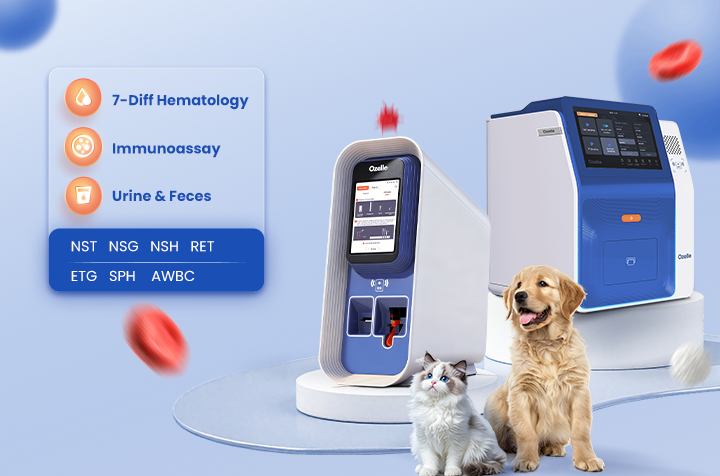
Основные характеристики:
- Technology: AI Digital Morphology with optical imaging
- Result time: 8-9 minutes
- Differential: 7-part (AI-classified)
- Sample volume: 30-55µL
- Parameters: 7-part CBC + immunoassay + 29-parameter urine + 29-parameter feces
- Throughput: 6-7 samples/hour
- Maintenance: Zero (pipeline-free)
- QC: Dry cards at room temperature
Comparative Analysis: Head-to-Head Evaluation
| Характеристика | IDEXX ProCyte One | Zoetis VetScan HM5 | Seamaty SMT-50 | Ozelle EHVT-50 |
| Primary Technology | Laser Flow Cytometry + Optical Fluorescence | Impedance + Chemical Differentiation | Laser Scatter + Impedance | AI Digital Morphology |
| Дифференциальный тип | 5 частей | 5-part or 3-part | 5 частей | 7-part (AI) |
| Parameters Reported | 24 | 22 | ~21 | 42+ (including morphology) |
| Результат Время | 5 minutes | 3-4 minutes | 6-10 минут | 8-9 minutes |
| Объем образца | ~30µL | 50µL (5-part), 25µL (3-part) | 20µL | 30-55µL |
| Пропускная способность | High (~100+/day) | 16-20/hour | 6-10/hour | 6-7/hour |
| Multi-Modal | Нет | Нет | Нет | Yes (CBC + Immunoassay + Urine + Feces) |
| Equipment Cost | Low/Free (Pay-per-run) | ~$4,995 | Entry-level laser | Mid-tier |
| Cost-per-Test | $9.25-9.50 | $0.75-1.00 | $0.60-0.80 | Higher (but consolidates 4 machines) |
| Техническое обслуживание | Минимум | Умеренный | Минимум | Zero (pipeline-free) |
| Platelet Clump Handling | Excellent (optical) | Хорошо | Хорошо | Excellent (visual verification) |
| Species Validation | Multiple | 15 species | Multiple | Canine, Feline (customizable) |
| Visual Morphology | Нет | Нет | Нет | Yes (AI images) |
Financial Analysis: The Cost-of-Ownership Imperative
Equipment price is only the first dimension of ownership costs. True financial evaluation requires analyzing consumables, maintenance, support, and opportunity cost.
The Pay-Per-Run vs. Equipment Purchase Decision
IDEXX’s Strategic Model: The ProCyte One’s pay-per-run pricing eliminates capital equipment cost but generates ongoing per-test charges. For practices running high volumes (100+ tests daily), cumulative per-test costs exceed $1.00 (including quality control materials), resulting in total annual expenses that dwarf upfront equipment purchase in traditional models. However, the model offers profound cash-flow advantages: practices avoid $5,000-$8,000 initial capital outlay and don’t carry inventory risk. This works well for established practices with stable cash flow and predictable testing volumes.
Equipment Purchase Model: Seamaty and Zoetis emphasize equipment ownership. A $4,995 VetScan HM5 with $0.75-per-test consumables generates approximately $10,000 in first-year costs (equipment + 12,500 annual tests). A practice running 50 tests daily (12,500 annually) achieves break-even within 4-6 months relative to reference laboratory pricing ($8-$15 per external test), then generates $7,000-$9,000 in annual savings thereafter.
Total Cost of Ownership Calculation
A practical example clarifies the financial case for in-house testing:
Mixed Animal Clinic Running 50 Daily Tests (12,500 Annually)
| Категория затрат | In-House Analyzer | Reference Laboratory |
| Equipment (5-year amortized) | $1,000/year | $0 |
| Consumables | $9,375/year | $0 |
| Maintenance/Service | $500/year | $0 |
| Общая стоимость | $10,875/year | $100,000/year |
| Savings | $89,125/year |
The analyzer pays for itself within approximately two weeks—a stunningly rapid ROI that explains the industry’s aggressive adoption of point-of-care hematology.
Consumable Cost Optimization
Consumable expenses represent 60-70% of five-year operating costs. Practices must evaluate:
- Pack vs. Bulk: Self-contained reagent packs offer convenience but cost 15-30% more per test than bulk reagent bottles requiring more inventory management.
- Waste and Expiration: Bulk systems risk reagent expiration and waste; cartridge-based systems eliminate this entirely.
- Maintenance Consumables: Traditional analyzers consume distilled water and cleaning solutions in daily maintenance; pipeline-free analyzers eliminate these consumables entirely.
The Business Case by Practice Type
Startup or Single-Doctor Clinic (1-3 Veterinarians)
Recommendation: Seamaty SMT-50 or Ozelle EHVT-50
Rationale: Capital expenditure must be minimized while diagnostic capability remains credible. The Seamaty offers 5-part laser accuracy at the lowest equipment cost, with break-even economics at 20-25 daily tests. The Ozelle is compelling if the practice prioritizes comprehensive diagnostics (CBC + urine&feces+ immunoassay from one device) despite higher per-test costs, as equipment consolidation reduces total counter space and training requirements.
Financial Reality: 20-30 daily tests support either choice. Seamaty breaks even faster; Ozelle offers superior diagnostic breadth and operational integration.
24-Hour Emergency Hospital
Recommendation: IDEXX ProCyte One
Rationale: Throughput is non-negotiable. When three hit-by-car cases arrive simultaneously, physicians need CBC results in five minutes, not ten. IDEXX’s speed advantage and proven reliability in high-stress environments justify premium per-test costs. Seamless VetConnect integration ensures critical data reaches electronic medical records instantly, supporting rapid clinical decision-making.
Financial Reality: 100+ daily tests render IDEXX’s per-test cost structure economically neutral compared to alternatives while delivering superior speed and support reliability.
Mixed-Animal Practice (50-150 Daily Tests)
Recommendation: Zoetis VetScan HM5 or Ozelle EHVT-50 (depending on species diversity)
Rationale: The HM5 offers proven reliability, species validation across 15 animal types, and reasonable capital cost. The EHVT-50 excels if the practice regularly performs urinalysis and immunoassay (parasitism screening, infectious disease detection), as equipment consolidation eliminates redundant devices while ensuring seamless sample management.
Financial Reality: Both models achieve break-even within 4-6 months. The HM5 emphasizes lower per-test cost; the EHVT-50 emphasizes diagnostic breadth and operational simplification.
Clinical Technology Trends Reshaping Hematology in 2025
Digital Morphology Replaces Manual Smear Review
The traditional workflow—run a CBC, see an unusual result, make a glass slide, stain it, dry it, squint through a microscope—is becoming obsolete. Modern analyzers like Ozelle capture digital images during the run, automatically flag abnormalities, and provide visual verification without manual intervention. This represents a fundamental paradigm shift: automated morphology analysis is moving from a “nice-to-have” feature to a standard of care expectation.
Zoetis responded to this trend by developing the AI Masses tool on its Vetscan Imagyst platform, enabling detection of potential cancers in minutes versus days for traditional laboratory review. IDEXX has introduced its own digital analysis tools, but these remain add-on devices rather than integrated systems. The trend clearly favors platforms that integrate image capture and AI analysis from the initial test run.
Parasite Identification and Allergic Response Screening
Five-part and seven-part analyzers excel at eosinophil counting—critical for parasitic infection detection and allergic response assessment. As parasitic resistance to conventional treatments accelerates in certain regions, accurate eosinophil trending helps practitioners modify treatment protocols based on objective cell response rather than presumptive diagnosis. The 5-part differential has become the pragmatic minimum for mixed-animal practices.
Reticulocyte Counting for Chronic Disease Monitoring
Reticulocyte counting—assessment of immature red blood cell production—has transitioned from specialty laboratory procedure to routine clinical parameter. For anemic patients, reticulocyte counts indicate whether bone marrow is appropriately responding to blood loss or whether aplastic anemia or chronic kidney disease is suppressing red blood cell production. Analyzers with reticulocyte capability (IDEXX’s optical fluorescence method or equivalent) are increasingly expected.
Selection Framework: Matching Analyzer to Practice
Ask these questions before finalizing purchase:
- What is your realistic daily testing volume? Conservative estimates should be used; practices tend to underestimate peak demand. Include all testing modalities—CBC, urine, fecal, immunoassay.
- What species does your practice serve? Confirm species-specific reference ranges are available. Cats require optical or AI-based platelet handling; exotics require specialized protocols.
- What is your capital budget versus operating budget preference? Pay-per-run models preserve capital but generate higher long-term costs; equipment purchase requires upfront outlay but lower ongoing expenses.
- What is your practice management system? Verify LIS compatibility before purchase. Incompatible analyzers create manual workarounds negating time-savings benefits.
- How stable is your laboratory staffing? High turnover argues for user-friendly interfaces and minimal maintenance procedures; stable teams can invest in feature-rich systems requiring deeper expertise.
- What is your diagnostic scope? Single-function analyzers suit basic screening; multi-functional platforms serve comprehensive diagnostics with space efficiency.
- What is your support infrastructure? Rural practices require analyzers designed for independence; urban centers benefit from premium support networks.
Conclusion: Strategic Recommendations for 2025
The veterinary hematology analyzer market in 2025 is characterized by genuine technological divergence rather than incremental feature refinement. There is no single “perfect” analyzer—only the best fit for specific practice needs, diagnostic scope, and business priorities.
For High-Volume Emergency and Specialty Hospitals: IDEXX ProCyte One remains the strategic choice. Superior speed, ecosystem integration, and proven reliability justify premium per-test pricing when throughput exceeds 80-100 daily tests.
For Value-Focused Independent Practices: Seamaty SMT-50 delivers legitimate 5-part laser accuracy at a capital cost and per-test expense that make in-house testing economically rational even for modest test volumes (15-25 daily).
For Established Mixed-Animal Practices: Zoetis VetScan HM5 offers proven reliability and species-specific validation without premium pricing. The traditional impedance technology adequately serves general screening, and 22 parameters provide sufficient diagnostic depth for routine cases.
For Forward-Thinking Clinics Prioritizing Diagnostic Innovation: Ozelle EHVT-50 represents the future trajectory of veterinary diagnostics—consolidated multi-modal analysis, AI-assisted morphology interpretation, and maintenance-free operation. The trade-off between speed and diagnostic breadth favors comprehensive workups over raw throughput.
In 2025, the transition from external reference laboratory dependence to in-house point-of-care hematology is financially inevitable for all but the smallest practices. The upgrade from older impedance-only analyzers to 5-part or 7-part systems is a clinical and financial imperative. The choice among modern analyzers should reflect your practice’s diagnostic philosophy, patient population, staffing capability, and long-term strategic vision.
The best analyzer is the one that gives you clinical confidence while fitting seamlessly into your daily workflow—delivering results that guide immediate patient care decisions while strengthening your practice’s diagnostic reputation.