
 Português
 English
 Français
 Русский
 Español
 Deutsch
 العربية
 Italiano

Choosing veterinary diagnostic equipment involves more than comparing test menus, analysis speed, and instrument size. For veterinary practices, the key questions are which clinical needs the equipment will address, how results will be reviewed, and what it will take to operate the system reliably over time.
The London Vet Show 2026 diagnostics programme highlights the importance of combining automated testing with established clinical techniques and interpreting findings within the wider patient picture. These themes offer a useful starting point for European veterinary practices and distributors evaluating in-house diagnostic equipment, from hematology and integrated testing to consumables, costs, and local service support.
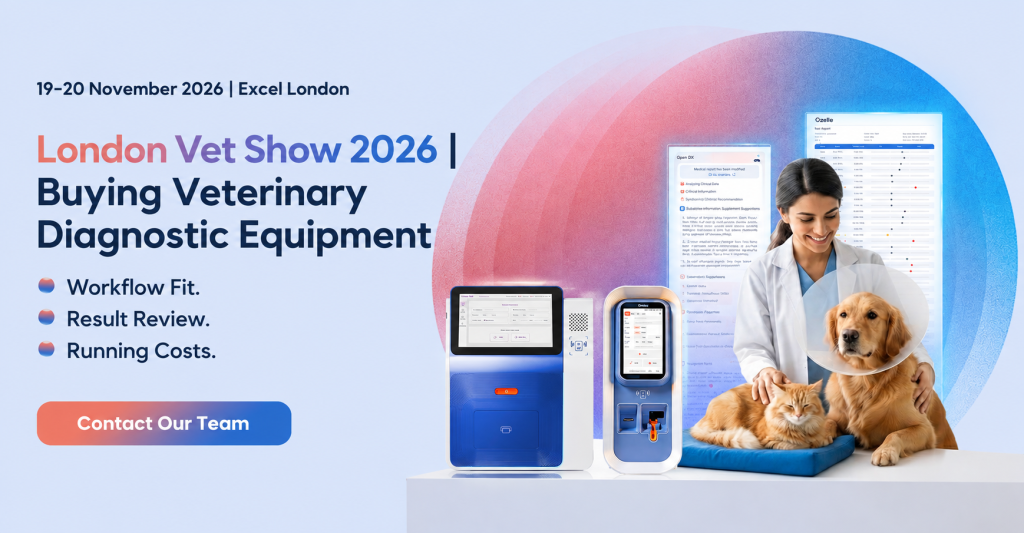
What Gap Will the Equipment Fill?
Before comparing veterinary diagnostic equipment, identify the gap in the practice’s current testing service. Is the priority to introduce a new test, reduce reliance on external laboratories for selected investigations, or improve an existing in-house workflow?
The answer determines what buyers should evaluate. Introducing a new test requires evidence that the assay is suitable for the intended species and clinical application. Bringing testing in-house requires sufficient demand, trained staff, and quality-control arrangements. Improving an established workflow calls for closer examination of sample handling, result review, and operating capacity.
Define the Application Before Choosing the Instrument
Start by identifying the species, specimen types, and diagnostic applications the practice intends to support. For veterinary haematology, buyers should look beyond a general statement of species compatibility and confirm the available differential results, morphology-related outputs, species-appropriate reference intervals, and relevant performance evidence.
The proposed test menu should also reflect actual clinical demand. Adding urine, faecal, immunoassay, or biochemistry testing introduces different specimen-handling, consumable, quality-control, and staff-training requirements. These should be assessed for each method rather than assumed to be covered by the same operating procedure.
For distributors, the same exercise clarifies where a product fits within their portfolio. A new analisador de hematologia veterinária needs a clear role within the customer base: meeting an unmet requirement, improving an existing workflow or supporting a planned expansion of services.
The resulting proposal should explain the intended application, the capability being added and the resources required to use it.
How Will Automated Results Be Reviewed?
Automated haematology results should be evaluated alongside the information available for reviewing unusual or uncertain findings. At London Vet Show 2026, sessions on blood smear examination and blood morphology highlight the continuing role of cellular assessment when automated counts or instrument flags require closer attention.
For buyers, this raises an important distinction: a differential count, instrument flags, digital cell images, and manual blood smear examination provide different types of information. Image-based morphology may make cell-level information available within routine testing, but additional smear examination or specialist review may still be appropriate in selected cases.
A purchasing demonstration should therefore show not only the numerical CBC report, but also how morphology-related findings, images, alerts, and review information are presented to the veterinary team.
Assess the Review Process Alongside the Report
A demonstration should cover the report format, available review information and the steps an operator follows when a result requires attention.
Useful questions include:
- During a demonstration, ask the supplier to show how the system handles results that require closer attention. This includes abnormal counts, instrument flags, morphology-related findings, and measurements that cannot be reported reliably.
- Buyers should confirm whether cell images can be viewed alongside their corresponding results, how findings can be retrieved, and what procedures apply when repeat testing or blood smear examination is indicated. The demonstration should also cover the available reporting formats and result-transfer options.
- Clinical interpretation remains the responsibility of the veterinary team. Local technical support and manufacturer application specialists can assist with instrument operation, troubleshooting, and product-specific questions, but should not be presented as substitutes for veterinary clinical judgment.
Training arrangements should cover routine operation and the handling of instrument-related issues. The practice should also define who reviews results and how findings are referred for further assessment.
For distributors, a clear support pathway distinguishes local technical assistance, manufacturer application support and clinical review. Agreeing these responsibilities before installation gives both parties a practical route for resolving questions once the equipment enters service.
Does Faster Testing Improve the Whole Workflow?
A useful assessment of testing speed covers the full process, from specimen collection and identification to preparation, analysis, result review, and reporting. An analyser’s stated processing time represents only one part of this workflow.
For in-house diagnostics, the practical question is how soon a usable result becomes available to the veterinary team, taking account of manual tasks, operator availability, and any additional review required. Faster analysis does not necessarily mean faster completion of the entire testing process.
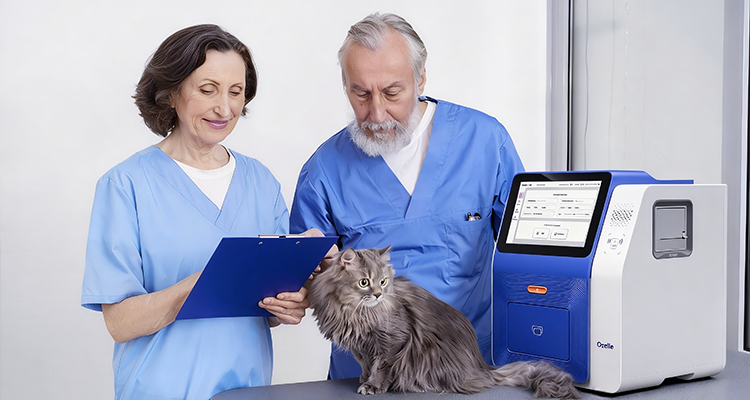
Demonstrate a Complete Testing Task
A product demonstration should follow a representative testing task from specimen preparation to the final report. Buyers should observe the operator’s actions, required consumables, processing steps, and points where additional review or manual intervention may be needed.
For multi-functional veterinary analysers, demonstrations should also show how the system handles different test categories, including specimen preparation, test selection, and the transition between applications. Buyers should confirm whether tests can be performed together or require separate runs, rather than assuming all functions share the same processing workflow.
Connectivity should be assessed against the practice’s existing software. Buyers should confirm which reporting and data-transfer options are supported, whether the proposed analyser can connect to the practice management system or LIS, and what integration work may be required.
The quotation should identify any additional software, interface configuration, or licensing costs, together with responsibility for implementation and testing. Demonstrating network connectivity alone does not establish that results will transfer correctly into the patient record.
What Does Each Additional Test Add to the Business Case?
An expanded test menu should address identifiable clinical needs rather than simply increase the number of available functions. Buyers should consider which investigations are requested regularly, which are referred to external laboratories, and whether bringing selected tests in-house would improve the practice’s testing workflow.
Different diagnostic methods provide different information. Haematology, immunoassays, biochemistry, urine analysis, and faecal examination should be evaluated according to their intended clinical applications, specimen requirements, and operating procedures.
For example, the Ozelle EHVT-50 combines 9-diff haematology with urine and faeces analysis, immunoassays, and selected biochemistry testing. Buyers should identify which of these functions are needed at installation and confirm the available assays, compatible consumables, and training requirements for their market.
Tests considered for future expansion should be assessed separately. A broader platform is useful when its additional capabilities correspond to real clinical demand and can be supported within the practice’s resources.
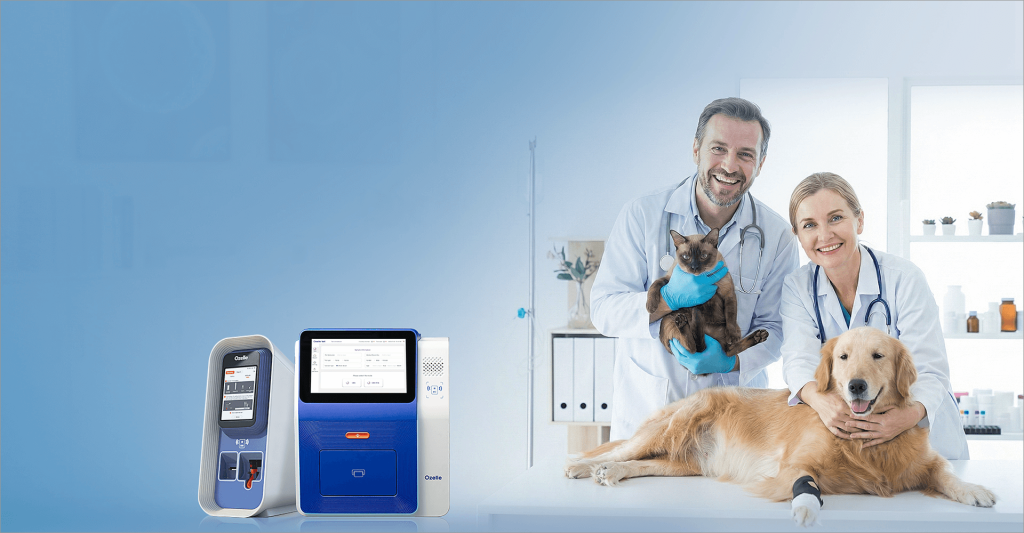
Matching Ozelle Veterinary Analysers to Practice Needs
Ozelle’s EHVT series offers different integrated-testing configurations for veterinary practices. Both EHVT-75 and EHVT-50 combine AI-assisted 9-diff haematology with digital cell morphology and urine and faeces analysis. EHVT-50 extends the available test menu to immunoassays and selected biochemistry tests.
For buyers, the distinction is primarily the range of diagnostic applications required—not an assumption that a broader test menu delivers better haematology performance. The preferred configuration should reflect the practice’s clinical needs, testing volume, available consumables, and staff capabilities.
Compare Running Costs Alongside Purchase Price
The cost of veterinary diagnostic equipment extends beyond the purchase price. Buyers should account for test consumables, QC materials, staff time, maintenance, technical support, and any recurring software or connectivity charges.
Consumable pack sizes, shelf life, storage conditions, and expected testing volume can influence the effective cost per reportable result. Low-volume practices should consider expiry-related wastage, while higher-volume facilities may need to assess staff workload, replenishment frequency, and equipment capacity.
A useful comparison should therefore evaluate ongoing costs under realistic testing scenarios rather than relying solely on the quoted price per test or the maximum capacity of the analyser.
Use a Consistent Supplier Comparison
A short comparison document can turn these questions into a purchasing tool. Ask each supplier for equivalent information and record any items that require clarification.
| Evaluation area | Information to request | What it helps establish |
| Application fit | Available tests, supported species, sample types, species-specific reference intervals and relevant performance evidence | Whether the configuration meets the intended need |
| Result review | Sample reports, instrument flags, morphology-related findings, available cell images and review procedures | How abnormal or uncertain findings can be assessed |
| Workflow | A complete demonstration covering sample preparation, analysis, result review and reporting | Operator tasks, preparation requirements and scheduling |
| Running costs | Consumable and QC costs, storage conditions, shelf life, software and service charges | The ongoing costs associated with expected testing volume |
| Conectividade | Supported interfaces, PMS/LIS compatibility, implementation responsibilities and testing requirements | How results will be transferred into existing records |
| Ongoing support | Training, consumable availability, service coverage, repairs and continuity arrangements | Who will support the system after installation |
| Market documentation | Applicable product documentation, intended-use information, labelling and country-specific requirements | Whether the proposed system is suitable for the destination market |
Using the same criteria across suppliers makes it easier to compare proposed configurations, identify missing information, and clarify requirements before making a purchasing decision.
What Support Is Needed After Installation?
Support arrangements should be specific enough to guide routine operation and resolve problems when they occur. Four areas deserve agreement before purchase.

Training and Responsibilities
Training arrangements should specify which staff will be trained, what procedures are covered, and whether refresher training or support for new operators is available. Training should include specimen handling, instrument operation, QC procedures, routine maintenance, and appropriate result-review workflows.
The service proposal should also establish the initial technical contact, the information needed to report an issue, and the route to manufacturer or application-specialist support. Responsibilities for technical assistance and veterinary clinical interpretation should remain clearly distinguished.
European Supply and Service Arrangements
European buyers should confirm the actual supply and service arrangements for their country, including where consumables and spare parts are stocked, expected delivery times, and the organisation responsible for local support. Regional warehouse presence alone does not establish the same service coverage or replenishment speed in every market.
Service quotations should identify support hours, on-site service availability, applicable travel charges, and procedures for urgent technical problems. For distributors, these details should be reflected in inventory planning and customer service commitments.
Repairs and Continuity
Before purchase, buyers should establish how equipment faults will be assessed, who is responsible for repairs, and whether replacement components or loan equipment may be available under the proposed agreement. Any service response commitments should be documented rather than assumed.
Practices should also maintain an alternative testing route for periods when the analyser is unavailable. Depending on the tests involved, this may mean access to another system or an external reference laboratory.
Application Scope and Documentation
The supplied documentation should identify the exact model, supported species, intended applications, available assays, software configuration, and relevant operating requirements. Buyers should also confirm the availability of appropriate instructions, training materials, and technical documentation for the destination market.
For European purchases, market requirements should be checked country by country. Veterinary diagnostic devices should not automatically be assessed under the same regulatory framework as human in vitro diagnostic medical devices. Applicable product safety, electrical equipment, import, and other requirements depend on the product and destination market.
Choosing Veterinary Diagnostic Equipment for Long-Term Use
The right veterinary diagnostic equipment should fit the practice’s clinical needs, testing workload, and available resources. Species-specific performance, result-review capabilities, integrated test menus, and dependable local support all contribute to a practical purchasing decision.
Ozelle’s EHVT series combines AI-assisted haematology and digital cell morphology with integrated diagnostic testing options for everyday veterinary practice.
Explore Ozelle’s veterinary diagnostic solutions or contacte a nossa equipa to discuss available configurations, consumables, and support arrangements for your market.
Interested in a distribution partnership? Visit our Distributor Partnership page to discuss opportunities in your region.