
 Deutsch
  English
  Français
  Русский
  Español
  Português
  العربية
  Italiano
The 32nd APHM International Healthcare Conference and Exhibition was held in Kuala Lumpur from 28–30 July 2026. Its theme, “From Volume to Value: Measuring What Matters in Healthcare Performance,” focused on value-based care, efficiency, and sustainable delivery—issues that also shape how hospital laboratories evaluate CBC and hematology workflows.
For hospital laboratories across Southeast Asia, broader healthcare pressures do not translate into one uniform equipment strategy. Countries, hospital types, funding models, laboratory maturity, patient populations, and local service arrangements differ substantially. Against this background, laboratory productivity, diagnostic information quality, connectivity, and capacity provide a useful framework for examining how hospital hematology workflows may evolve across different Southeast Asian settings.

Cost Pressure Is Raising the Importance of Laboratory Productivity
Productivity Extends Beyond Reported Throughput
Cost pressure in healthcare affects more than the purchase price of a laboratory analyzer. For a hospital laboratory, the practical cost of a CBC workflow may also include staff time, sample preparation, repeat testing, quality-control procedures, consumables, maintenance, service response, downtime, result review, and the ability to manage demand during busy periods.
This makes productivity a broader concept than the stated throughput of a hospital CBC analyzer. A high published test-per-hour figure may not, by itself, reflect routine laboratory performance. Laboratories also need to consider analyzer availability, workflow interruptions, sample loading, emergency-sample handling, repeat or reflex testing, result review, and whether results meet the laboratory’s defined quality requirements.
Productivity Must Be Evaluated Within Quality Requirements
For a laboratory analyzer to contribute to productivity, it should fit the laboratory’s actual operating pattern. A compact in-house hematology analyzer may suit lower-volume or space-constrained settings, while a larger laboratory may need more automation, batch loading, redundancy, or expandable capacity. The right model depends on the relationship between routine volume, peak demand, staffing, turnaround-time targets, and the laboratory’s review procedures.
Productivity should also not be interpreted as a reason to lower quality standards. Laboratories need defined quality-management processes, appropriate verification before routine use, and procedures for reviewing results that require further attention. Depending on local accreditation requirements, intended use, and whether the method is being introduced or modified, implementation may include verification or validation of characteristics such as precision, method comparison or bias, carryover, reportable range, and reference intervals where applicable.
Diagnostic Information Quality Matters in Value-Based Care
CBC Results Need Context and Traceability
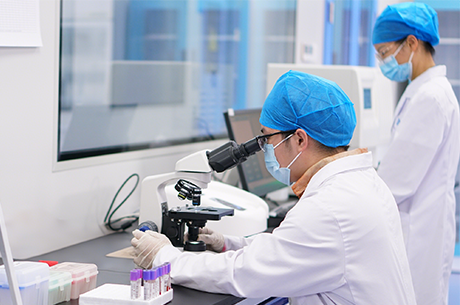
Value-based care shifts attention from volume alone to whether healthcare resources contribute to meaningful, reliable care processes. Within the laboratory, this includes whether diagnostic information is timely, analytically appropriate, reviewable, and supported by clear result records.
An automated CBC analyzer can provide more than basic cell counts. Depending on the system, routine hematology outputs may include quantitative parameters, leukocyte differentials, calculated indices, instrument flags, histograms, scattergrams, and extended parameters. These outputs provide important hematologic information, but they must be interpreted in the context of the patient presentation, previous laboratory results, and other relevant tests.
Differential Capability Should Fit the Workflow
For hospital laboratories, the choice between conventional 5-part differential systems and analyzers offering extended or alternative cell classifications should be based on more than the number of reported categories. In Ozelle’s AI × CBM framework, for example, 7-diff hematology includes additional neutrophil and morphology-related classifications.The appropriate differential capability depends on the laboratory’s patient mix, clinical service profile, review criteria, staffing, workflow, and expectations for morphology-related information.
Quality Management Supports Information Value
Diagnostic information quality also relies on what happens after the analyzer produces a result. Laboratories need appropriate QC procedures, validation and verification processes, defined action criteria, and trained personnel who can review findings where required.
This perspective is relevant for both hospitals and their distributors or local partners. A laboratory analyzer is not only a device specification; it is part of a wider diagnostic process that includes installation, operator training, reagent and consumable planning, QC management, technical service, laboratory review, and clinical correlation.
AI-Assisted Hematology Adds a New Information Layer
AI Complements Routine CBC Information
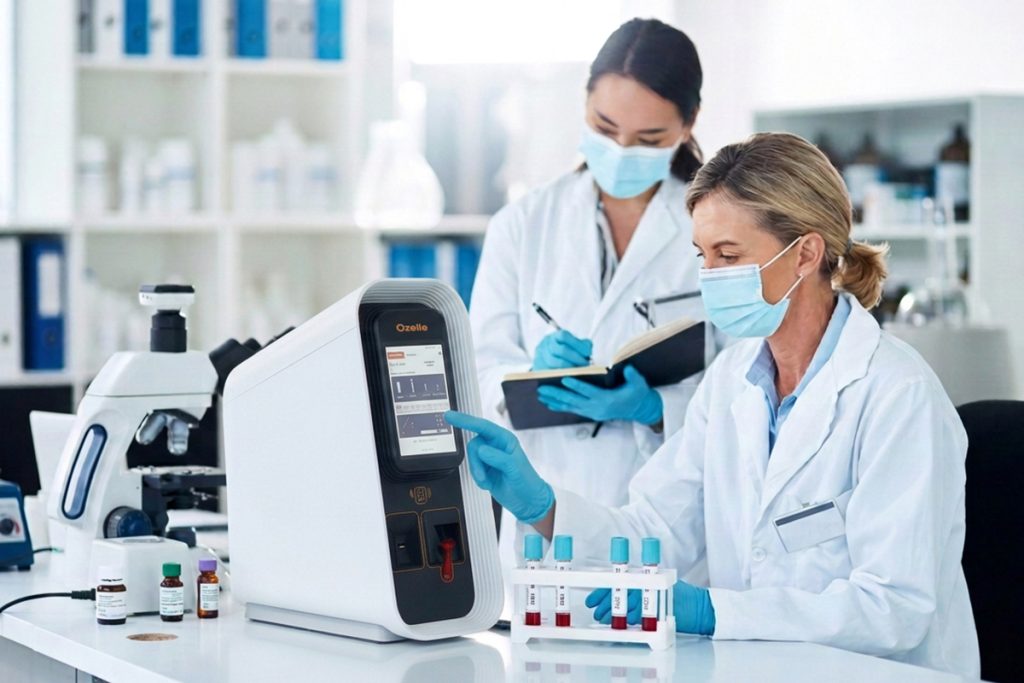
AI is becoming more visible in hospital laboratory discussions, but its role in hematology should be described carefully. AI-assisted hematology does not make conventional CBC methods obsolete, nor does it remove the need for laboratory review. Instead, image-based and AI-assisted morphology approaches may add an additional information layer to routine hematology workflows.
Traditional and contemporary automated CBC systems already generate valuable quantitative parameters, leukocyte differentials, calculated indices, flags, and graphical outputs. AI-assisted morphology can complement these results by helping present morphology-related information or image-based evidence for laboratory review.
Laboratory Review Remains Essential
The potential value lies in how this information is incorporated into an appropriate workflow—not in presenting AI classification as a final diagnosis or as a substitute for trained personnel.
In practice, laboratories should determine how AI-assisted morphology information will be reviewed, how it will be related to instrument flags or existing smear-review criteria, and when manual intervention is required for review. Automated results, images, and AI-assisted classifications may support laboratory assessment, but their significance still depends on established procedures, correct operation by trained personnel, and clinical correlation.
Compact AI-Assisted Hematology Workflows
For example, Ozelle’s human-use EHBT-75 is positioned as a compact 7-diff hematology analyzer that combines complete blood morphology (CBM), liquid-based staining, image-based detection, and AI-assisted cell classification. With a throughput of 10 samples per hour, EHBT-75 is better evaluated for compact or morphology-focused workflows where that capacity matches demand, rather than as a central high-throughput hematology platform.
Connected Diagnostics: LIS and Interoperability
Connectivity Is a Workflow Requirement
A hospital laboratory analyzer increasingly operates within a connected diagnostic environment. Depending on the hospital architecture, analyzer results may need to move through validated interfaces into the LIS and, where applicable, onward to HIS or electronic health-record systems.
The value of connectivity is not simply that a device can transmit data; it is whether data flow is reliable, appropriately governed, and practical for the laboratory’s daily workflow. This includes how sample and record identifiers are managed, how results are transferred and retained, and how QC records, abnormal-result review, repeat testing, and audit requirements fit into established laboratory processes.
ASEAN Context for Interoperability
An ASEAN-specific assessment of digital-health adoption identifies fragmented systems, limited trust in data protection and cybersecurity, and gaps in interoperability as barriers to wider digital-health adoption. Its recommendations include strengthening data protection and governance, developing interoperability standards, supporting innovation, and expanding digital-health training for healthcare professionals.
For hospital laboratories, this makes connectivity an implementation issue as much as a technical feature. A connected-diagnostics strategy requires a clear understanding of data governance, local infrastructure, interface validation, workflow ownership, and support responsibilities.
Access: Compact and Decentralized Testing Models
Bringing Testing Closer to Care Settings
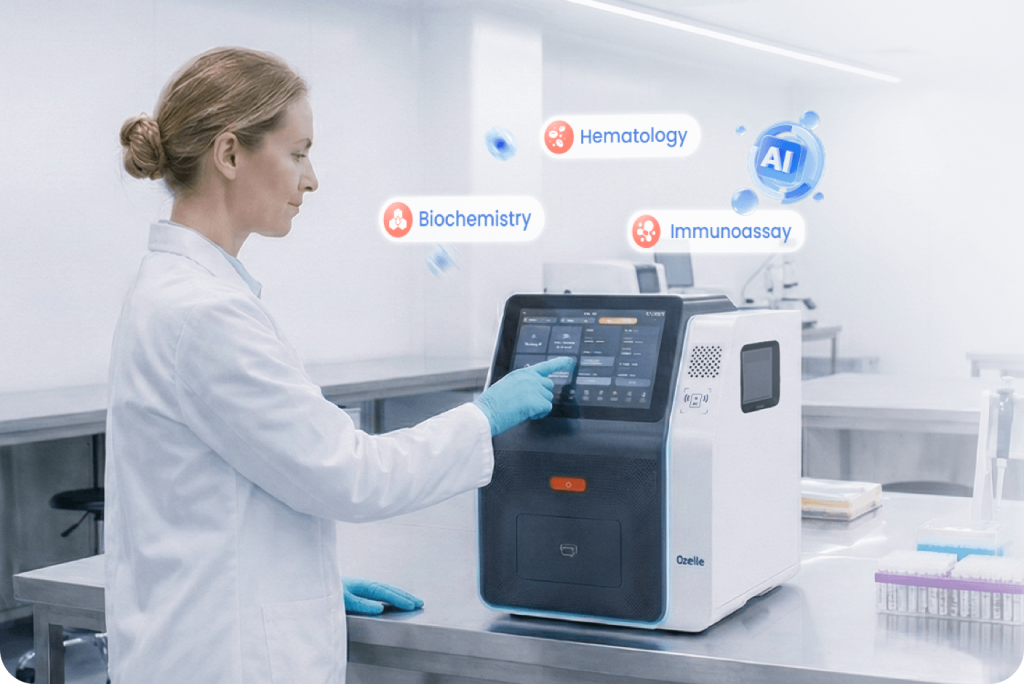
Access to hematology testing does not depend solely on the existence of a central laboratory. In some hospital networks and healthcare settings, compact analyzers may support in-house or decentralized testing closer to where care is delivered. This may be relevant for smaller hospitals, outpatient facilities, satellite locations, community-based services, or laboratories with limited bench space.
A compact hospital CBC analyzer may help shorten internal sample movement or provide local testing capacity where centralized workflows are not always practical.
Decentralized Testing Still Requires Quality Oversight
Decentralized testing should not be interpreted as a lower-standard version of laboratory medicine. The level of laboratory oversight and permissible operator model depends on local regulation, accreditation, and intended use.The same fundamental needs remain: suitable operator training, sample-handling procedures, quality-control processes, result review, maintenance planning, and pathways for further assessment or confirmatory testing where indicated.
Compactness also needs to be evaluated in operational terms. The relevant question is not only the analyzer’s footprint, but also whether its functionality can support the laboratory’s complete workflow. This includes storage of consumables, waste handling, power and network requirements, staff coverage, QC materials, service access, and the relationship between local testing and the central laboratory’s oversight.
Compact Human Diagnostic Solutions
Ozellen human hematology portfolio includes compact hematology and multifunctional analyzer configurations intended for different clinical laboratory needs. The appropriate fit should be assessed according to local workload, intended use, implementation capacity, quality-management processes, and applicable regulatory requirements—not by compact dimensions alone.
Capacity: When Hospitals Need High-Throughput Hematology

Capacity Planning Must Account for Peak Demand
As testing demand grows, hospitals may need to assess not only average daily CBC volume but also peak periods, urgent testing pathways, staffing patterns, sample loading, reporting targets, and contingency planning. A laboratory that manages a modest average workload may still encounter concentrated morning collections, emergency-department demand, inpatient peaks, or limited staff availability that create capacity constraints.
High-throughput hematology is therefore not defined by speed in isolation.
Workflow Factors Beyond Tests Per Hour
Relevant considerations include peak rather than only average sample volume, batch size, random access, loading and unloading arrangements, STAT-sample prioritization, analyzer uptime, redundancy, maintenance planning, service recovery, review criteria, manual follow-up, available bench space, staffing, and the possibility of modular expansion.
Scalable Automated Hematology Workflows
For larger CBC workloads, a modular expandable architecture can be one way to match capacity with demand. Ozelle’s O-Cyte 1 extends the company’s AI-assisted CBM approach into automated hematology workflows. The analyzer is specified at up to 60 tests per hour as a standalone unit and up to 360 tests per hour in a cascaded configuration. Its brochure also describes 25-sample loading, barcode identification, STAT and Auto Loader modes, and available automated loading and unloading in expanded workflows.
These specifications do not remove the need for laboratory-specific assessment. Hospitals should evaluate whether a high-throughput hematology configuration fits their sample profile, infrastructure, staff model, quality procedures, service arrangements, and local validation requirements.
The Outlook for Hospital Laboratories in Southeast Asia
APHM 2026 provides a useful setting for considering how broader healthcare pressures may reshape hospital laboratory priorities across Southeast Asia. Rising costs, workforce constraints, digital transformation, and demand for timely diagnostic information may increase attention on laboratory productivity, information quality, connected workflows, access, and scalable capacity.
In this context, hospital laboratories may increasingly evaluate hematology capabilities as part of a broader operational model—one that balances productivity, diagnostic information quality, connectivity, service reach, and the capacity to scale with changing demand.