

Point-of-care testing is gaining a larger role in human diagnostics as clinics, hospitals, emergency departments, and laboratories need faster blood test results closer to the patient. For distributors, this creates a practical opportunity to work with a POCT device supplier that offers dependable human hematology platforms, scalable support, and meaningful product differentiation beyond basic CBC testing.
In human POCT distribution, supplier selection influences far more than product sourcing. It affects channel competitiveness, account confidence, onboarding efficiency, and the ability to offer clinical customers a stronger diagnostic solution rather than a standalone instrument.

The Human POCT Opportunity
Human POCT devices are designed to perform diagnostic testing near the patient rather than routing every sample through a centralized laboratory, which helps shorten turnaround time and support faster clinical decisions. In hematology, that matters across primary care, urgent care, emergency departments, inpatient wards, and decentralized hospital settings where CBC results often influence next-step decisions.
The market is steadily moving toward compact analyzers that combine automation, practical workflow design, and richer diagnostic output in smaller clinical environments. That shift is especially relevant for distributors serving facilities that want lab-grade CBC capability without the complexity of larger laboratory systems.
Why Supplier Choice Matters
When distributors select a supplier for human POCT instruments, the wrong choice can weaken product differentiation, complicate onboarding, and reduce buyer confidence during evaluation and installation. The right POCT device supplier supports a stronger channel strategy by pairing analyzers with a coherent human diagnostics portfolio, workflow relevance, and a clear clinical value proposition.
A reliable supplier should therefore be assessed on more than stock availability. Distributors need to examine whether the product line fits real hospital and clinic workflows, whether the technology supports meaningful hematology upgrades, and whether the portfolio can scale across different human care settings.
What Distributors Should Evaluate

Technology and clinical value
In human CBC workflows, the most important technical question is whether the analyzer delivers more than routine counting. Buyers increasingly expect stronger differential capability, morphology-aware output, and AI-supported interpretation that improves the practical value of each CBC run.
The EHBT human line is built around AI-powered Complete Blood Morphology, combining CBC analysis with image-based cell interpretation and intelligent abnormal cell detection. This matters in clinical environments where users want more informative reports without moving to a much larger or more complex laboratory platform.
Product positioning across customer types
Distributors should evaluate whether the supplier’s human POCT portfolio can support multiple account types, including outpatient clinics, emergency settings, compact hospital labs, and mid-size diagnostic facilities. A stronger supplier portfolio makes it easier to build channel coverage across entry, mid-range, and higher-value customer segments without forcing every buyer into the same product logic.
Ease of use and operational design
Ease of use remains a central buying factor in human POCT. Compact analyzers need to fit routine clinical spaces, simplify training, reduce maintenance burden, and support repeatable workflows for non-specialist operators as well as lab staff.
The EHBT series is defined around maintenance-free operation, one-click workflow, and single-use reagent kits without sample pretreatment or cold-chain storage, which supports easier deployment in clinics and decentralized sites. The EHBT‑75 also uses a no-internal-fluid-path architecture that keeps samples isolated within closed single-use cartridges, helping reduce contamination risk and simplify day-to-day operation.
Connectivity and workflow fit
For organized clinical networks and hospital accounts, workflow fit matters alongside analytical capability. Human hematology platforms need to support test review, data handling, and integration into practical diagnostic routines rather than functioning as isolated devices.
The human hematology portfolio is built around an integrated AI workbench, Open DX, which functions as a unified workspace for test orders, result review, and AI-assisted diagnostic reference. For distributors, this strengthens the POCT device supplier story by showing that the platform is designed not only for current testing needs but also for more connected future workflows.
Commercial terms and partnership model
Beyond technical criteria, distributors should also evaluate commercial terms such as warranty coverage, service-level expectations, demo unit policies, and territory rules offered by each POCT device supplier. Clear agreements on pricing, after-sales support, training responsibilities, and marketing cooperation make it easier to invest in market development without channel conflict or unexpected costs. This is particularly important when promoting AI-powered CBC systems like EHBT‑50 and EHBT‑75, which require sustained education and clinical engagement to fully demonstrate their value.
EHBT-50 and EHBT-75: AI-Powered Hematology Solutions for Human Diagnostics
EHBT-50: Multi-Functional Human POCT Mini Lab
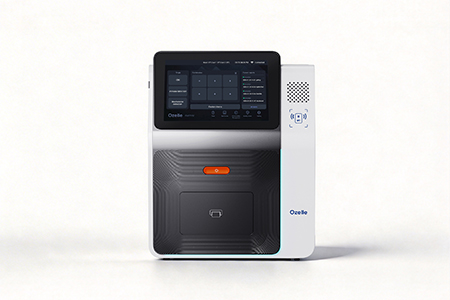
إن EHBT-50 is a 7-diff multi-functional mini lab built for human diagnostic settings that need more than a standalone CBC analyzer. It combines hematology, immunoassay, and biochemistry in one platform, making it suitable for clinics, outpatient centers, emergency departments, and compact hospital laboratories that want broader testing coverage from a single system.
In its hematology channel, EHBT-50 integrates AI-powered Complete Blood Morphology and delivers 42 parameters, including routine CBC outputs as well as advanced markers such as NST, NSG, NSH, NLR, PLR, ALY, RET, and platelet-related indicators. This gives distributors a strong human POCT value proposition in accounts where buyers want menu consolidation, workflow efficiency, and more informative blood testing without adding multiple separate devices.
Its value is not limited to CBC alone. By combining 7-diff hematology with immunoassay markers and dry biochemistry, EHBT‑50 gives distributors a broader product story for clinics, decentralized hospital units, and compact diagnostic sites where space, efficiency, and test menu expansion matter.
EHBT-75: Advanced Human Hematology Analyzer
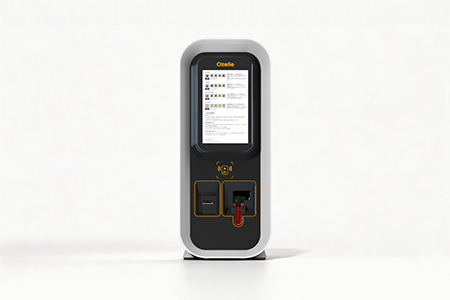
إن EHBT-75 is a professional 7-diff auto hematology analyzer designed for clinics, laboratories, and higher-complexity CBC workflows that require deeper morphology value. It uses AI-powered Complete Blood Morphology, deep learning, and high-resolution imaging to identify multi-classified blood cells such as NST, NSG, ALY, PAg, and RET, helping generate richer hematology insight from a small blood sample.
Compared with a broader multi-functional platform, EHBT‑75 is more focused on dedicated hematology depth. It supports 37 parameters and is suited to clinical environments that prioritize stronger CBC interpretation, abnormal cell-related outputs, and compact automated operation in routine human blood analysis.
Practical Use Scenarios for Distributors
Distributors evaluating a POCT device supplier in human diagnostics can map the EHBT series to concrete use cases to clarify positioning. EHBT‑50 fits small clinics, GP offices, and emergency units that want one compact analyzer to cover CBC, infection markers, and core biochemistry panels during the same visit. EHBT‑75 fits mid-size hospitals and diagnostic laboratories where the priority is deeper hematology interpretation, more informative morphology output, and tighter integration with existing lab workflows. Together, these scenarios help distributors build a tiered offering that speaks directly to the needs of different human healthcare facilities rather than promoting a single generic device.

Comparing AI-Powered Human POCT Devices for Your Portfolio
For human POCT distributors, the EHBT‑50 and EHBT‑75 represent two different ways to deliver AI-enhanced CBC and Complete Blood Morphology in real clinical settings. The EHBT‑50 is positioned as a 7-diff multi-functional mini lab for facilities that need CBC plus additional testing on one compact platform, while the EHBT‑75 is a dedicated 7-diff advanced hematology analyzer built for deeper hematology workflows and morphology value.
| الميزة | EHBT‑50 | EHBT‑75 |
| Product positioning | 7-diff multi-functional mini lab for human clinics, hospitals, and decentralized testing sites. | 7-diff advanced hematology analyzer for human hospitals, labs, and higher-complexity CBC workflows. |
| Human use focus | Designed for facilities that want more than standalone CBC, especially where space and workflow consolidation matter. | Designed for human clinical environments that prioritize deeper hematology and morphology analysis in a compact footprint. |
| CBC / differential capability | 7-diff CBM with 42 parameters, including NST, NSG, NSH, NLR, PLR, ALY, RET, and platelet-related outputs. | 7-diff CBC with 37 parameters and advanced abnormal cell-related outputs including NST, NSG, NSH, ALY, PAg, RET, NLR, and PLR. |
| Core AI / CBM strength | Combines CBC with AI-driven Complete Blood Morphology inside a multi-functional testing workflow. | Emphasizes high-resolution imaging and deep learning for deeper morphology-oriented hematology analysis. |
| Additional test capability | Integrates hematology, immunoassay, and dry biochemistry in one analyzer. | Focused on dedicated hematology and morphology rather than multi-module testing. |
| Typical customer fit | Small clinics, outpatient centers, emergency departments, and compact hospital labs that need broader menu coverage from one device. | Mid-size hospitals, diagnostic laboratories, and advanced clinical sites that want stronger hematology specialization and morphology depth. |
| Throughput and timing | About 6 minutes per sample and around 10 samples per hour, supporting decentralized human testing workflows. | Around 10 samples per hour, with report time of about 6 minutes. |
الأسئلة الشائعة
Why does AI matter in human hematology analyzers?
AI matters because it helps turn CBC testing into a morphology-aware workflow rather than a count-only process. In the EHBT series, AI and CBM support image-based interpretation, abnormal cell-related outputs, and more clinically informative reporting from compact human hematology platforms.
Which model is better for decentralized human POCT settings?
EHBT‑50 is better suited for decentralized human POCT settings that need broader test coverage from one device. It combines 7-diff CBC, immunoassay, and dry biochemistry in one compact system, which is valuable for clinics, outpatient sites, and space-limited hospital environments.
What should distributors evaluate beyond instrument price?
Distributors should evaluate analytical depth, workflow fit, maintenance model, training burden, connectivity, and how clearly the supplier portfolio maps to different human clinical settings. A lower price may not create better channel performance if the analyzer is harder to position, support, or differentiate in front of hospitals and clinics.
Conclusion and Next Steps for Human POCT Distributors
As point-of-care hematology and multi-functional analyzers move closer to the patient, distributors who align with the right supplier will play a larger role in how clinics, hospitals, and laboratories deliver faster blood diagnostics. In this human diagnostics context, the most competitive channel strategy is not to chase the lowest instrument price, but to choose platforms that combine AI-enhanced CBC, Complete Blood Morphology, practical workflow design, and dependable long-term support.
The EHBT‑50 and EHBT‑75 show two clear directions within the same human hematology portfolio: one focused on multi-functional POCT expansion, the other on deeper hematology and morphology value. For distributors, that creates a more flexible way to serve different clinical accounts while building a stronger and more defensible product line in human IVD.
If you are evaluating a POCT device supplier for human hematology, it is essential to look at both technology and partnership model rather than price alone. To explore Ozelle’s human hematology and POCT portfolio in more detail, visit أوزيل‘s official website. It is a practical starting point for reviewing the EHBT series, understanding the brand’s AI hematology positioning, and assessing whether the portfolio fits your regional distribution strategy.
 English
  Français
  Русский
  Español
  Deutsch
  Português
  العربية
  Italiano