
 Italiano
  English
  Français
  Русский
  Español
  Deutsch
  Português
  العربية
In current emerging market, pet clinics and animal hospitals often face a practical mismatch between rising diagnostic demand and the resources available to support in-house testing. Common constraints include limited access to centralized veterinary laboratories, uneven technical support, restricted equipment budgets, and the need to manage routine cases within compact clinical spaces. These conditions are pushing POCT device manufacturers to design compact, low-maintenance analyzers that fit everyday veterinary workflows more closely.
This article examines how POCT device manufacturers adjust veterinary diagnostic POCT strategies to the operational and economic conditions of emerging markets. It focuses on technical design, product structuring, clinical application, and long-term planning for compact veterinary analyzers, with Ozelle serving as a practical example of how one manufacturer organizes such solutions for canine and feline care.

Technical design choices for low-maintenance veterinary POCT
In emerging markets, several trends are shaping how POCT device manufacturers approach veterinary diagnostic POCT. Pet clinics and animal hospitals are increasingly seeking analyzers that combine species-specific CBC capability with simpler operation, lower maintenance demands, and broader in-clinic testing coverage. Distributors and clinic operators are also placing greater emphasis on compact form factors, predictable consumable management, and workflows that can function without dedicated laboratory personnel.
These trends are directly influencing technical design choices across veterinary POCT analyzers. Manufacturers are increasingly adopting sealed reagent systems, no-fluid-path architecture, room-temperature storage, and AI-powered morphology analysis so that analyzers can operate more consistently under ordinary clinic conditions. This is the same context in which Ozelle’s EHVT series is positioned, with compact veterinary analyzers structured around low-maintenance operation and integrated CBC, morphology, and multi-modal testing for dogs and cats.
Ozelle’s EHVT series: compact veterinary mini labs for emerging markets
Ozelle’s EHVT analyzers illustrate how a POCT device manufacturer can structure veterinary diagnostic POCT solutions specifically for pet clinics and animal hospitals in emerging markets. The series is built around compact analyzers that integrate hematology, morphology, and selected additional modalities within clinic-level devices, emphasizing low maintenance and species-focused AI.
EHVT‑50: multi-functional veterinary mini lab
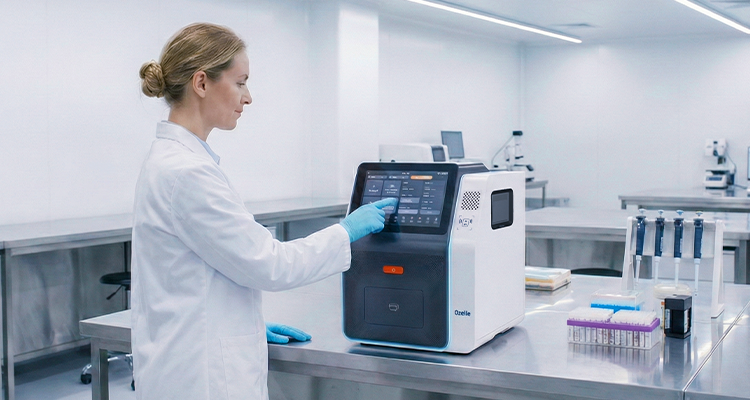
Il EHVT‑50 is presented as an AI-powered veterinary mini lab that consolidates several diagnostic functions within a single analyzer for canine and feline care. Its hematology module provides 8‑part differential CBC combined with CBM, using AI image recognition to support morphological assessment of white cells and red cell forms in animal blood. In parallel, the analyzer integrates automated urine sediment evaluation and fecal microscopy, enabling clinics to examine urinary and gastrointestinal indicators without deploying multiple instruments.
The EHVT‑50 also incorporates a veterinary immunoassay capability, covering markers such as cCRP, fSAA, pancreatic lipase, thyroid hormones, and selected cardiac markers relevant to small-animal practice. This configuration allows pet clinics and animal hospitals to perform hematology, morphology, urine, feces, and targeted immunoassays within one compact workflow, aligning with the case profiles typical of emerging-market facilities. Architectural choices such as tubeless design, closed reagents, and room-temperature storage are intended to reduce maintenance interventions and simplify logistics for equipment providers and clinics.
EHVT‑75: compact CBC, CBM, urine and feces

Il EHVT‑75 is a compact veterinary hematology analyzer that combines 8‑diff CBC with Complete Blood Morphology, urine analysis, and feces analysis within an approximately 8 kg device. Its configuration is intended for pet clinics and animal hospitals that need integrated blood and microscopy-related testing in one analyzer while maintaining a small physical footprint and a simplified operating routine.
The EHVT‑75 is also positioned around low-maintenance deployment. Closed reagent cartridges, tubeless architecture, and automated imaging are designed to support stable daily use under typical veterinary clinic conditions. This makes the analyzer relevant to emerging-market settings where equipment uptime, manageable maintenance, and compact installation matter as much as analytical scope.
AI workbench and reporting workflow
Across the EHVT series, Ozelle links analyzers to an AI-powered workbench that organizes CBC, morphology, and multi-modal results into structured veterinary reports. This software layer concentrates on report clarity and case visualization while maintaining the clinician’s role in interpretation and decision-making. For POCT device manufacturers, the EHVT portfolio demonstrates a pattern in emerging markets: combining compact hardware, species-aware AI, and workflow-oriented software into integrated offerings for pet clinics and animal hospitals.
Application scenarios in pet clinics and animal hospitals
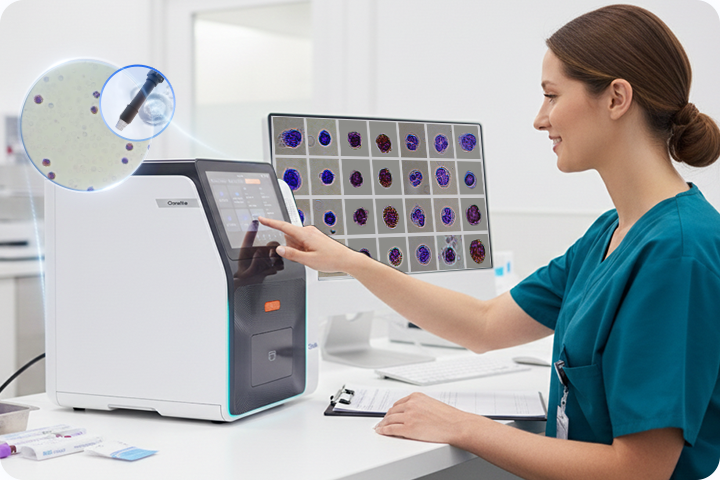
In smaller pet clinics, POCT device manufacturers typically align compact CBC or CBC + CBM analyzers with routine diagnostic workflows. Systems with simplified menus and intuitive interfaces allow single-veterinarian practices or small teams to incorporate hematology into wellness checks, pre-surgical assessments, and initial workups without disrupting appointment schedules. The availability of point-of-care CBC and morphology enables veterinarians to complete risk stratification and initial treatment planning on the same day, reducing reliance on delayed decisions that depend on external laboratory reports.
In animal hospitals and larger clinics, diagnostic needs extend beyond basic CBC screening and involve more complex case profiles in internal medicine, surgery, and emergency care. These facilities increasingly look for compact systems that can consolidate hematology, lmorphology-related blood analysis, urine and feces analysis, and selected immunoassays into coherent workflows rather than operating multiple disconnected devices.
Strategic planning for manufacturers in emerging markets
For a POCT device manufacturer, success in veterinary emerging markets depends on aligning product structure with clinic reality rather than with abstract specification tiers. That means understanding whether a clinic primarily needs same-day CBC support, a broader multi-modal workflow, or a maintenance-light analyzer that can reduce dependence on outsourcing over time. It also means planning around total ownership conditions—reagent format, service burden, training demands, and uptime—not just around headline features.
Species coverage is another strategic consideration, but it needs to be approached selectively. Extending veterinary menus beyond dogs and cats may be appropriate in some markets, yet it requires separate assessment of local case profiles, clinical relevance, and implementation priorities rather than automatic inclusion. At the same time, support models have become more important: onboarding guidance, remote training, and practical quality-control procedures are now part of how manufacturers make POCT systems usable in non-laboratory veterinary environments.
Future directions in veterinary POCT hematology
Looking ahead, the next stage of veterinary POCT development is likely to depend less on making devices larger or more complex, and more on improving how compact systems organize, visualize, and support review of diagnostic data. As AI-assisted imaging and reporting technologies develop, veterinary analyzers may provide more consistent support for reviewing blood cell morphology, urine sediment elements, and fecal microscopy findings.For emerging markets, this is especially relevant because software and algorithm refinement can strengthen diagnostic performance without forcing clinics into frequent hardware replacement cycles.
At the same time, compact multi-modal analyzers are likely to remain central to veterinary hematology strategy. In many clinics, the real value of POCT lies in bringing together several decision-critical data points within one visit, helping veterinarians move from testing to treatment planning more efficiently. For that reason, the long-term direction for the POCT device manufacturer in veterinary care is not simply miniaturization, but the development of clinic-ready systems that combine manageable ownership, integrated reporting, and meaningful diagnostic breadth for real clinical use.
Explore the EHVT portfolio
For additional technical context on compact veterinary POCT for pet clinics and animal hospitals, see Ozelle’s veterinary hematology portfolio and analyzer documentation.