
 Italiano
  English
  Français
  Русский
  Español
  Deutsch
  Português
  العربية
When CBC Demand Exceeds Routine Capacity
In a busy hospital laboratory, the most difficult CBC periods often begin when a large number of blood samples arrive within a limited time window. Morning outpatient collections, inpatient rounds, scheduled admissions, and samples from multiple departments can quickly create a queue that routine bench workflows struggle to absorb.
The challenge is not simply the total number of CBC requests completed in one day. During concentrated collection periods, laboratory staff must receive and identify samples, manage loading, handle priority requests, confirm quality-control status, and review results while keeping the queue organized.
A laboratory may process routine CBC samples efficiently for much of the day, yet still face pressure when large batches arrive together. Hematology workflow planning therefore needs to focus on how the laboratory manages concentrated sample demand, from receipt and loading through analysis, review, and reporting.

From Peak CBC Workload to Required Throughput
Peak CBC workload refers to the volume of samples arriving or requiring processing during the laboratory’s busiest sustained period. Analyzer throughput, by contrast, describes the rate at which the system can process tests. Capacity planning should consider both: how quickly samples accumulate and how quickly the laboratory can move them through analysis and review.
For example, a hospital laboratory may receive a large batch of outpatient specimens shortly after morning collection begins. Inpatient samples and priority requests may enter the queue before the initial batch has been completed. Operational capacity is therefore tested by whether the laboratory can move this concentrated workload through the CBC process in an orderly way.
Peak demand should be evaluated alongside the full workflow rather than as an isolated number. A laboratory needs to understand how many samples arrive in the busiest one to three hours, how priority samples enter routine work, who performs review, and whether quality procedures can be completed without disrupting the sample queue.
| Workflow factor | Why it matters for capacity planning |
| Peak arrival window | Identifies when sample demand is concentrated |
| Peak sample volume | Shows how many samples accumulate during the busiest sustained interval |
| Analyzer throughput | Determines how quickly the analyzer can process the queue |
| Batch-loading capacity | Affects how frequently operators need to intervene during peak periods |
| STAT workflow | Determines how priority samples enter routine processing |
| Review workload | Flags, morphology review, reruns, and verification can affect total turnaround |
| Future workload growth | Helps determine whether additional processing capacity may be required |
Choosing a CBC Blood Test Analyzer for Peak Demand
After peak processing demand has been defined, the next step is to identify a CBC blood test analyzer that can support the movement of high-volume samples through the laboratory. The analyzer needs to fit the sample queue, batch-handling process, priority-sample requirements, morphology review procedures, quality system, and future capacity plan.
For hospital laboratories, the selection process should begin with workflow questions rather than a throughput number alone. How are samples received and identified? How many tubes need to be loaded during the busiest interval? How are STAT requests introduced into routine work? How will images and morphology-related information be reviewed? These factors determine whether the analyzer can be integrated into the existing laboratory process.
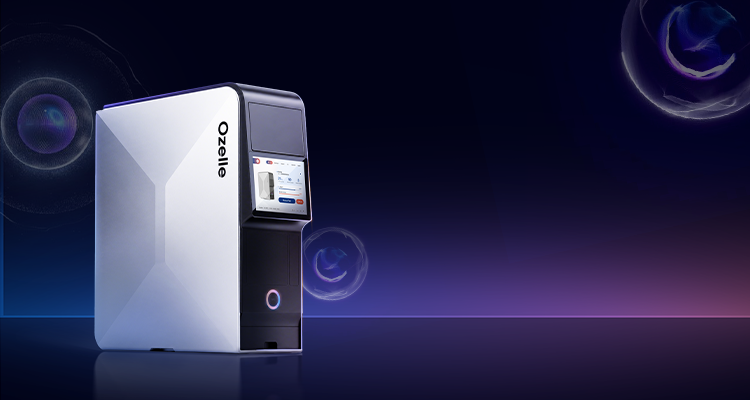
O-Cyte 1 as a CBC Blood Test Analyzer for Batch Workflows
Ozelle O-Cyte 1 automated hematology analyzer is built around batch processing, automated sample preparation, priority sample access, image-based morphology information, and a modular capacity-expansion path.
O-Cyte 1 supports 25-sample loading through five racks with five positions each. Random tube placement and automatic barcode identification allow routine specimens to enter the workflow without a fixed tube order within each batch. O-Cyte 1 supports Auto Loader Mode for standalone workflows. In cascaded configurations, automated loading and unloading modules and a centralized operation console support a unified workflow across the expanded system.
When a large volume of specimens arrives during the morning collection period or from multiple hospital departments, this structure helps organize samples before and during analysis. The workflow can accommodate routine processing without requiring staff to build a fixed sequence for every loaded rack.
Sample Handling and Operator Workflow
The analyzer includes auto mixing and closed-tube piercing. With appropriate operator training, laboratory personnel can work within established requirements for sample-integrity assessment, biosafety procedures, and documented laboratory standard operating procedures.
O-Cyte 1 supports whole blood, capillary blood, and predilution mode. The current product specification lists 80 μL for whole-blood and capillary testing, with separate sample requirements for predilution mode.
For laboratories operating under routine capacity pressure, these functions are valuable not only because they reduce manual workload. They also create a more structured route from sample receipt to analysis, particularly when large batches enter the laboratory at the same time.
STAT Access Within Routine Batch Work

STAT mode gives priority samples a dedicated processing option alongside routine batch work. This can help laboratories organize urgent and routine CBC samples within the same workflow, while maintaining local procedures for priority assignment, quality control, result review, and reporting.
A defined STAT process is particularly relevant in hospital laboratories where priority requests may arrive while routine outpatient or ward samples are already in the queue. The laboratory can establish its own rules for prioritization and result release according to its clinical service model and internal workflow.
Adding Image-Based Morphology to CBC Review
Mature automated CBC workflows already provide quantitative cell parameters, white blood cell differentials, calculated indices, flags, histograms, scattergrams, and rule-based prompts for further review. On this foundation, AI-assisted image morphology is adding a visible and reviewable layer of cellular information that can be integrated into laboratory workflows across different workload levels and clinical settings.
AI × CBM in the O-Cyte 1 Workflow
O-Cyte 1 is an automated hematology analyzer combining 7-diff CBC with AI-assisted morphology in one workflow. It integrates cell imaging, image-based classification, and morphology-related information with routine CBC outputs.
The analyzer reports WBC, RBC, HGB, HCT, red-cell indices, platelet parameters, and differential-related outputs. Its listed parameters include NEU, NST, NSG, NSH, LYM, MON, EOS, BAS, ALY, NLR, PLR, PAg, P-LCC, and P-LCR, with RET# and RET% available as optional parameters.

Visual Evidence for Laboratory Review
Image-based morphology adds a visual and traceable information layer to the quantitative and graphical outputs already used in laboratory review. O-Cyte 1 reports images, histograms, highlighted findings, and morphology-related information, providing multidimensional reference information for laboratory review and clinical assessment.
| Information layer | O-Cyte 1 workflow contribution |
| Quantitative CBC results | WBC, RBC, HGB, HCT, PLT, RBC indices, platelet indices, and related parameters |
| Differential and extended results | Differential-related cell subsets, NLR, PLR, optional reticulocyte results, and platelet-related outputs |
| Graphical information | Histograms and highlighted findings |
| Image-based morphology | Cell images and AI-assisted classification |
Not every abnormal CBC result requires a blood smear. Laboratories can apply their established review criteria to determine when further review, smear preparation, microscopy, or another follow-up procedure is appropriate. Image-based morphology makes relevant visual information available within the automated workflow, supporting this review process.
From Standalone Capacity to Cascaded Expansion
O-Cyte 1 supports up to 60 tests per hour as a standalone analyzer and up to 360 tests per hour across a six-analyzer cascade.

This expansion model allows laboratories to begin with a configuration aligned to current CBC workflow requirements and add capacity as sample queues, service coverage, or operational demand increase. Laboratories can adjust capacity around changes in peak sample arrivals and future workload needs, rather than treating capacity as a fixed value determined at installation.
A standalone O-Cyte 1 configuration may be suitable when peak demand can be managed within one analyzer’s available throughput. As workloads increase, cascaded expansion can provide greater capacity for laboratories processing larger batches, supporting multiple collection points, or regularly experiencing concentrated queue pressure.
Capacity expansion should be planned together with sample handling, staffing, quality control, laboratory review procedures, space, information-system connectivity, consumable supply, and local technical support. Increasing analyzer throughput is most effective when the surrounding laboratory workflow can support the additional volume.
QC, Connectivity, and Service Planning
O-Cyte 1 uses a closed-fluidics architecture in which fluidics are contained in consumables. This configuration supports cleaner laboratory operation, helps reduce carryover risk, and can extend service intervals.

The service-ready modular design enables quick module replacement when needed. Buyers should confirm local replacement procedures, parts availability, response times, and service responsibilities with their distributor or authorized local partner.
O-Cyte 1 supports internal morphology liquid QC. This capability helps laboratories manage QC procedures within a morphology-enabled hematology workflow. Laboratories can incorporate it into their own QC schedules, acceptance criteria, documentation, trend review, and corrective-action processes.
For connectivity, O-Cyte 1 supports LIS, USB, RJ45, Wi-Fi, and Bluetooth. These options allow laboratories to plan result transmission and workflow integration according to their local laboratory information-system requirements.
What to Assess Before Implementation
Before implementing O-Cyte 1, laboratories and local partners should evaluate the analyzer within the context of the full CBC workflow:
- Peak CBC demand: Identify the number of samples that arrive during the busiest period, not only total daily volume.
- Sample flow: Define how specimens are received, accepted, identified, loaded, tracked, and prioritized.
- Batch processing: Confirm whether 25-sample loading, random tube placement, and barcode identification match the laboratory’s routine collection pattern.
- STAT workflow: Establish how priority samples enter the workflow and how they are handled alongside routine batches.
- Review criteria: Define how flags, images, histograms, and morphology-related findings will be incorporated into review procedures.
- Quality management: Set requirements for verification, internal morphology liquid QC, documentation, corrective actions, and trend review.
- LIS/HIS integration: Validate result-field mapping, transmission logic, user permissions, and data-management requirements.
- Operator training: Ensure laboratory personnel complete required analyzer operation, QC, biosafety, and workflow training.
- Service planning: Confirm consumable supply, module replacement procedures, technical support, and local service coverage.
- Expansion strategy: Define the sample-volume or queue threshold at which cascaded capacity should be evaluated.
Planning High-Throughput CBC Workflows for Long-Term Capacity
A high-throughput CBC workflow is not defined by analyzer capacity alone. It depends on how peak sample arrivals, batch loading, STAT handling, QC procedures, morphology review, information-system integration, trained personnel, and local service planning operate together.
For hospital laboratories, capacity planning should account for the hours when the largest sample queues reach the bench, as well as future changes in workload and service coverage. A suitable hematology workflow should support structured sample movement, consistent quality procedures, and a clear path for expanding processing capacity when operational demand increases.
If you are evaluating O-Cyte 1 for your market, customer portfolio, or hospital laboratory projects, contattare Ozelle to discuss throughput requirements, cascaded configurations, and local support options. You can also reach the team at info@ozellepoct.com.