
 Français
  English
  Русский
  Español
  Deutsch
  Português
  العربية
  Italiano
Picture this: a patient walks into your rural GP clinic with persistent fatigue, fever, and a pale complexion. Your clinical instinct tells you something is off in their blood. But the nearest hospital laboratory is 60 kilometers away, and you have no trained lab technician on staff. You need a complete blood count — and you need it now.
This scenario plays out daily in thousands of underserved clinics around the world. The question is no longer si a point-of-care CBC test machine can help — it’s whether a compact device can be trusted to deliver results accurate enough to guide real clinical decisions. The answer, backed by AI-driven technology and validated clinical data, can achieve clinically acceptable performance when properly validated and used.
What Is a CBC Test and Why Does It Matter at the Point of Care?
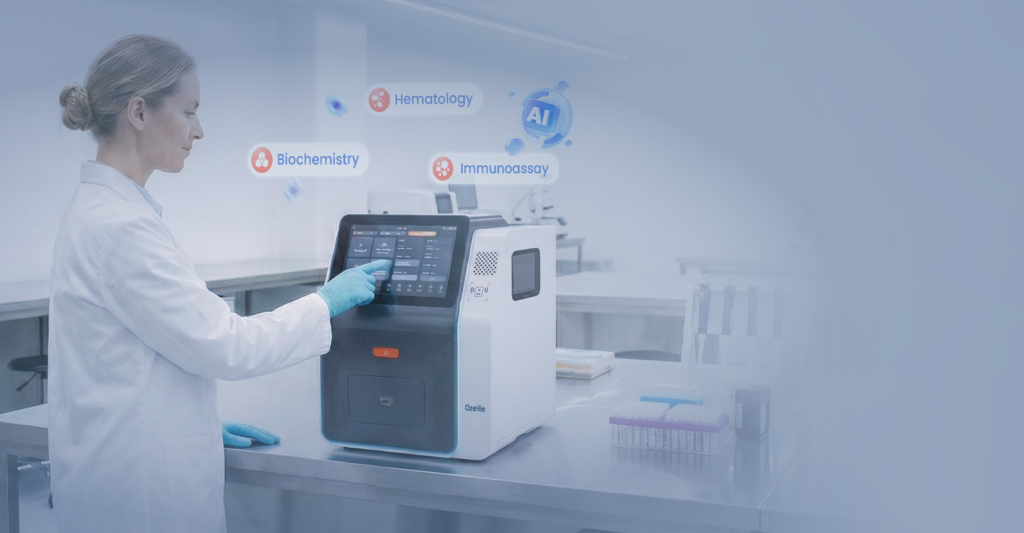
A complete blood count (CBC) is one of the most frequently ordered diagnostic tests in medicine. It measures the key components of blood — white blood cells (WBC), red blood cells (RBC), hemoglobin (HGB), hematocrit (HCT), platelets (PLT), and a range of derived indices — to help clinicians screen for infections, anemia, clotting disorders, and hematological conditions.
Traditionally, CBC tests required laboratory-grade analyzers, reagent pipelines, refrigerated consumables, and trained personnel for operation, quality control, and result validation. For rural or resource-limited settings, this setup is simply not feasible. Point-of-care CBC test machines are designed to bring that same diagnostic power directly to the bedside or consultation room — without the infrastructure overhead.
The clinical value of an accurate, on-site CBC cannot be overstated. A solo GP who can confirm elevated neutrophils and CRP within six minutes of a patient visit can make faster, evidence-based decisions about antibiotic prescriptions, urgent referrals, or safe discharge — saving both lives and unnecessary travel.
The Fear: Will a Compact Device Actually Be Accurate?
This is the most legitimate concern any clinician should have before trusting a point-of-care CBC test machine with patient outcomes. The worry is understandable: smaller devices often mean simplified technology, reduced parameters, and results that don’t match what a hospital’s reference analyzer would produce.
That fear is rooted in the history of early impedance-based portable analyzers, which were limited in scope and prone to interference. But the landscape has fundamentally changed. Modern AI-powered CBC machines use cell morphology imaging, deep learning, and multi-spectral optical systems to replicate — and in some areas — achieve comparable performance in selected parameters”.
The key question to ask of any CBC test machine is not just “does it work?” but “does it work as well as a hospital analyzer, and can I rely on it without a technician?” Let’s examine how the Ozelle EHBT-50 answers both.
Meet the Ozelle EHBT-50: An AI-Powered Mini Lab for the Point of Care
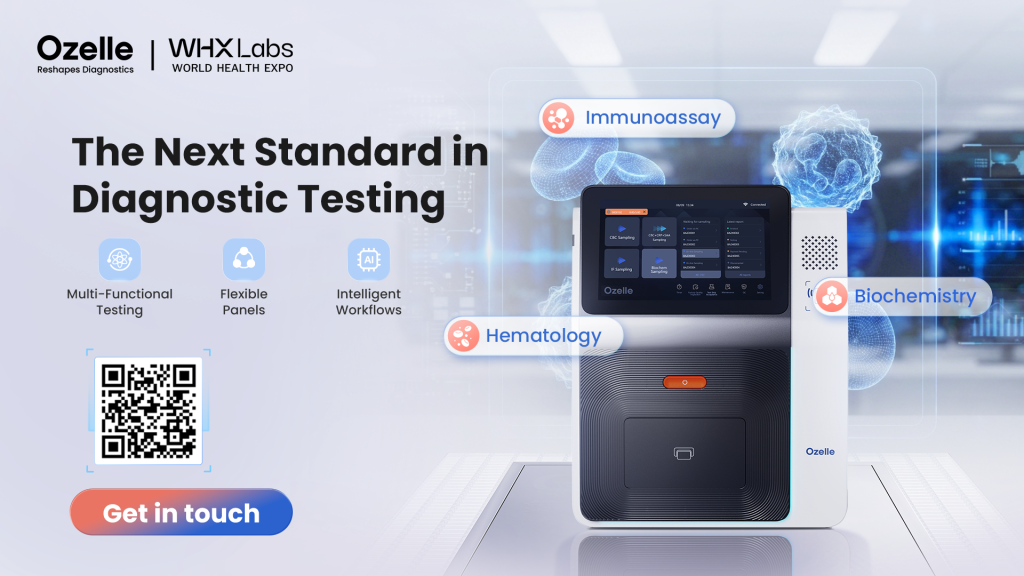
Le Ozelle EHBT-50 is a 7-Diff hematology, immunoassay, and biochemistry analyzer — an all-in-one CBC test machine designed specifically for settings where space, staffing, and laboratory infrastructure are limited.
Rather than relying on the older impedance method, the EHBT-50 uses AI Cell Morphology (CBM) technology — inspired by principles used in digital morphology and cytology workflows. 50+ Million Cell Images Generated Daily: Continuous cellular imaging from real diagnostic workflows
100+ Billion Cell Data Points Accumulated: One of the largest morphology datasets in hematology diagnostics.
For a rural GP with no lab technician, this means the machine does the skilled analytical work that would normally require a trained human. You collect a 30 µL fingertip blood sample, load it into the single-use test cartridge, and the device handles everything: automated staining, scanning, cell classification, and report generation — all within 6 minutes.
EHBT-50 Specifications at a Glance
| Fonctionnalité | Details |
| Test Principle | AI Cell Morphology (CBM) + Photoelectric Colorimetry for HGB |
| Paramètres CBC | 37 parameters (WBC, NEU#, NST#, NSG#, NSH#, LYM#, MON#, EOS#, BAS#, ALY#, NEU%, NST%, NSG%, NSH%, LYM%, MON%, EOS%, BAS%, NLR, PLR; RBC, HGB, HCT, MCV, MCH, MCHC, RDW_CV, RDW_SD, RET#, RET%; PLT, MPV, PDW, PCT, PAg#, P_LCC, P_LCR) |
| Additional Tests | Immunoassay ( CRP, CRP/SAA, IL-6, PCT, cTnI, NT-proBNP, CK-MB, HbA1c, T3, T4, TSH, D-Dimer, 25-OH-VD, hs-CRP* , SAA*, Myo*, cTnl/Myo/CK-MB*, cTnT*, FT3*, FT4*, mALB*, NGAL*, β2-MG*, Ferritin*, β-HCG*, LH*, FSH*, Prog*, PRL*, E2*, TESTO*, AMH*) |
| Type d'échantillon | Capillary (fingertip) or venous whole blood |
| Volume de l'échantillon | 30 µL (capillary) / 100 µL (EDTA tube) |
| Résultat Temps | 6 minutes par échantillon |
| Débit | 10 échantillons/heure |
| Affichage | Écran tactile de 10,1 pouces |
| Connectivité | LIS, HIS, WiFi, LAN, USB, SIM port |
| Poids | 15 kg |
| Dimensions | 400 × 350 × 450 mm |
| Alimentation électrique | 100–240V, 50/60Hz |
| Maintenance | Maintenance-free (individual single-use test kits) |
| Consumable Storage | Room temperature (hematology cartridge: 2-year shelf life) |
| Certifications | CE, FDA, ISO 13485:2016, ISO 9001, CQC |
How Does the EHBT-50 Accuracy Compare to Hospital-Grade Analyzers?
This is where the data matters most. The EHBT-50’s correlation data, validated against international reference brands including Beckman Coulter and Sysmex, demonstrates strong agreement across all major CBC parameters.
| Paramètres | Correlation Coefficient (R²) | Clinical WBC CV | Clinical RBC CV | Clinical HGB CV | Clinical PLT CV |
| WBC | 0.9962 | ≤6.0% | - | - | - |
| RBC | 0.9787 | - | ≤3.0% | - | - |
| HGB | 0.9867 | - | - | ≤2.5% | - |
| PLT | 0.9834 | - | - | - | ≤10.0% |
| HCT | - | - | - | - | ≤3.0% |
R² values above 0.97 across WBC, RBC, HGB, and PLT confirm that the EHBT-50 delivers results statistically equivalent to reference laboratory analyzers. This level of performance is not what rural clinicians typically expect from a portable device — and it fundamentally changes the case for point-of-care CBC testing.
Designed for Clinicians, Not Technicians
One of the most important design decisions Ozelle made with the EHBT-50 was to eliminate the need for specialized training. Traditional laboratory analyzers require sample pre-treatment, pipette calibration, liquid reagent management, and periodic maintenance — all tasks that demand a trained operator.
The EHBT-50 removes every one of those barriers:
- No sample pre-treatment required — blood goes straight into the cartridge
- Graphic-guided interface on a 10.1-inch touch screen walks the user through each step
- Smart built-in camera automatically detects correct consumable placement, preventing user error
- Individual single-use cartridges eliminate cross-contamination and blockages, removing the need for pipeline cleaning
- Liquid-free design means no fluid maintenance, virtually eliminating machine faults
- Auto calibration with a dry-type QC card requires no technical calibration expertise
- Room temperature consumable storage removes the need for cold chain logistics, critical for remote clinics
The result is a four-step workflow: prepare the test kit, collect 30 µL of blood from a fingertip, load the consumables, and press start. Any trained clinical staff member — or even a nurse — can operate the machine after minimal onboarding.
More Than a CBC: Replacing Multiple Lab Instruments in One Device
For a rural clinic with limited budget and zero lab infrastructure, the EHBT-50 is not just a CBC test machine — it is effectively a mini laboratory. By combining hematology, immunoassay, and biochemistry analysis on a single platform, it replaces what would otherwise require three to four separate instruments.
A single EHBT-50 device can run:
- Infection panels: CBC + CRP + SAA (bacterial vs. viral differentiation)
- Diabetes management: CBC + HbA1c + GLU + TG + TC + UA
- Thyroid screening: CBC + TSH + FT3 + FT4
- Cardiac risk: CBC + NT-proBNP + cTnI + CK-MB
- Kidney function: CBC + Cystatin C + UA + CREA + UREA
- Early pregnancy: CBC + β-HCG + Progesterone
This means that a rural GP can order a targeted multi-panel test in a single run and receive a comprehensive clinical report within minutes — eliminating the need to send patients to referral labs for follow-up testing.
AI-Powered Diagnostic Support: Your Virtual Lab Consultant
Perhaps the most significant advantage of the EHBT-50 for an isolated rural clinician is its AI diagnostic support layer. After every CBC or combined panel test, the device generates an AI-assisted interpretation report that flags abnormal parameters, suggests possible clinical implications, and lists decision-support suggestions.
For example, if a result shows elevated NST (immature neutrophils), low LYM (lymphocytes), and elevated CRP, the AI report will indicate that this pattern supports bacterial infection — particularly pneumonia, UTI, or sepsis — and recommend clinical correlation. This is not a replacement for physician judgment; it is a structured second opinion that helps a solo GP interpret complex hematology data with greater confidence.
The AI engine is built on a deep learning model trained on over 40 million real clinical blood samples and was recognized at the 2022 World Artificial Intelligence Conference (WAIC) — a meaningful external validation of the algorithm’s reliability.
Connectivity That Doesn’t Require a Hospital Network
For rural clinics operating in low-connectivity environments, the EHBT-50’s IoT capabilities offer practical value. The device connects via WiFi, LAN, or SIM port and integrates with Ozelle’s Smart IoT Platform, which allows test results to be reviewed, audited, and managed remotely.
This means that even if a clinician is unsure about an abnormal result, they can share the report digitally with a specialist in an urban hospital without the patient needing to travel. The platform also tracks consumable inventory, device status, and testing history — all accessible from a web or mobile dashboard. For a solo GP managing dozens of patients per day, this kind of operational visibility is a genuine time and cost saver.
Foire aux questions (FAQ)
Q1: Can the EHBT-50 CBC test machine be used without any laboratory training?
Yes. The EHBT-50 is specifically designed for minimal-training operation. Its graphic-guided touch screen interface, auto-placement detection camera, and maintenance-free single-use cartridge system mean that any clinical staff member can operate the device safely after basic onboarding — no laboratory technician required.
Q2: How accurate is the EHBT-50 compared to a hospital hematology analyzer?
Clinical validation data show correlation coefficients (R²) of 0.9962 for WBC, 0.9787 for RBC, 0.9867 for HGB, and 0.9834 for PLT when compared against reference analyzers such as Beckman Coulter and Sysmex. Coefficient of variation (CV) values are ≤6% for WBC and ≤2.5% for HGB, meeting international laboratory quality standards.
Q3: What happens if consumables run out in a remote location — are they hard to store?
The EHBT-50 uses single-use cartridges that can be stored at room temperature with a two-year shelf life. There is no cold chain requirement, which makes logistics straightforward for clinics in remote areas without refrigeration infrastructure.
Q4: Does the EHBT-50 only run CBC tests, or can it do other blood tests too?
The EHBT-50 is a multi-functional analyzer that combines 7-Diff CBC, immunoassay (including CRP, SAA, thyroid hormones, cardiac markers, and HbA1c), biochemistry (glucose, lipids, liver and kidney function) — all on one device.
Q5: How long does a CBC test take on the EHBT-50?
A complete 7-Diff CBC result is delivered in approximately 6 minutes from the time the sample is loaded. The device has a throughput of 10 samples per hour, making it practical for moderate patient volumes in a primary care setting.
Q6: What does the AI diagnostic report actually tell the doctor?
After each test, the AI-generated report lists all CBC parameters with reference ranges, flags abnormal values, provides real microscopic cell images, and includes a differential diagnosis list ranked by likelihood based on the combination of results. It is designed to support — not replace — clinical decision-making by the physician.
The Bottom Line for Rural Clinicians
The question was never whether a rural clinic deserves lab-grade diagnostics — it always does. The real question was whether the technology had reached a point where reliable, accurate CBC testing could be delivered without laboratory infrastructure. With the Ozelle EHBT-50, that threshold has been crossed.
A 30 µL fingertip blood sample. A single-use cartridge. Six minutes. Forty oneThirty-seven CBC parameters, AI morphology imaging, optional CRP and HbA1c in the same run, and a structured diagnostic report — all from a device that weighs 15 kg, fits on a consultation desk, and requires no maintenance, no technician, and no cold storage.
For solo GPs and rural healthcare providers who have long operated without diagnostic support, the Ozelle EHBT-50 is not just a CBC test machine. It is a leveling of the playing field between primary care and the hospital laboratory — and it is available right now. Learn more at https://ozellemed.com/en/.