
 Français
 English
 Русский
 Español
 Deutsch
 Português
 العربية
 Italiano

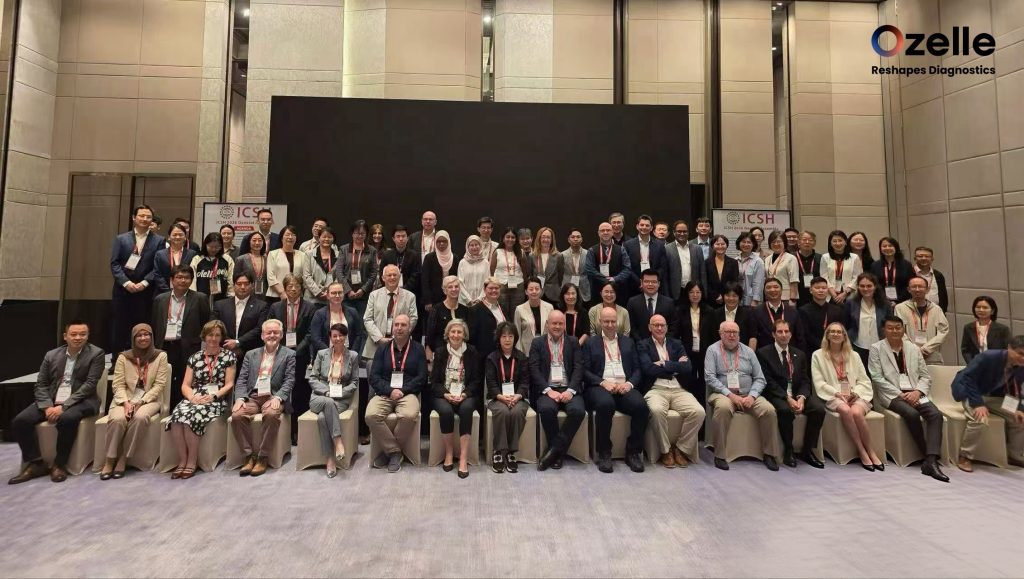
As an ICSH Corporate Member, Ozelle joined international hematology experts at the 2026 General Assembly of the International Council for Standardization in Haematology (ICSH), held on October 14–15 in Shanghai, China. The Assembly formally approved a new digital morphology standardization project, an important step toward developing shared guidance for clinical practice.
The decision comes as AI-assisted cell classification finds a growing role in hematology. Its clinical value depends not only on classification accuracy but also on how samples are prepared, images are captured, results are verified and findings are reviewed. During the Assembly, participants identified areas requiring further guidance, including verification, morphology-specific quality indicators, competency assessment, external quality assessment, standardized reporting and image retention. The discussions also highlighted practical obstacles, such as variability in sample preparation, recognition of artifacts and fragmented data—issues that cannot be solved by improving an algorithm alone.
From Technical Progress to Reliable Practice
ICSH has highlighted the challenges of digital morphology for years. In its 2019 review of digital morphology analyzers, ICSH identified variations in staining, magnification, image display, software and file formats, and called for greater standardization across pre-analytical, analytical and post-analytical processes. The review also emphasized the continuing role of skilled morphologists in cell reclassification and diagnostic interpretation. At its 2025 General Assembly, ICSH discussions turned more directly to AI, including minimum performance metrics, operability and quality assurance.
These issues matter in routine blood film review. Differences in slide preparation and staining can change the appearance of cells, while rare or atypical findings still require careful evaluation by trained professionals. For AI-assisted morphology to be useful beyond a single instrument or laboratory, users need dependable images, classifications that can be checked against those images, and appropriate procedures to monitor system performance. A classification result alone cannot provide all of that assurance.
Ozelle’s Approach to More Consistent Morphology
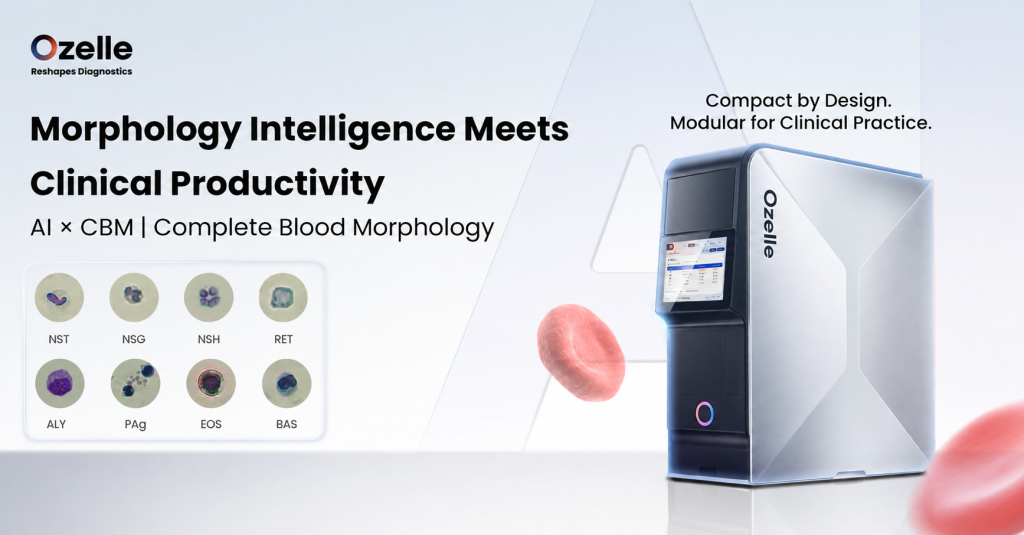
This emphasis on consistency is closely aligned with Ozelle’s AI × CBM (Complete Blood Morphology) approach. It brings cellular imaging and AI-assisted analysis together: CBM is designed to capture morphological features consistently, while AI supports cell classification and interpretation. The aim is to make morphology easier to use and review in routine testing, without replacing professional judgment.
AI × CBM is used across Ozelle’s hematology platforms. O-Cyte 1 offers a recent example of how this approach can fit into higher-throughput laboratories. It combines 7-diff CBC and AI-assisted morphology in one workflow, linking quantitative results and morphology findings with corresponding cell images. This allows laboratory professionals to examine the visual evidence behind the reported findings rather than relying on an isolated algorithmic output.
Conventional hematology QC primarily focuses on numerical measurements, while image-based morphology introduces additional quality considerations around cellular imaging and recognition. Ozelle has developed liquid morphology QC materials specifically for AI-assisted morphology analysis, designed to reflect blood cell morphology and support routine internal quality checks. With three QC levels—High, Medium and Low—the system is intended to help laboratories incorporate morphology-related quality monitoring into their daily workflows. Internal morphology QC adds another layer of quality monitoring, complementing method verification, external quality assessment and professional review.
Contributing to the Next Stage of Digital Morphology
The newly approved ICSH project creates an opportunity to turn shared challenges into practical guidance. Ozelle will work alongside ICSH and other stakeholders as the project progresses, contributing experience from cell imaging, AI-assisted classification, morphology quality control and real-world laboratory workflows.
For Ozelle, standardization is part of making innovation work in clinical practice—helping ensure that AI-assisted morphology can be consistently evaluated, reviewed and trusted across different healthcare settings.