
 Français
  English
  Русский
  Español
  Deutsch
  Português
  العربية
  Italiano
Clinical CBC analyzers will be standing at an inflection point, and ADLM 2026 will act as one of the clearest windows into how decentralized hematology, morphology intelligence, and modular designs are likely to shape the next stage of laboratory medicine. Within this broader trend, Ozelle will present the O‑cyte 1 clinical CBC analyzer at ADLM 2026 as one example of how manufacturers are preparing for these shifts rather than attempting to redefine the industry on their own.
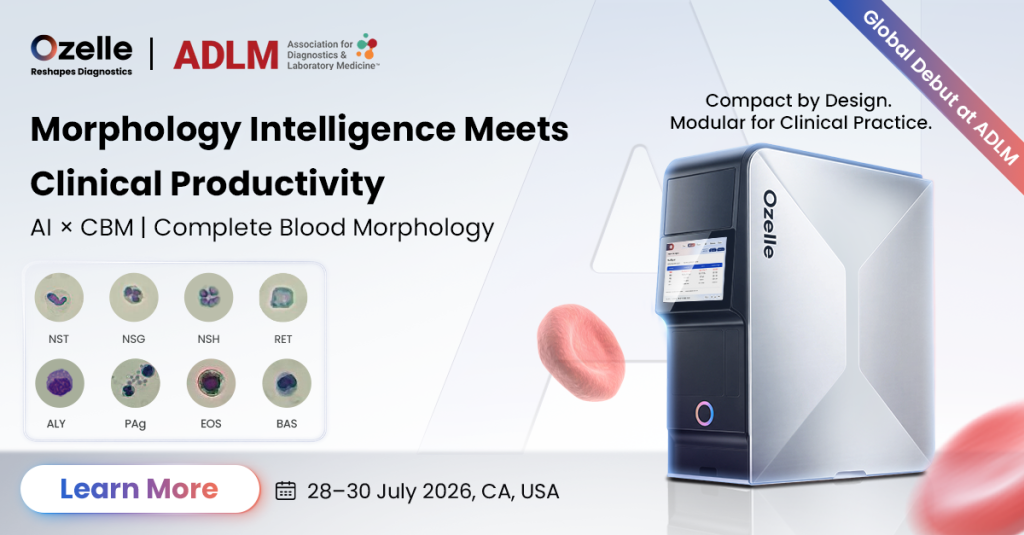
ADLM 2026 will highlight the future direction of clinical CBC analyzers
ADLM 2026 as a forward‑looking platform for hematology
The ADLM Annual Scientific Meeting and Clinical Lab Expo will continue to serve as a global stage where laboratories, clinicians, and manufacturers explore upcoming developments in laboratory medicine. CBC testing will remain a core component of this discussion, because CBC is one of the most requested tests in clinical practice and underpins many daily hematology workflows.
At ADLM 2026, the clinical CBC analyzer segment is expected to showcase how systems will evolve for decentralized hematology networks, rather than remaining confined to large central laboratories. Morphology intelligence, compact designs, and flexible throughput will be recurring themes as manufacturers present solutions for health screening centers, regional hospitals, and independent laboratories.
Why industry observers will use ADLM 2026 to read future hematology trends
Because ADLM will gather many of the key actors in hematology and diagnostics, visitors and observers will use the event to interpret where the CBC ecosystem is heading over the next three to five years. Product announcements, roadmaps, and technical sessions will collectively indicate which technologies are maturing and which use cases will attract sustained investment.
In this sense, ADLM 2026 will not simply introduce individual analyzers; it will frame expectations about what a clinical cbc analyzer will be required to deliver in decentralized and near‑patient settings in the near future. O‑cyte 1 will be positioned within this landscape as one response to these expectations, rather than as an isolated innovation.
Decentralized hematology: how clinical CBC analyzers will move closer to screening centers and regional hospitals
From centralized CBC hubs to distributed hematology networks
CBC testing has traditionally been concentrated in large central laboratories equipped with high‑volume analyzers and specialized staff. As health systems expand screening programs and formalize chronic disease management pathways, they will need CBC capacity closer to patient flows, including health screening centers, regional hospitals, and independent laboratories.
Over the next few years, clinical cbc analyzer deployment will therefore continue shifting toward decentralized hematology networks, where analyzers operate in multiple nodes connected by shared data and quality protocols. ADLM 2026 will reinforce this direction by highlighting solutions designed for distributed architectures rather than single, centralized hubs.
Requirements that will define decentralized hematology CBC platforms
Research on near‑patient hematology and innovative CBC platforms points to several requirements that will define decentralized systems: low sample volumes, robust performance outside core labs, and simple workflows that non‑specialist staff can handle. These systems will also need to integrate artificial intelligence support while keeping maintenance demands minimal.
As a result, future clinical cbc analyzer designs will increasingly combine compact form factors with morphology intelligence and maintenance‑free architectures. O‑cyte 1 will be presented at ADLM 2026 as a compact platform engineered for these decentralized hematology scenarios, aligning with demands that are emerging across multiple markets.
Morphology intelligence: AI × CBM will become a standard expectation, not an exception
From parameter‑only CBC to morphology‑rich clinical assessment
Conventional CBC analyzers have focused on numerical parameters and differential counts, which are valuable but sometimes limited when complex cell patterns need to be assessed. Recent research on AI‑enabled CBC systems shows that combining complete blood morphology (CBM) with deep learning can improve flagging capabilities and highlight patterns associated with anemia, inflammatory states, and infection risks.
As these studies accumulate and more platforms validate their performance against reference systems, morphology intelligence will increasingly be seen as a standard expectation for new clinical cbc analyzer designs. ADLM 2026 will provide a venue where these morphology‑rich systems can be demonstrated and compared in live workflows.
How AI‑powered CBM will fit into everyday clinical assessment
In routine practice, AI‑powered CBM will not be positioned as a replacement for physician judgment, but as a way to translate cell images into structured observations that support clinical assessment. Algorithms will highlight abnormal distributions, unusual morphology patterns, and potential risk indicators that clinicians can integrate with other laboratory tests and clinical context.
O‑cyte 1 will be introduced with morphology intelligence as a core design element, reflecting this industry move toward AI × CBM as part of everyday CBC testing rather than as a specialist add‑on. By doing so, Ozelle will be aligning its product strategy with a broader shift that ADLM 2026 is expected to showcase across multiple exhibitors.
Maintenance‑free and modular architectures: CBC analyzers will be designed for low friction operation
Why maintenance‑free concepts will be central to decentralized CBC strategies
Traditional hematology analyzers often rely on complex liquid pipelines and internal fluidics, which require regular cleaning and specialized maintenance. In decentralized hematology networks, where technical staff and time are constrained, such maintenance obligations can become key barriers to adoption.
Industry discussions and recent products suggest that maintenance‑free or low‑maintenance architectures will become central to CBC deployment strategies, particularly in screening centers and regional hospitals. ADLM 2026 will likely highlight analyzers designed to minimize daily interventions and reduce the risk of cross‑contamination.
Fluidics contained in consumables and modular service design
One way future clinical cbc analyzer platforms will achieve lower maintenance demands is by moving fluidics into sealed, single‑use consumables, reducing contact with internal tubing. Another strategy will involve modular architectures, where key components can be replaced quickly rather than repaired in place.
O‑cyte 1 will be introduced with fluidics contained in consumables and service‑ready modular design, illustrating how a new analyzer can be built around lower maintenance burden and faster service recovery. These features will position the analyzer as part of a wider movement toward clinical cbc analyzer platforms that prioritize uptime and operational simplicity.
Flexible throughput: one product generation will need to cover small sites and regional networks
Throughput variability and CBC planning across different sites
In decentralized networks, CBC workloads will vary significantly between sites: a health screening center may process tens of CBC tests per day, while a regional hospital or independent laboratory may handle much higher volumes and peaks. Fixed‑capacity analyzers can either be under‑utilized in small sites or become bottlenecks in larger facilities.
As procurement teams plan hematology capacity for the second half of 2026 and beyond, they will expect clinical cbc analyzer platforms to offer scalable throughput options that can grow with demand. ADLM 2026 will therefore act as a reference point for understanding how vendors intend to solve this challenge.
Standalone compact throughput and cascaded expansion
The O‑cyte 1 clinical CBC analyzer will be presented with a compact standalone throughput of around 60 tests per hour and a cascaded architecture that can be expanded to about 360 tests per hour through multiple units. This design will allow institutions to start with a single analyzer in smaller sites and later build cascaded lines when volumes increase, without changing platforms.
By combining compact design with flexible throughput, O‑cyte 1 will serve as an example of how one product generation can support both emerging decentralized hematology nodes and more established regional laboratories. This approach will mirror a broader expectation that clinical cbc analyzer families should support modular expansion rather than forcing complete upgrades.
Application scenarios after ADLM 2026: how trends will translate into real‑world CBC workflows
Health screening centers and preventive medicine programs
In health screening centers, CBC testing will remain central to routine hematology assessments in preventive check‑up programs. After ADLM 2026, morphology‑rich, compact clinical cbc analyzer platforms will be increasingly adopted to provide deeper information in these programs without adding complex test menus.
Maintenance‑free operation and simple workflows will help these centers manage growing volumes without proportionally increasing technical staffing. Platforms like O‑cyte 1 will be evaluated based on how well they fit into this preventive care context rather than solely on technical specifications.
Regional hospitals and near‑patient hematology
Regional hospitals will continue to expand near‑patient hematology capabilities for emergency departments, inpatient units, and outpatient clinics. After ADLM 2026, clinical cbc analyzer systems that combine morphology intelligence, flexible throughput, and modular service are expected to become typical choices for these facilities.
In this setting, O‑cyte 1 will be one of the analyzers considered for integration into distributed CBC workflows that link core labs and satellite units. Its design will be evaluated alongside other systems that follow similar trends showcased at the meeting.
Independent laboratories and regional networks
Independent laboratories and regional laboratory networks will also adjust their CBC strategies in light of the trends visible at ADLM 2026. They will be looking for clinical cbc analyzer platforms that can be deployed at multiple sites, share standardized morphology outputs, and expand throughput over time.
Across these networks, analyzers equipped with morphology intelligence, maintenance‑free architecture, and scalable throughput will gradually form the backbone of decentralized hematology capacity. Laboratory teams following future updates around O‑cyte 1 and AI CBC platforms will see how this specific analyzer fits into real‑world deployments alongside other solutions.
Ozelle’s O‑cyte 1: one manufacturer’s response to the trends visible at ADLM 2026
O‑cyte 1 as a compact, modular clinical CBC analyzer aligned with ADLM trends
Ozelle will be preparing the O‑cyte 1 clinical CBC analyzer for its debut at ADLM 2026 as a compact, modular system designed for decentralized hematology. Rather than positioning the product as an attempt to reshape the entire market, Ozelle will present it as a response to trends that ADLM is expected to highlight: morphology intelligence, maintenance‑free fluidics, modular service, and scalable throughput.
With AI × CBM at its core, O‑cyte 1 will turn cell images into structured outputs that support clinical assessment in screening centers, regional hospitals, and independent laboratories. Its maintenance‑free consumable design and service‑ready modular architecture will aim to reduce friction for decentralized CBC operations.
How industry observers will read O‑cyte 1 at ADLM 2026
For visitors at ADLM, O‑cyte 1 will be one data point in a larger pattern of CBC innovation, not a stand‑alone statement. Observers will compare it with other analyzers that implement similar concepts, forming an overall view of where clinical cbc analyzer technology is heading.
Over time, articles and case studies around morphology‑driven CBC and decentralized hematology solutions—including resources on AI‑powered hematology analyzers et decentralized hematology solutions—will help clarify how these trends translate into everyday practice. O‑cyte 1 will sit within this evolving narrative as one example of a product designed explicitly around ADLM‑visible trends rather than isolated design decisions.