
 Français
  English
  Русский
  Español
  Deutsch
  Português
  العربية
  Italiano
South America’s clinical laboratory market is entering a new phase of hematology modernization, shaped by rising demand for automation, workflow efficiency, and more clinically relevant CBC information. Across Brazil and neighboring markets, laboratories are no longer evaluating a CBC analyser machine only by counting performance; they are increasingly looking at how analyzers support morphology review, reduce maintenance burden, fit decentralized testing models, and improve daily laboratory productivity.
Recent industry discussions around Congresso Brasileiro de Análises Clínicas (CBAC), one of Brazil’s leading congresses for clinical laboratory medicine, reflect this broader shift. As laboratory specialists, technical leaders, and diagnostic companies gather around topics such as hematology, automation, innovation, and laboratory management, CBAC provides a useful reference point for understanding how CBC analyser machine expectations are evolving across South America.
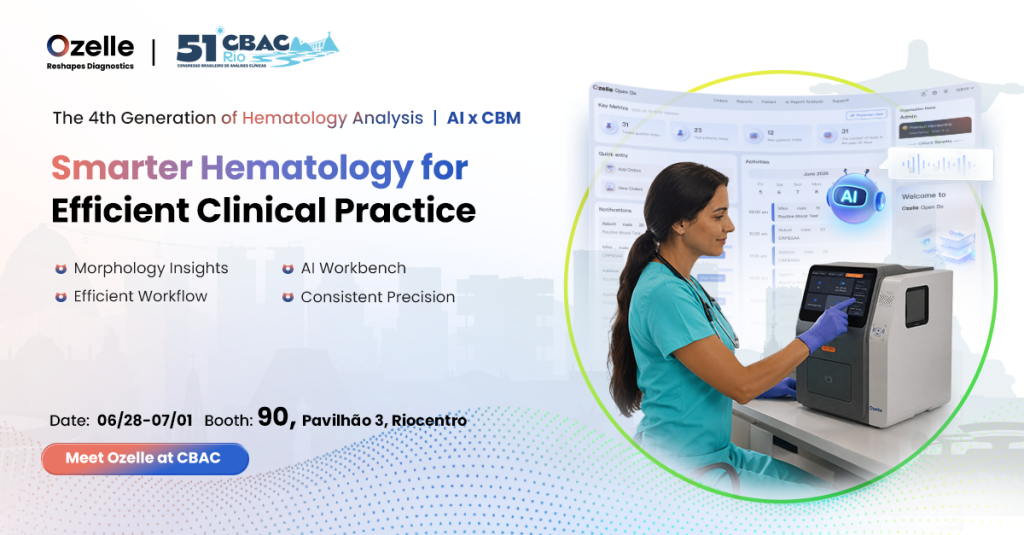
Within hematology, CBAC is significant because it provides a concentrated view of how regional laboratories are redefining their expectations for the modern CBC analyser machine. The congress program and surrounding industry activity indicate that market demand is moving beyond basic blood count capability toward platforms that deliver stronger workflow efficiency, lower maintenance requirements, and greater clinical interpretability.
CBAC as an Indicator of Regional Laboratory Priorities
According to official and related event information, CBAC 2026 is structured not only as a scientific congress but also as a meeting point for innovation, education, and commercial exchange in the Brazilian laboratory sector. That structure matters because Brazil remains the largest laboratory market in South America and often functions as an early indicator of broader regional procurement preferences, especially in segments such as hematology automation and integrated diagnostics.
The profile of the congress also suggests that laboratories in the region are evaluating technology through a more operational lens than in the past. Scientific relevance remains essential, but the questions increasingly extend to throughput, staffing efficiency, service continuity, digital integration, and the degree to which analyzers can support interpretation rather than simply generate counts.
Taken together, these signals point to four major shifts in the South American CBC analyser landscape. They include the movement beyond basic cell counting, the growing weight of maintenance efficiency in procurement, the rise of AI-enabled morphology, and the stronger fit of compact testing platforms for decentralized care delivery

Trend One: CBC Is Moving Beyond Basic Cell Counting
A central signal emerging from the hematology segment is the shift from basic counting functions toward higher-value analytical output. Traditional CBC analyzers remain indispensable, but laboratories are increasingly looking for systems that can provide richer data layers through expanded parameters, better flagging performance, and more informative classification capability.
This transition reflects a broader clinical requirement. In routine care, emergency medicine, oncology, and infection management, laboratories are under pressure to generate information that can support faster triage and earlier recognition of clinically meaningful abnormalities, rather than serving only as a first-pass screening tool In practical terms, this raises the value of a CBC analyser machine that can identify abnormal patterns earlier and reduce unnecessary manual review.
Trend Two: Low-Maintenance Automation Is Becoming a Core Purchasing Criterion
Another strong directional signal is the growing importance of operational stability. Across Latin America, analyzer selection is shaped not only by analytical performance but also by the total burden of ownership, including maintenance frequency, consumable handling, downtime risk, and access to technical support
This is particularly relevant in South America, where many laboratories operate with constrained technical teams and uneven service infrastructure. For that reason, low-maintenance or maintenance-reduced CBC systems have gained strategic importance, especially those designed around simplified reagent management, automated calibration routines, and workflow architectures that reduce daily intervention. The direction is clear: laboratories increasingly value analyzers that sustain reliable operation with less operator dependency and fewer interruptions to routine testing.
Trend Three: AI and Digital Morphology Are Reshaping the Value Proposition of CBC Systems
Global hematology technology is entering a phase in which AI-supported morphology is becoming a differentiating layer rather than an experimental add-on, and the emphasis on innovation and advanced laboratory practice at CBAC is consistent with that transition. Modern systems are moving beyond conventional 3-part or 5-part differentiation by combining imaging, algorithmic analysis, and morphology recognition models to strengthen the detection of abnormal white cells, atypical red cell patterns, and platelet-related abnormalities.
The strategic implication is substantial. When AI-enabled morphology is integrated into a CBC workflow, the analyzer begins to serve not only as an automation tool but also as a structured interpretation layer that can support earlier suspicion of clinically significant findings and reduce dependence on labor-intensive microscopic review. In regional markets where specialist manpower is limited, that evolution could materially change how hematology testing is deployed and how laboratories prioritize investment across routine and advanced diagnostics.
Trend Four: Compact and Decentralized Testing Models Fit South American Care Delivery
CBAC’s broader focus on laboratory practice, innovation, and public health relevance also aligns with another important development: the need for distributed diagnostic capacity. South American healthcare systems are marked by major differences in infrastructure between metropolitan centers and peripheral regions, which increases the relevance of compact, simplified, and flexible analyzer platforms for lower-complexity environments
This favors two equipment pathways. One is the continued rise of small-footprint CBC analyzers suitable for clinics, emergency points, and laboratories with limited staffing or space. The other is the expansion of integrated minilab concepts, in which CBC testing is combined with additional assays such as HbA1c or basic chemistry, improving the amount of diagnostic information available during a single patient encounter. For much of Latin America, these models are relevant not because they are compact in form alone, but because they better match the operational realities of multi-tier healthcare delivery.
Ozelle’s Alignment With These Trends

Ozelle’s hematology portfolio aligns with several demand layers now becoming more visible in South America. The EHBT-25 fits compact routine CBC and primary care settings, the EHBT-50 supports integrated and decentralized testing through its multi-functional mini-lab design, and the EHBT-75 targets laboratories seeking deeper AI-powered morphology and higher-tier hematology capability.
| Produit | Key Technical Focus |
| EHBT-25 | 3‑diff CBC with AI‑powered cell morphology; maintenance‑free operation; low sample volume requirements. |
| EHBT-50 | 7‑diff CBC with Complete Blood Morphology; integrated immunoassay and dry biochemistry via all‑in‑one cartridges. |
| EHBT-75 | 7‑diff CBC with full Complete Blood Morphology; high‑resolution imaging; AI morphology analysis and abnormal cell flagging. |
Across the portfolio, the common logic is AI-powered Complete Blood Morphology, simplified workflow design, and lower-maintenance operation, which correspond closely to the operational priorities highlighted by the broader South American market shift
Market Outlook for South America
Available market reporting indicates that hematology analyzers remain a growth segment globally and in Latin America, supported by rising demand for blood diagnostics, expansion of healthcare infrastructure, and the continued need for efficient chronic disease and infection management Within South America, that growth is likely to be uneven across countries and care settings, but the direction of equipment preference is becoming more consistent: laboratories are placing greater emphasis on analyzers that combine analytical capability with operational efficiency and scalable deployment.
In that context, the next phase of competition in the CBC analyser machine market is unlikely to be defined by parameter volume alone. More decisive factors will include the analyzer’s ability to reduce manual burden, maintain stable performance, improve interpretive value, and adapt to both centralized and decentralized testing environments CBAC 2026 therefore serves as a useful lens through which to observe not only current product positioning, but also the evolving criteria by which South American laboratories are likely to evaluate a CBC analyser machine over the next several years.
Ozelle’s Outlook for the South American Market
Ozelle’s relevance in South America is strongest where laboratories need to balance diagnostic capability with simpler daily operation across different care settings. In that context, features such as compact footprint, lower-maintenance design, and morphology-enhanced interpretation are likely to be commercially meaningful in both centralized and decentralized testing environments.
The company’s portfolio of compact analyzers, integrated mini-lab systems, and AI-powered morphology platforms places it in line with the market direction reflected at CBAC Platforms such as AI-enabled hematology analyzer systems are relevant because they combine routine CBC capability with broader deployment flexibility and deeper hematology insight
Conclusion
CBAC 2026 suggests that the South American CBC analyser market is moving into a more mature stage of demand, where laboratories are no longer assessing a CBC analyser machine solely on the basis of core blood count functionality. The stronger priorities now appear to be automation quality, maintenance efficiency, interpretive depth, and deployment flexibility across different care levels. As a result, the regional trajectory points toward CBC platforms that are not only faster and more automated, but also more clinically informative and better aligned with the structural realities of Latin American laboratory medicine