
 Français
  English
  Русский
  Español
  Deutsch
  Português
  العربية
  Italiano
Un analyseur d'hématologie vétérinaire est le moteur principal d'un laboratoire vétérinaire interne, transformant quelques microlitres de sang en une numération sanguine complète (NFS) et un différentiel qui guident le diagnostic de l'anémie, de l'infection, de l'inflammation et de nombreuses maladies chroniques. Alors que la charge de travail augmente et que les propriétaires d'animaux attendent des réponses le jour même, de plus en plus de cliniques s'appuient sur des tests de NFS en clinique au lieu d'envoyer des échantillons à des laboratoires externes, faisant de l'analyseur d'hématologie vétérinaire un investissement stratégique plutôt qu'un simple appareil de plus.
Cet article jette un regard équilibré sur les principales marques d'analyseurs d'hématologie vétérinaire en 2026. Il les compare en fonction de la technologie, des fonctionnalités, du flux de travail et de leur adéquation à différents types de cliniques, des petites entreprises en démarrage aux hôpitaux de référence très fréquentés. Au lieu de désigner un seul “meilleur” système, l'objectif est de vous aider à créer une liste restreinte pratique en fonction de vos patients, de votre charge de travail et de votre budget, car chaque marque offre des atouts uniques pour différents scénarios.
Facteurs clés à prendre en compte lors du choix d'un analyseur d'hématologie vétérinaire
A. Capacités analytiques
L'une des premières décisions à prendre concerne la profondeur d'analyse dont vous avez réellement besoin avec un analyseur d'hématologie vétérinaire. Une différentielle en 3 parties divise généralement les globules blancs en lymphocytes, cellules moyennes et granulocytes, ce qui peut convenir pour un dépistage de base dans les cabinets généraux à faible volume. Une différentielle en 5 parties sépare les neutrophiles, les lymphocytes, les monocytes, les éosinophiles et les basophiles, ajoutant plus de détails cliniques pour la médecine interne, l'oncologie et les soins d'urgence.
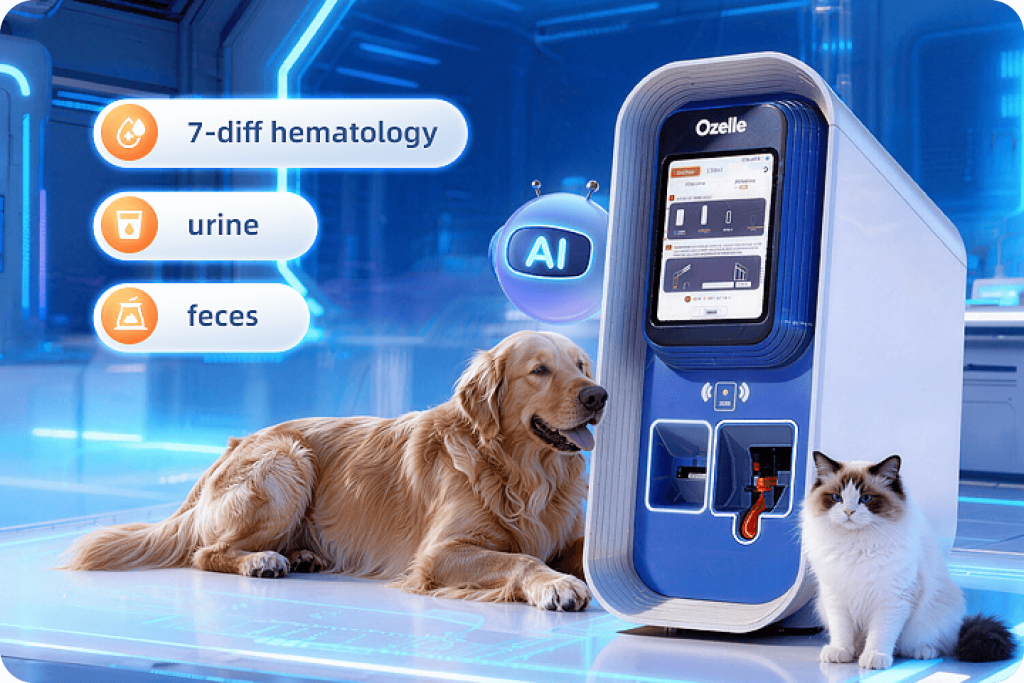
Certains analyseurs avancés offrent un différentiel en 7 parties ou étendu, y compris des sous-populations granulocytaires plus raffinées ou des formes immatures, ce qui aide à traiter les cas inflammatoires et hématologiques complexes. Au-delà de la NFS, de nombreux systèmes rapportent les réticulocytes (RET), les globules rouges nucléés (NRBC) et les drapeaux de cellules anormales, donnant un aperçu de la réponse de la moelle osseuse et mettant en évidence les échantillons qui peuvent nécessiter un examen par frottis. Les plateformes dotées d'IA comme l'EHVT-50 d'Ozelle relient ces résultats numériques aux images cellulaires réelles, ajoutant un contexte morphologique à chaque rapport.
B. Plate-forme technologique
Les analyseurs d'hématologie vet traditionnels reposent sur l'impédance électrique et la colorimétrie pour compter les cellules et mesurer l'hémoglobine, une approche robuste et largement utilisée pour les tests de routine de la NFS. De nombreux systèmes modernes ajoutent des méthodes optiques ou laser, telles que la cytométrie de flux ou la diffusion laser multi-angle, afin de mieux caractériser la taille et la granularité des cellules, ce qui améliore la séparation des populations de globules blancs et la détection des changements subtils.
L'imagerie morphologique cellulaire alimentée par l'IA est la dernière génération. Au lieu de déduire les types de cellules uniquement à partir des signaux, ces analyseurs capturent des images haute résolution des cellules sanguines et utilisent des algorithmes entraînés pour les classer. L'Ozelle EHVT-50, par exemple, associe la morphologie sanguine complète à l'IA pour analyser 7 NFS différentes et 42 paramètres, offrant ainsi une classification basée sur l'image à partir d'une seule plateforme.
Le format des réactifs influe également sur les flux de travail. De nombreux systèmes utilisent des réactifs liquides en flacon qui nécessitent une maintenance régulière, un nettoyage et une gestion des déchets, ce qui est possible dans les laboratoires à haut volume mais plus exigeant pour les petites cliniques. Les kits de coloration humide en cartouche ou à usage unique, tels que ceux utilisés par l'EHVT-50, simplifient la logistique en supprimant les tuyaux et les réservoirs de liquide, ce qui réduit le risque de contamination croisée et rend l'appareil pratiquement sans entretien lors de l'utilisation quotidienne.
C. Flux de travail et facilité d'utilisation
Un analyseur d'hématologie vétérinaire doit s'adapter au rythme quotidien de la clinique. Le volume de l'échantillon est essentiel, en particulier pour les chats, les petits chiens et les patients fragiles : les analyseurs modernes n'ont souvent besoin que de 30 à 60 μL pour une NFS complète, l'EHVT-50 étant conçu autour d'une prise de sang de 55 μL pour l'hématologie. Les besoins en échantillons plus petits réduisent le stress des patients et permettent une surveillance plus fréquente.
La facilité d'utilisation et d'intégration est tout aussi importante. Les interfaces à écran tactile, les flux de travail guidés et les routines de contrôle de qualité automatiques raccourcissent le temps de formation et réduisent les erreurs d'utilisation. La connectivité avec les logiciels de gestion de cabinet ou de SIL via un réseau local ou un port USB permet de transférer les résultats directement dans les dossiers des patients, tandis que les outils d'IA tels que Open Dx d'Ozelle convertissent automatiquement les données en rapports structurés et interprétables pour les cliniciens et les clients.
D. Coût total de possession
Lorsque vous comparez un analyseur d'hématologie vétérinaire, ne vous contentez pas du prix affiché. Les coûts réels comprennent les réactifs ou les cartouches, les matériaux de contrôle de qualité, la maintenance, l'étalonnage et les contrats de service sur plusieurs années. Les analyseurs en cinq parties ou dotés de l'IA peuvent sembler plus chers par test, mais s'ils éliminent le besoin d'appareils séparés (pour l'urine, les fèces ou les tests immunologiques), l'investissement global peut être inférieur à l'utilisation de plusieurs systèmes.
Le service et l'assistance font également partie du coût total. Une assistance locale ou à distance fiable réduit les temps d'arrêt et les pertes de revenus. De nombreux fabricants, dont Ozelle, IDEXX et d'autres, proposent des diagnostics à distance, des mises à jour logicielles et des programmes de formation structurés pour assurer le bon fonctionnement des analyseurs et la confiance du personnel.
Aperçu des principales marques d'analyseurs d'hématologie vétérinaire

Aperçu du marché à l'horizon 2026
Le paysage des analyseurs d'hématologie vétérinaire de 2026 associe des leaders mondiaux du diagnostic à des fabricants spécialisés axés sur l'IA et l'innovation sur le lieu de soins. Des sociétés comme IDEXX et Zoetis proposent des écosystèmes complets d'analyseurs, de laboratoires de référence et de logiciels, tandis que Seamaty et Ozelle mettent l'accent sur des systèmes multifonctionnels compacts, abordables ou alimentés par l'IA et conçus spécifiquement pour un usage vétérinaire.
Dans ce guide, les marques sont présentées dans un ordre neutre plutôt que dans un classement. Le “meilleur” analyseur d'hématologie vétérinaire pour votre clinique dépend de facteurs tels que la charge de travail, la complexité des cas, le budget, la technologie préférée et le fait que vous souhaitiez une NFS autonome ou une plateforme tout-en-un.
Profils de marques et systèmes représentatifs
A. IDEXX - Marque de référence mondiale
IDEXX est un leader établi de longue date dans le domaine du diagnostic vétérinaire, offrant des analyseurs en clinique, des services de laboratoire de référence et des logiciels intégrés. Son portefeuille d'hématologie comprend des systèmes tels que ProCyte One et ProCyte Dx, qui fournissent des résultats de NFS de qualité laboratoire de référence pour un large éventail d'espèces.
Ces analyseurs utilisent la cytométrie de flux laser et la fluorescence optique pour fournir une véritable différentielle en 5 parties, une numération des réticulocytes et jusqu'à 27 paramètres du sang total en seulement quelques minutes. Des algorithmes spécifiques aux vétérinaires pour plusieurs espèces et l'intégration avec les plateformes IDEXX aident les cliniciens à suivre l'évolution des résultats de la NFS dans le temps et à les corréler avec les résultats de la chimie et de l'imagerie.
Les systèmes d'hématologie IDEXX sont idéaux pour les cliniques à haut volume et les hôpitaux d'urgence qui apprécient la vitesse, la profondeur des données et une solide infrastructure d'assistance mondiale. Ils sont souvent choisis lorsqu'un cabinet souhaite disposer d'un écosystème de diagnostic haut de gamme et entièrement intégré.
B. Zoetis - Le diagnostic lié à la thérapeutique
Zoetis est surtout connue pour ses produits pharmaceutiques et ses vaccins destinés à la santé animale, mais elle propose également des analyseurs de diagnostic en clinique qui relient les tests au traitement. Ses solutions hématologiques VetScan utilisent généralement une technologie basée sur l'impédance pour fournir des NFS fiables en 3 ou 5 parties, adaptées à la pratique des petits animaux.
Ces analyseurs sont conçus pour être faciles à utiliser, pour offrir des flux de travail simples et des capacités multi-espèces, ce qui les rend accessibles aux cabinets de médecine générale qui souhaitent des performances solides en matière d'hémogramme au quotidien. Zoetis associe les diagnostics à des ressources éducatives et à des produits thérapeutiques, afin d'aider les cliniciens du diagnostic au traitement.
Les analyseurs d'hématologie vétérinaire de Zoetis séduisent souvent les cliniques qui apprécient de travailler avec un seul partenaire pour les tests et les médicaments, en mettant l'accent sur des performances pratiques et fiables dans les flux de travail quotidiens.
C. Seamaty - Compact et rentable
Seamaty se concentre sur les analyseurs compacts pour une utilisation sur le lieu de soins, y compris plusieurs modèles d'hématologie vétérinaire. Les systèmes tels que les séries VBC30 ou VBC50 s'appuient sur des méthodes d'impédance et d'optique pour fournir des différentiels en 3 ou 5 parties dans un faible encombrement, avec des interfaces à écran tactile et de faibles exigences en matière d'échantillons.
Ces analyseurs sont conçus pour être faciles à installer et à utiliser, avec une utilisation efficace des réactifs et des routines de maintenance automatisées. Ils prennent en charge les tests multi-espèces et offrent les paramètres dont la plupart des cabinets de médecine générale ont besoin pour les analyses de routine de la NFS, souvent à un coût d'investissement inférieur à celui de certains systèmes haut de gamme.
Les analyseurs d'hématologie Seamaty vet conviennent aux cliniques de petite et moyenne taille, aux start-ups et aux unités mobiles qui souhaitent des capacités de NFS modernes, un encombrement modeste et un contrôle minutieux de l'investissement total.
D. Ozelle - Analyseur d'hématologie vétérinaire multifonctionnel alimenté par IA
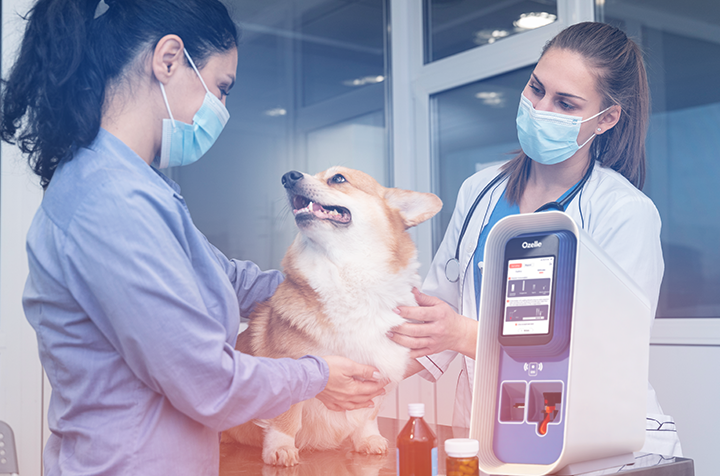
Ozelle est une société de diagnostic axée sur le numérique, spécialisée dans l'analyse sanguine basée sur l'IA et l'IoT, avec des applications en médecine humaine et vétérinaire. Son système vétérinaire phare est l'analyseur multifonctionnel EHVT-50 pour Vet, conçu comme un “mini-laboratoire d'IA” pour les cliniques vétérinaires.
Le EHVT-50 combine un analyseur d'hématologie vet à 7 différentiels (avec 4238 paramètres) et une morphologie sanguine complète avec une reconnaissance d'image AI, fournissant une classification cellulaire au niveau du microscope à partir d'un échantillon de sang de 55 μL. Parallèlement, il intègre des immunodosages (tels que cCRP, fSAA, cPL, fPL), des analyses d'urine et des analyses fécales dans un seul appareil compact, le tout soutenu par une reconnaissance des cellules, des cristaux, des parasites et des micro-organismes basée sur l'IA.
Techniquement, l'analyseur utilise une optique de haute précision et une imagerie multispectrale, avec des algorithmes entraînés sur des dizaines de millions d'échantillons. Des kits de coloration humide à usage unique et une architecture sans tube permettent à l'EHVT-50 de ne pas nécessiter d'entretien dans le cadre d'une utilisation quotidienne, ce qui élimine de nombreux problèmes fluidiques traditionnels. Un écran tactile de 10,1 pouces, la connectivité LIS et LAN et l'atelier Open Dx AI transforment les résultats bruts en rapports structurés et visuels.
Le EHVT-50 est particulièrement adapté aux cliniques de petite et moyenne taille qui souhaitent consolider les tests de NFS, d'immunoessais et d'urine/fèces dans une seule plateforme d'analyseur d'hématologie vétérinaire, tout en tirant parti de l'IA pour améliorer la confiance dans le diagnostic. De plus amples informations sont disponibles sur le site officiel d'Ozelle à l'adresse suivante https://ozellemed.com/en/ehvt-50/
E. Autres marques établies dans le domaine de l'hématologie vétérinaire
D'autres fournisseurs, dont HORIBA, Heska et divers fabricants régionaux, proposent des analyseurs d'hématologie vétérinaire basés sur la technologie de l'impédance et de l'optique, souvent avec des différentiels en 3 ou 5 parties et une intégration avec des analyseurs de chimie. Ces systèmes peuvent offrir des performances robustes et des réseaux de service locaux solides, ce qui peut être décisif sur certains marchés.
Les cliniques comparent souvent deux ou trois marques côte à côte, en tenant compte de la technologie, de la présence de services et des commentaires des utilisateurs avant de prendre une décision d'achat finale. Cette approche comparative permet souvent d'obtenir une meilleure adéquation à long terme que si l'on se concentre uniquement sur les spécifications.
Adaptation d'un analyseur d'hématologie vétérinaire à votre clinique
Profil de la clinique, mélange d'espèces et budget
Les petites cliniques et les start-ups privilégient souvent les systèmes compacts, les flux de travail simples et les coûts prévisibles par test. Pour eux, un analyseur rationalisé en 3 ou 5 parties ou une plateforme multifonctionnelle comme l'EHVT-50 peut offrir une large capacité avec un espace de travail et des besoins de formation minimaux. Les grands hôpitaux et les centres de référence peuvent privilégier les analyseurs à haut débit avec des différentiels avancés et une intégration profonde dans les systèmes d'information de l'hôpital.
Le mélange d'espèces et le menu des tests ont également leur importance. Les cliniques qui s'occupent principalement de chiens et de chats peuvent choisir des analyseurs optimisés pour les animaux de compagnie, tandis que les cabinets qui s'occupent d'animaux mixtes peuvent rechercher des bibliothèques d'espèces plus larges et des paramètres adaptés aux grands animaux ou aux animaux exotiques. Enfin, l'élaboration d'un modèle de coût simple incluant les réactifs, le service et la consolidation éventuelle de plusieurs appareils permettra de déterminer quel analyseur d'hématologie vétérinaire offre le meilleur rapport qualité-prix au cours des cinq à sept prochaines années.
En comprenant ces facteurs et en comparant les marques objectivement, chaque clinique peut sélectionner un analyseur d'hématologie vétérinaire qui permet des diagnostics plus rapides et plus précis et de meilleurs soins aux patients, qu'il s'agisse d'un système de référence à haut débit, d'un analyseur compact sur le lieu de soins ou d'une plateforme tout-en-un alimentée par l'IA comme l'EHVT-50 d'Ozelle.
FAQ
Q1. À quelle fréquence les un analyseur d'hématologie vétérinaire Besoin d'entretien ?
La fréquence de maintenance dépend du modèle ; les systèmes traditionnels nécessitent un nettoyage quotidien et hebdomadaire, tandis que les systèmes à cartouche ou sans maintenance nécessitent principalement un contrôle de qualité et le remplacement des réactifs.
Q2. Quel est le volume d'échantillon généralement requis ?
La plupart des analyseurs modernes ont besoin d'environ 30 à 60 μL de sang total, ce qui convient même aux chats, aux petits chiens et aux patients fragiles.
Q3. Un analyseur peut-il prendre en charge plusieurs espèces ?
Oui. De nombreux analyseurs d'hématologie vétérinaire comprennent des réglages multi-espèces et des gammes de référence pour les chiens, les chats et parfois d'autres animaux de compagnie ou de ferme.
Q4. Quelle est la durée d'un examen de CBC ?
Une NFS standard dure généralement entre 5 et 10 minutes, du chargement de l'échantillon au rapport final, en fonction de l'analyseur et du menu du test.
Q5. Les analyseurs basés sur l'IA remplacent-ils les frottis manuels ?
Les analyseurs basés sur l'IA ne remplacent pas totalement les frottis manuels ; ils hiérarchisent et signalent les échantillons suspects, réduisant ainsi la charge de travail liée aux frottis sans pour autant éliminer l'examen par un expert.
Q6. De quelle formation les infirmières ont-elles besoin pour faire fonctionner le système ?
La plupart des systèmes sont conçus pour une prise en main rapide ; après une brève session de formation du fournisseur, les infirmières peuvent généralement fonctionner, effectuer des contrôles de qualité et résoudre des problèmes de base de manière autonome.