
 Español
  English
  Français
  Русский
  Deutsch
  Português
  العربية
  Italiano
En muchos países, los servicios de urgencias están sometidos a una presión constante. El volumen de pacientes aumenta, los recursos de personal son limitados y la rotación de camas puede ser lenta, por lo que son frecuentes las largas esperas y las zonas de espera abarrotadas. Entre los factores que contribuyen a esta situación, cabe citar los retrasos en las pruebas de laboratorio básicas, sobre todo en los análisis de sangre. hemograma completo-juegan un papel importante, ya que las decisiones clínicas dependen a menudo de estos resultados.
Si una máquina CBC puede entregar un 7-CBC diferencial y otras pruebas clave a pie de cama en pocos minutos, puede mejorarse el momento de tomar decisiones de triaje y tratamiento. Este es el tipo de ayuda que Ozelle pretende ofrecer a los equipos de urgencias.
Por qué es importante el tiempo de respuesta de la analítica en urgencias
En urgencias, el hemograma es una de las pruebas que se solicitan con más frecuencia. Los pacientes con fiebre, sospecha de infección, dolor torácico, fatiga, hemorragia o síntomas inespecíficos a menudo necesitan un hemograma para ayudar a evaluar la infección, la anemia, la actividad de la médula ósea o las anomalías de las células sanguíneas, y luego decidir si se requieren más pruebas o el ingreso.
En un flujo de trabajo convencional, las enfermeras recogen muestras de sangre y las envían a un laboratorio central. Las muestras esperan en una cola, se procesan por lotes, se validan y finalmente se comunican los resultados al médico. Este proceso suele durar entre 45 y 120 minutos. Durante este período, los pacientes pueden permanecer en pasillos o unidades de observación, y los médicos pueden tener que tomar decisiones conservadoras con información limitada, lo que lleva a estancias prolongadas y evaluaciones repetidas. Con el tiempo, esto contribuye a prolongar la estancia, ralentizar la rotación de camas y elevar las tasas de pacientes “abandonados sin ser vistos” (LWBS, por sus siglas en inglés).
Llevar la máquina de hemograma a la cabecera del paciente
Las pruebas en el punto de atención (POCT) ofrecen una forma práctica de acortar los retrasos en el diagnóstico. En lugar de depender únicamente de un laboratorio central, los dispositivos POCT pueden colocarse en zonas de triaje, salas de reanimación, unidades de observación o incluso ambulancias, de modo que las pruebas se realicen cerca del paciente y los resultados estén disponibles más rápidamente.
Los estudios clínicos han demostrado que el uso de pruebas POC de hemograma y bioquímica básica en el SUH puede reducir el tiempo necesario para tomar una decisión médica y disminuir la duración total de la estancia en el SUH. Cuando los resultados del hemograma y de los análisis químicos rutinarios están disponibles en cuestión de minutos, los médicos pueden decidir con mayor rapidez si iniciar el tratamiento, solicitar más pruebas, ingresar o dar el alta.
En este contexto, una máquina de hemograma adecuada para entornos de urgencias se convierte en un componente práctico del flujo de trabajo del SUH y no sólo en un sustituto a pequeña escala de un analizador central.
El minilaboratorio AI de Ozelle como analítica para urgencias
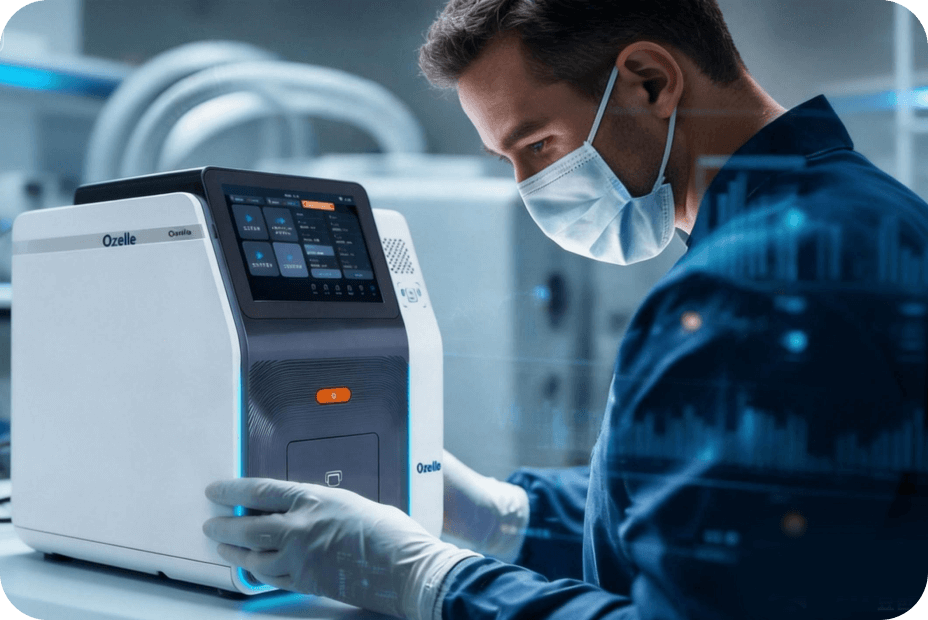
Minilaboratorio multifuncional EHBT-50 de Ozelle está diseñado para funcionar como un equipo de hemograma con funciones añadidas. Realiza hemogramas de 7 diferencias y también admite pruebas de inmunoensayo y bioquímica, lo que resulta útil en departamentos con limitaciones de tiempo y espacio, como urgencias.
Entre las principales funciones para aplicaciones de urgencias se incluyen:
- Hemograma de 7 diferencias en pocos minutos a partir de una pequeña muestra El dispositivo utiliza sangre capilar o venosa, requiere sólo unos 30-40 μL y puede proporcionar un informe de hemograma de 7 diferencias en aproximadamente 6 minutos. Esto es adecuado para adultos mayores, niños y pacientes para quienes la venopunción repetida es difícil.
- Información sobre morfología celular basada en IA Mediante imágenes de morfología celular, la máquina de hemograma puede proporcionar parámetros como NST, NSG, NSH, RET y PAg. Estos datos ofrecen información adicional sobre el estado de la infección, la actividad hematopoyética y la morfología anormal de los hematíes o las plaquetas, lo que puede ayudar al juicio clínico.
- Cada prueba utiliza un cartucho cerrado que combina la toma de muestras, la dilución, la tinción y el recuento. Esto reduce el riesgo de contaminación cruzada y disminuye el mantenimiento diario, por lo que el personal de enfermería de urgencias puede utilizar el dispositivo con pasos sencillos y estandarizados.
Con estas características, la máquina de hemograma proporciona información oportuna a los clínicos y se adapta a las rutinas diarias del SUH.
Más allá del CBC en una única plataforma
La toma de decisiones en urgencias suele requerir múltiples parámetros en lugar de un hemograma por sí solo. La máquina de hemograma de Ozelle puede realizar pruebas adicionales de inmunoensayo y bioquímica en la misma plataforma, lo que resulta práctico para las presentaciones habituales en urgencias, los pacientes en estado crítico y los que están en observación.
- Marcadores de inflamación e infección Además del hemograma, el sistema puede medir marcadores como la PCR, la SAA, la PCT y la IL-6. Estos marcadores pueden ayudar a los médicos a evaluar la probabilidad de una infección bacteriana frente a una infección vírica y a estimar la carga inflamatoria. Estos marcadores pueden ayudar a los médicos a evaluar la probabilidad de una infección bacteriana frente a una infección vírica y a estimar la carga inflamatoria, lo que permite un uso más adecuado de los antibióticos y el diagnóstico por imagen.
- Pruebas de función cardiaca y orgánica Las pruebas opcionales incluyen marcadores cardiacos como troponina y NT-proBNP y pruebas renales y hepáticas como creatinina, urea, ALT, AST y bilirrubina, junto con glucosa y lípidos. Esto permite una evaluación rápida del dolor torácico, la disnea, la sospecha de insuficiencia cardíaca o una posible disfunción orgánica.
- Una extracción de sangre, múltiples resultados Para los médicos, esto significa que una muestra puede proporcionar un hemograma más marcadores inflamatorios y bioquímica esencial, sin depender de varios dispositivos diferentes ni esperar a los informes del laboratorio central. Varios puntos de decisión en la vía clínica pueden abordarse en un solo plazo de tiempo.
Escenarios típicos en urgencias con un equipo de hemograma
Varias situaciones habituales en urgencias ilustran cómo una máquina de hemograma de este tipo puede apoyar el trabajo clínico:
- Sospecha de sepsis Un paciente presenta fiebre, taquicardia e hipotensión limítrofe. Tradicionalmente, la analítica y los análisis básicos se envían al laboratorio central, y los médicos pueden esperar entre una y dos horas antes de decidir si inician una vía de sepsis. Con la máquina de hemograma Ozelle situada en el área de triaje o de observación, el hemograma, la PCR/SAA/PCT y los análisis químicos clave pueden estar disponibles en cuestión de minutos, lo que permite una identificación más temprana de la sepsis y un inicio más oportuno de la administración de líquidos y antimicrobianos.
- Dolor torácico agudo Para los pacientes con dolor torácico, un acceso más rápido a la información puede ayudar a aclarar la situación. Los resultados rápidos de hemograma, troponina, NT-proBNP y química básica de la máquina de hemograma pueden ayudar a diferenciar entre causas cardiacas y no cardiacas y a decidir si se activa un protocolo de dolor torácico sin demoras innecesarias.
- Fiebre pediátrica Para los niños, los largos tiempos de espera y las múltiples venopunciones son especialmente estresantes. Con una pequeña muestra de sangre capilar, la máquina de hemograma puede proporcionar hemograma y marcadores inflamatorios en cuestión de minutos, lo que ayuda a los médicos a estimar el riesgo de infección bacteriana grave y, potencialmente, acortar la estancia en urgencias y evitar el uso innecesario de antibióticos.
En todos estos ejemplos, una disponibilidad más rápida de las pruebas ayuda a los médicos a tomar decisiones más tempranas y con mayor conocimiento de causa.
Perspectiva operativa del uso de un analizador de sangre en urgencias
La saturación de los SUH tiene implicaciones económicas y clínicas. Las estancias prolongadas conllevan más horas extra, una rotación más lenta de las camas y mayores tasas de PTMI, y cada visita de PTMI puede representar varios cientos de dólares en ingresos perdidos para un hospital. Para los SUH urbanos de gran volumen, esto puede suponer una pérdida anual considerable.
Por lo tanto, una máquina de CBC que acorta el tiempo de respuesta del laboratorio y ayuda a reducir los retrasos y las tasas de LWBS puede considerarse no solo una herramienta de diagnóstico, sino también un elemento de mejora operativa. La máquina CBC de Ozelle utiliza cartuchos de un solo uso, consumibles estables a temperatura ambiente y un diseño de bajo mantenimiento para ayudar a controlar los costes operativos, y su conectividad IoT permite la supervisión centralizada de los volúmenes de pruebas, los consumibles y el control de calidad.
De este modo, el dispositivo apoya tanto la toma de decisiones clínicas como la gestión diaria del SUH.