
 Español
  English
  Français
  Русский
  Deutsch
  Português
  العربية
  Italiano
In a busy animal hospital, your day rarely slows down. One moment you are stabilizing a vomiting dog, the next you are assessing a cat with a high risk of urinary obstruction, then reviewing lab work for a frail senior before anesthesia, or re‑evaluating a chronic GI case that still is not straightforward. You do not just need numbers on a screen – you need specific, clinically relevant parameters that tell you whether to admit, treat, refer, or reassure.
That is exactly the gap Ozelle’s EHVT-50 is built to fill. Rather than acting as a generic veterinary blood testing machine, it works as an AI‑driven diagnostic system for dogs and cats, with its test menu focused on the hematology, urine, fecal, and immuno markers that make a real difference in everyday decision‑making in animal hospitals.
Instead of sending samples to multiple machines and trying to mentally glue together data from different interfaces, the EHVT‑50 lets your team work from one unified platform. CBC, automated urine sediment, fecal microscopy, and key immunoassays are generated on the same analyzer, with species‑appropriate reference ranges and image‑backed results that are easy to interpret and to explain to worried owners.
7‑Diff CBC for Dogs and Cats That Goes Beyond “Normal or Not”
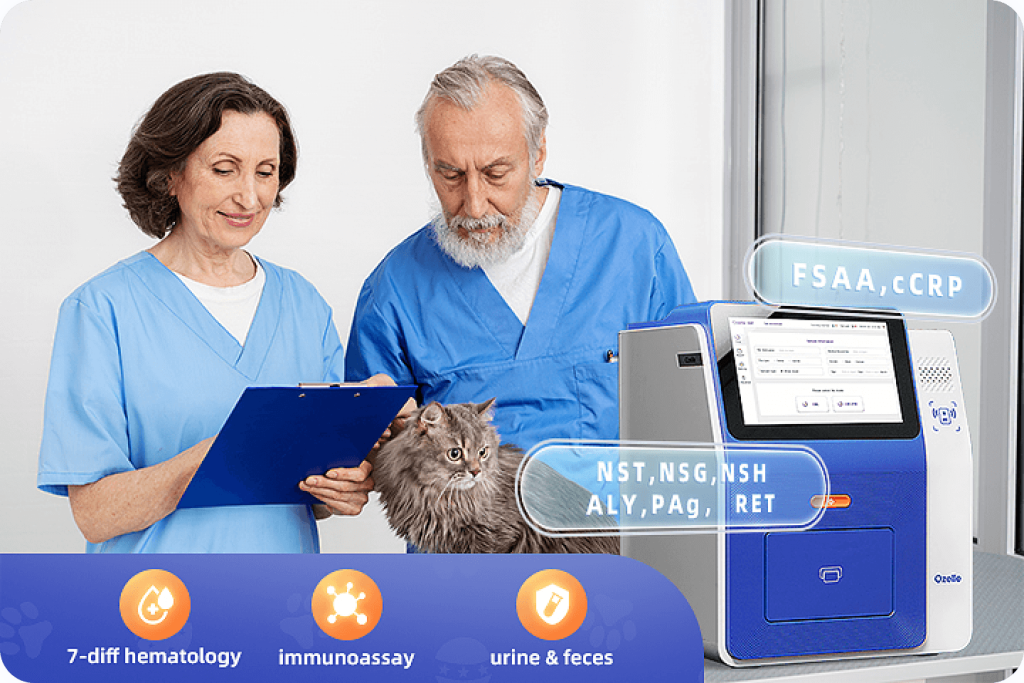
For many clinics, CBC is the first in‑house test ordered on a sick patient. EHVT‑50 uses AI‑driven cell morphology and 7‑part differential analysis to provide a rich CBC profile for canine and feline samples, delivering around 42 hematology parameters plus automated morphology assessment.
Instead of a simple “WBC high or low” and a basic 3‑part differential, you see a detailed picture of the white cells, red cells, and platelets that actually supports specific clinical decisions. The analyzer does not just count cells – it captures high‑resolution images, classifies them with AI, and flags abnormal patterns that you might otherwise miss at 2 a.m. on a busy shift.
White Blood Cells: Understanding the Pattern, Not Just the Total
In many conventional analyzers, white blood cell interpretation stops at “elevated” or “low” and perhaps a broad neutrophil/lymphocyte split. EHVT‑50 provides NEU, LYM, MON, EOS, BAS, plus neutrophil subsets such as NST (band neutrophils) and NSG (segmented neutrophils), supported by AI morphology.
In practice, this means you can distinguish:
- Stress leukogram vs true inflammatory leukocytosis
- Early left shift (rising NST) that supports bacterial infection
- Eosinophilia patterns that point to allergy, parasitism, or other hypersensitivity processes
For a coughing dog with fever, seeing a marked neutrophilia with bands and toxic may support further investigation for infectious or inflammatory disease, rather than “wait and see.” For a cat with vague lethargy and only mild changes in total WBC, a pattern more suggestive of stress leukogram than severe inflammation lets you structure a more measured workup and give owners realistic expectations.
Over time, these more nuanced WBC profiles also help your team build internal patterns: what does a septic abdomen look like on EHVT‑50, how does an immune‑mediated disease differ from a simple steroid‑induced leukogram, and how do those patterns change with treatment.
Red Cells: Not Just “Anemic or Not,” But “What Type of Anemia”
EHVT‑50 reports core RBC indices such as HGB, HCT, MCV, MCH, MCHC, RDW, and also reticulocytes (RET#, RET%), with AI support for morphology. These parameters help you quickly separate different anemia mechanisms and urgency levels.
These parameters help you rapidly differentiate: regenerative versus non-regenerative patterns and other common anemia presentations
In a pale, tachycardic dog, seeing low HCT with high reticulocytes immediately supports a regenerative picture and helps you prioritize imaging for internal bleeding or hemolysis workup instead of focusing on bone marrow failure. In a chronic CKD cat with low HCT and low RET, you can justify erythropoietin support, iron reassessment, and long‑term anemia management, rather than attributing the problem vaguely to “old age.”
Because the EHVT‑50 combines numeric indices with cell images, you can also catch subtle morphology changes such as schistocytes or abnormal RBC shapes that support more complex diagnoses like microangiopathic processes or hereditary red cell defects.
Platelets: Making Surgery and Bleeding Risk Decisions Safer
For anesthesia, surgery, and trauma cases, platelet information from EHVT‑50 is critical. The analyzer provides PLT count and indices such as MPV, as well as image‑based review, so you see both quantity and qualitative trends.
In practical terms, this means you are not sending a dog into orthopedic surgery or a cat into extensive dental extractions blind to their coagulation risk. If you see meaningful thrombocytopenia or abnormal platelet morphology, you can:
- Delay elective procedures and investigate immune‑mediated thrombocytopenia, bone marrow issues, or consumptive coagulopathy
- Adjust your surgical and anesthetic plan for higher‑risk patients
- Communicate clearly with owners about bleeding risk and the need for transfusion or more intensive monitoring
In emergency settings, such as trauma or suspected rodenticide toxicity, having fast, reliable platelet data from the same platform as your CBC speeds up both diagnosis and triage.
Urine Microscopy Parameters That Really Matter in Daily Practice
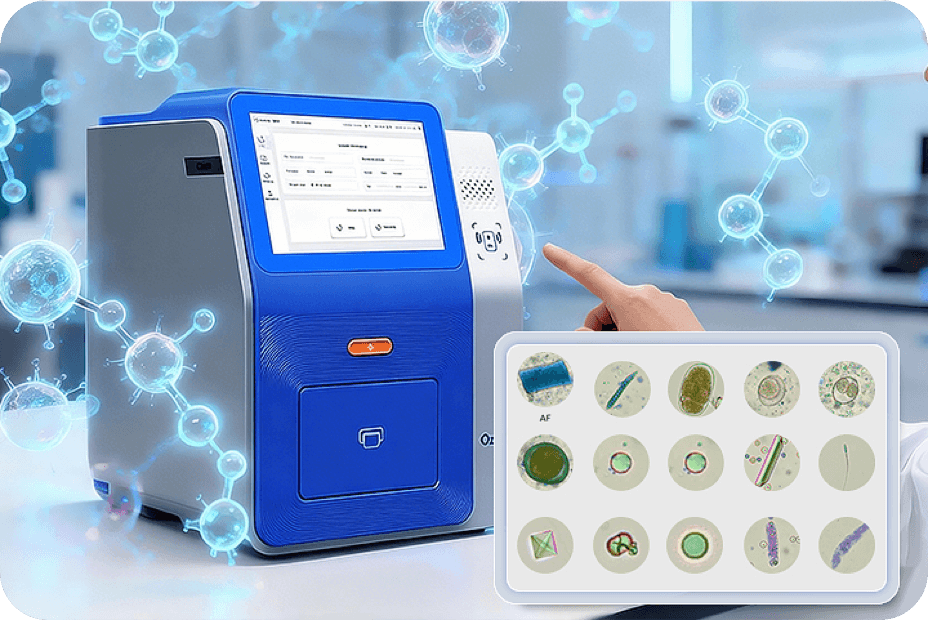
Urinalysis is often underused in animal hospitals because manual sediment review is time‑consuming, subjective, and highly dependent on a single experienced technician. EHVT‑50 automates urine microscopy and gives you structured parameters that directly support kidney and lower urinary tract decisions.
Automating Sediment Review So You Use Urinalysis More Often
In urine microscopy, EHVT‑50 focuses on the elements that change your real‑world decisions. The analyzer uses AI‑assisted cell morphology to identify:
- RBC and WBC –findings consistent with urinary tract inflammation and possible infection
- Casts – including hyaline, cellular, granular, and wax casts, which may indicate tubular involvement that warrants further renal assessment
- Common crystals – such as struvite (magnesium ammonium phosphate) and calcium oxalate (mono‑ and dihydrate forms), supporting stone‑risk assessment and diet or surgery planning
Turning PU/PD and LUTD Cases into Clearer Kidney and Bladder Decisions
For a PU/PD cat, combining creatinine/urea (from an external chemistry analyzer) with EHVT‑50 urine sediment findings gives a much clearer picture of where the kidney is in the disease curve and whether there is a concurrent infection or active tubular injury. For a cat with recurrent lower urinary tract signs, seeing specific crystal patterns and inflammatory cells in an objective, repeatable format allows you to tailor diet, monitoring, and owner education far more precisely.
Making Urine Microscopy Standardized, Not Technician‑Dependent
Just as importantly, automated, standardized urine microscopy encourages your team to order urinalysis more often because it is quick, reproducible, and does not depend on availability of your most experienced technician. Over time, that means more kidney disease is caught early, fewer UTIs are missed, and your hospital’s internal medicine decisions become more data‑driven instead of impression‑driven.
Fecal Microscopy That Makes GI Workups Less Guesswork
Vomiting and diarrhea are among the most common reasons owners rush pets into animal hospitals. Yet many clinics still rely on quick smears, simple floatation, or incomplete stool checks. EHVT‑50 automates fecal microscopy and turns the slide into a set of structured, quantifiable parameters.
Focusing on the Parameters That Change Your Treatment Plan
For fecal microscopy, EHVT‑50 concentrates on what matters most in vomiting and diarrhea cases. Typical parameters include:
- Parasite eggs and oocysts – quickly confirm or rule out common parasitic causes in young, outdoor, or shelter animals
- RBC and WBC in stool – indicate mucosal damage or active inflammation rather than simple dietary upset
- Undigested food particles and fat droplets – may justify further investigation of maldigestion or malabsorption disorders
From “Probably Gastroenteritis” to a Specific Etiology
In daily practice, this means you can:
- Quickly confirm or exclude parasitic causes in puppies, kittens, and unvaccinated or stray animals
- Differentiate simple dietary indiscretion from more serious inflammatory or infectious enteropathy when RBC/WBC and abnormal material appear
- Support your decision to escalate to more advanced diagnostics (ultrasound, biopsy, endocrine testing) when stool parameters do not fit a simple, self‑limiting problem
For example, a young dog with bloody diarrhea might show RBC, WBC, and specific parasite oocysts on EHVT‑50 – leading you to immediate targeted anti‑parasitic treatment, appropriate isolation, and a clear prognosis discussion, rather than an open‑ended trial‑and‑error approach.
Using Fecal Trends to Guide Chronic GI Management
In a chronic GI case, repeated fecal results that consistently show fat droplets and undigested material, but no parasites, can support suspicion of exocrine pancreatic insufficiency or small intestinal disease and justify further specialized testing. As you adjust diet, enzymes, or anti‑inflammatory therapy, follow‑up fecal results become an additional, objective way to gauge whether your plan is really working.
Targeted Immunoassay Markers Built Around High‑Impact Vet Cases
EHVT‑50 adds a focused set of immunoassay biomarkers that map directly to the most common serious canine and feline presentations in animal hospitals. Rather than offering a huge, unfocused menu, the panel centers on the markers that change your management in a meaningful way.
Core Markers for Pancreas, Systemic Inflammation, and Thyroid
In everyday cases, the EHVT‑50 highlights a few core indicators that truly guide your decisions, such as:
- cPL / fPL – to support diagnosis of pancreatitis in vomiting dogs and cats
- cCRP / fSAA – systemic inflammatory markers that track overall disease burden more sensitively than WBC alone
- cT4 / fT4 – thyroid function markers for hyperthyroid cats and hypothyroid dogs
Beyond these, the immuno menu can include kidney markers (such as SDMA and Cys‑C), cardiac markers (cTnI, NT‑proBNP), and infectious disease antigens/antibodies for common canine and feline pathogens, depending on the configuration.
When Immuno Markers Change Your Next Step
These tests are not “nice extras” – they are exactly what you need when:
- A vomiting dog with abdominal pain has normal or only mild CBC changes, but elevated cPL supports early treatment of pancreatitis and a more intensive monitoring plan
- A cat with weight loss, vomiting, and tachycardia shows abnormal fT4 and fSAA, helping you distinguish pure hyperthyroidism from concurrent inflammatory or systemic disease
- A chronic inflammatory case is monitored over time with cCRP or fSAA trends, giving you an objective way to judge whether treatment is truly working, rather than relying only on owner impressions
One Platform for CBC, Urine, Feces, and Immunoassays
Because the immunoassays run on the same platform as your CBC, urine, and fecal tests, you reduce the friction of ordering them and avoid fragmented data across multiple devices. Over time, your team’s “standard workup” for common high‑impact presentations naturally evolves to include the markers that truly refine diagnosis and prognosis, without adding complexity to your workflow.
An Integrated, AI‑Driven Platform Designed Around Real Vet Decisions
When you put all of these pieces together, the real value of Ozelle’s EHVT‑50 is not that it can “do more tests,” but that it unifies the right ones on a single, AI‑driven platform built specifically for dogs and cats.
Instead of fragmenting CBC, urine, fecal and key immuno markers across multiple devices and interfaces, your team works from one coherent, image‑backed view of each case, with species‑appropriate reference ranges and AI support that make difficult calls feel less like guesswork. Test results are easier to compare side by side, easier to track over time, and easier to communicate in a clear narrative to owners who are trying to make fast, emotional decisions about their pets.
For animal hospitals that want their in‑house diagnostics to move beyond basic numbers and toward integrated, case‑driven insight, the EHVT‑50 is more than a veterinary blood testing machine – it is a compact mini lab designed around the real decisions you make every day. To see how it could fit into your workflows, you can explore the full details on Ozelle’s official product page for the EHVT‑50 Veterinary Multi‑Functional Analyzer.