
 English
  Français
  Русский
  Español
  Deutsch
  Português
  العربية
  Italiano
Why Small Pet Clinics Need a New Generation of Pet Hematology Analyzer
Small animal clinics and neighborhood pet hospitals are seeing more complex medical cases and more demanding pet owners who expect fast, accurate diagnostics. Cats and dogs present with subtle symptoms—vomiting, diarrhea, lethargy, weight loss, or urinary issues—that cannot be fully assessed without blood work and related lab tests.
However, many small clinics still rely on sending samples to external labs or using separate point solutions: one analyzer for CBC, dipstick‑based urinalysis, manual fecal microscopy, and rapid tests run on lateral‑flow strips. This creates long turnaround times, inconsistent quality, extra work for staff, and higher overall costs.
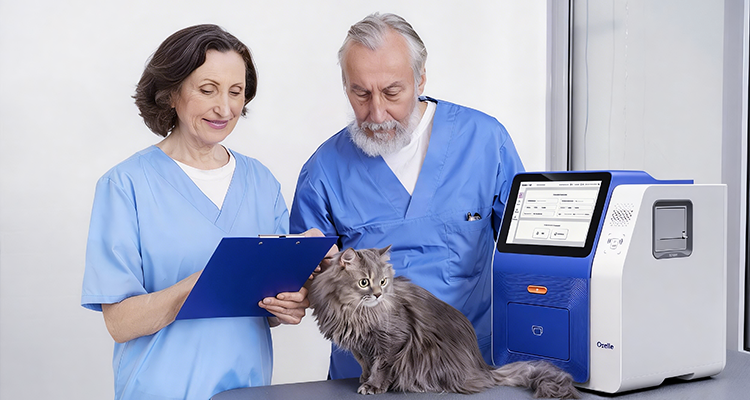
A modern pet hematology analyzer for small clinics needs to be more than a basic CBC machine. It must act as a compact veterinary mini lab, combining hematology, urine, feces, and immunoassay testing in one stable, easy‑to‑use system. The EHVT‑50 from Ozelle is one such solution, described as an AI‑powered veterinary mini lab specifically engineered for pet clinics. Small clinics can explore Ozelle’s veterinary hematology solutions to see how EHVT‑50 fits into a broader AI pet diagnostics offering.
What a Pet Hematology Analyzer Should Deliver for Dogs and Cats
From a small clinic’s point of view, a pet hematology analyzer should be species‑optimized, compact, maintenance‑free, and capable of covering most core in‑house diagnostics. The EHVT‑50 is designed to meet these requirements for dogs and cats by integrating four major diagnostic modules:
- 7‑diff hematology with AI‑based Complete Blood Morphology (CBM).
- Automated urine sediment analysis.
- Automated fecal microscopy.
- Veterinary immunoassays for key inflammatory, renal, endocrine, cardiac, and infectious disease markers.
This integration makes EHVT‑50 suitable not only for large animal hospitals but also for small pet clinics that want to bring “big‑hospital” capabilities into a limited space.
7‑Diff CBC Tailored for Pet Clinics
Species‑Optimized Hematology for Dogs and Cats
EHVT‑50 is explicitly described as a veterinary hematology analyzer for dogs and cats, offering 7‑diff CBC with 38+ hematology parameters optimized for companion animals. According to Ozelle’s published data, the hematology module provides:
- White blood cells (WBC) and differential:
- WBC, NEU#, LYMP#, MON#, EOS#, BAS#, with percentages for each subset.
- Neutrophil maturation markers: NST# (stab neutrophils), NSG# (segmented neutrophils), NSH# (hypersegmented neutrophils) and related percentages (NST/WBC%, NSG/WBC%, NSH/WBC%).
- Red blood cells (RBC) and indices:
- RBC, HGB, HCT, MCV, MCH, MCHC, RDW‑CV, RDW‑SD, HDW‑CV, HDW‑SD.
- Reticulocytes (RET#, RET%) and additional morphological categories that support anemia evaluation.
- Platelets (PLT) and indices:
- PLT, MPV, PDW, PCT.
- APLT#, P‑LCC (large platelet count), P‑LCR (large platelet ratio) to better assess platelet size distribution and macroplatelets in pets.
For small pet clinics, this means a single CBC run can reveal not just counts but also neutrophil maturation patterns, reticulocyte response, and platelet behavior in canine and feline patients.
AI‑Powered Morphology With Real Cell Images
EHVT‑50 uses CBM technology similar to Ozelle’s human analyzers: high‑resolution imaging coupled with AI recognition trained on extensive veterinary cell image datasets. The device can attach real cell images to results, giving the veterinarian visual context for abnormal cell populations without relying on manual smear review for every case.
This is particularly important in feline medicine, where subtle RBC and WBC morphological changes can hold diagnostic significance and where small sample volumes are common.
Bringing Urine and Feces Analysis Into the Same Pet Hematology Platform
Automated Urine Sediment Analysis for UTIs and Kidney Cases
For cats and dogs with urinary issues, a pet hematology analyzer that also handles urine saves time and bench space. EHVT‑50’s urine module can automatically recognize:
- Casts: hyaline, cellular, granular, and waxy (HYA#, RBC‑C#, LC#, RTC#, GRA#, WAC#, FC#, BC#).
- Cells: RBC#, WBC#, renal tubular epithelial cells (RTE#), squamous and transitional epithelial cells (SEC#, TEC#, SPE#).
- Crystals: MAP#, COMC#, COD#, CP#, UAC#, CYSC#, CC#, BilC#, AUC#.
- Microorganisms and particulates: COS#, BAC#, SAC#, FUN#, FAT#, PHL#.
Small animal clinics can thus evaluate UTIs, crystalluria, and renal risk quickly within the same platform used for CBC.
Fecal Microscopy for Parasites and GI Workups
Gastrointestinal (GI) cases—vomiting, diarrhea, weight loss—are everyday realities in pet clinics, especially for cats. EHVT‑50’s fecal module provides automated microscopy for:
- Parasite eggs: ALE#, ANE#, CEE#, DIP#, SPI#, TtE, TRE.
- Protozoa: TRI#, FLA#, COD#, COD0#, COD1#, COD2#, Tg#.
- Microorganisms: COS#, BACI#, C/B#, CAM#, BAC#, SS1#, SS2#, YEA#.
- Cells and digestive residues: RBC#, WBC#, EPC#, plus markers for starch, lipid, plant fiber, and muscle fiber (STA#, LFAT#, PLA#, AF#).
Instead of juggling separate microscopes and manual counts, small clinics can use the EHVT‑50 as a cat and dog fecal analyzer integrated with CBC and immunoassay.
Veterinary Immunoassays That Matter for Small Pet Clinics
In addition to CBC and microscopy, many pet clinics rely on rapid tests for infection, organ function, and chronic disease monitoring. EHVT‑50 integrates a veterinary immunofluorescence immunoassay (FIA) module designed for small animal practice.
The immunoassay menu includes:
- Inflammatory markers: cCRP, fSAA, AGP.
- Pancreatitis markers: cPL, fPL.
- Renal markers: cSDMA, fSDMA, cCys‑C, fCys‑C.
- Hormones and metabolism: Cortisol, T4, HbA1c, TSH, cProg, LH.
- Cardiac markers: cTnI, NT‑proBNP.
- Infectious disease tests: FeLV Ag, FIV Ab, FCoV Ag, FPV Ag, CCV Ag, CPV Ag, CDV Ag, Giardia Ag, HW Ag, Ehrlichia canis Ab, Anaplasma Ab, Lyme Ab, feline toxoplasma Ab, CIV Ag, Leptospira tests.
For a small clinic, this means one pet hematology analyzer can cover CBC plus many of the most common in‑house rapid tests used in everyday canine and feline cases. The menu is summarized on the EHVT‑50 veterinary mini lab product page.
Practical Design Features for Small Animal Clinics
Compact Footprint, In‑Clinic Throughput
EHVT‑50 is built with small and medium clinics in mind. According to device specifications, it offers:
- Sample volume: 100–200 μL per run, suitable for small pets where blood volume is limited.
- Throughput: Roughly 5–7 samples per hour, which aligns with typical daily loads in small clinics and pet hospitals.
- Sample types: Blood, urine, and feces from canine and feline patients.
- User interface: A 10.1‑inch touch screen with guided workflows designed for everyday veterinary staff.
This configuration allows a small clinic to run CBC, urinalysis, feces, and relevant immunoassays in‑house while preserving bench space and avoiding complex instrument clusters.
Maintenance‑Free, Pipeline‑Free Design
For small teams, maintenance is a major concern. EHVT‑50 is described as pipeline‑free and maintenance‑free:
- No liquid pipeline: No internal fluidic hoses, reducing risk of clogs and leakage and eliminating routine flushing.
- Single‑use wet staining kits: Sealed kits prevent cross‑contamination and simplify biohazard management.
- Automated workflow: From loading and staining to visualization and report generation, the system runs tests with minimal manual steps.
This design lowers total cost of ownership and makes it easier for clinics to maintain consistent uptime even with limited technical staff.
Everyday Use Cases for a Pet Hematology Analyzer in Small Clinics
Feline Vomiting and Diarrhea Cases
For cats with persistent vomiting or diarrhea, EHVT‑50 lets a clinic perform in one visit:
- 7‑diff feline CBC with reticulocytes and neutrophil maturation markers to assess systemic involvement.
- Fecal analysis for parasites, protozoa, and digestive markers.
- If indicated, immunoassays such as FPV Ag, FCoV Ag, or fSAA.
This integrated approach is especially valuable in busy urban feline clinics, as described in Ozelle’s guides on cat blood analyzers and cat blood testing devices.
Canine Wellness and Chronic Disease Management
For dog wellness visits and chronic disease follow‑up, small clinics can use EHVT‑50 to run:
- Routine CBC as part of wellness panels.
- Kidney markers (cSDMA, cCys‑C), HbA1c, and hormones for chronic conditions.
- Urine and feces microscopy when gastrointestinal or urinary symptoms are present.
Instead of sending multiple tests to external labs, clinics can deliver same‑visit counselling with in‑house results.
Emergency and Walk‑In Cases
For acute anemia, collapse, respiratory distress, or suspected cardiac issues, EHVT‑50 offers rapid CBC, reticulocytes, and cardiac markers such as cTnI and NT‑proBNP. With an in‑house pet hematology analyzer, small clinics can stabilize patients more effectively and decide whether referral or hospitalization is needed.
How EHVT‑50 Compares to Basic Pet Hematology Analyzers
The table below summarizes how an integrated system like EHVT‑50 compares to a basic pet hematology analyzer and a manual/outsourced approach.
| Aspect | Basic pet hematology analyzer | EHVT‑50 pet hematology analyzer | Manual/outsourced approach |
| CBC capability | Numeric CBC, limited parameters, often 3‑diff | 7‑diff CBC with 38+ parameters and AI morphology for dogs and cats | CBC done externally, limited control over TAT |
| Morphology | No images; smear review needed | CBM with real images of WBC, RBC, PLT for review | Manual microscopy on limited cases; subjective |
| Urine & feces | Separate microscopes or no in‑house capability | Automated urine and fecal microscopy in the same device | Manual microscopy or reference lab only |
| Immunoassays | External rapid test cassettes or send‑out | Integrated veterinary immunoassays for inflammation, pancreas, kidney, hormones, and infections | Largely send‑out, slower decisions |
| Maintenance | Fluid‑based systems with regular cleaning | Pipeline‑free, maintenance‑free, single‑use kits | No device maintenance, but high external lab dependency |
| Workflow & TAT | CBC only; other tests scattered | One platform covering CBC, urine, feces, and immunoassays | Long turnaround for many tests |
For small pet clinics that want to centralize diagnostics without expanding space or staff, EHVT‑50 functions as an “all‑in‑one mini vet lab.” More details on this positioning can be found on Ozelle’s EHVT‑50 veterinary mini lab page and its AI veterinary diagnostics overview.
Conclusion: When EHVT‑50 Is the Right Pet Hematology Analyzer for Your Clinic
For small animal clinics, a pet hematology analyzer must provide more than basic CBC numbers; it has to support real‑world canine and feline cases across wellness, chronic disease, GI complaints, urinary problems, and emergencies. The EHVT‑50 veterinary mini lab offers 7‑diff CBC with AI morphology, automated urine and fecal analysis, and a broad veterinary immunoassay menu in one compact, maintenance‑free system designed specifically for pet clinics.
By consolidating these capabilities into a single AI‑powered analyzer, EHVT‑50 helps small clinics deliver faster diagnostics, more complete work‑ups, and better communication with pet owners, all while controlling space and operational costs. Clinics interested in this category of equipment can visit Ozelle’s EHVT‑50 product page and veterinary hematology solutions to evaluate whether this pet hematology analyzer aligns with their caseload, workflow, and long‑term growth plans.