
 English
  Français
  Русский
  Español
  Deutsch
  Português
  العربية
  Italiano
Understanding Emergency Anemia in Pets
Anemia in dogs and cats means there are not enough healthy red blood cells to carry oxygen, which can rapidly become life-threatening in emergencies. Common causes include acute blood loss (trauma, internal bleeding), hemolysis (immune-mediated destruction, toxins), and decreased production from bone marrow disease or chronic illness.
In real-world veterinary practice, these patients often arrive with collapse, pale gums, tachycardia, or respiratory distress, and clinicians must quickly decide whether to stabilize, transfuse, or refer. A vet hematology analyzer provides objective data within minutes, helping differentiate regenerative from non-regenerative anemia and guiding immediate treatment.
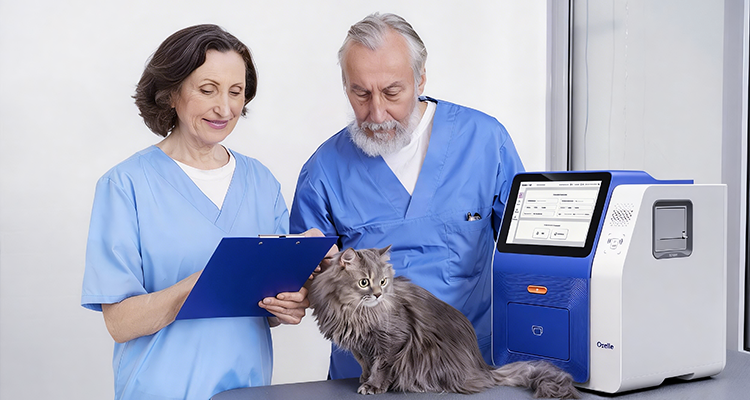
Why a Vet Hematology Analyzer Matters in Emergencies
In emergency anemia, every minute counts, and sending samples to an external lab often delays critical decisions. In-house veterinary hematology analyzers offer rapid complete blood counts (CBCs) and differentials, enabling on-the-spot triage and monitoring.
Modern analyzers like Ozelle’s EHVT‑50 veterinary hematology analyzer provide 7-differential CBC, complete blood morphology, and additional testing (urine, feces, immunoassays) from small volumes, making them suitable even for fragile kittens and puppies. With turnaround times of around 8–9 minutes per CBC and throughput of several samples per hour, clinics can monitor response to transfusion or fluid therapy in near real time.
Key roles in emergency anemia
- Rapid confirmation of anemia severity (HCT, HGB, RBC).
- Determining regeneration status via reticulocytes and red cell indices.
- Detecting concurrent problems such as leukocytosis, thrombocytopenia, or hemoparasites.
- Tracking treatment response after transfusion, surgery, or hemostatic therapy.
What “Lab-Grade” CBC Really Means
“Lab-grade” CBC performance implies accuracy and precision comparable to reference laboratories, not just basic point-of-care screening. It involves robust calibration, stable quality control, and technology that can reliably classify cells across species and disease states.
Ozelle’s EHVT‑50 uses AI-powered complete blood morphology with optical imaging, capturing high-resolution images and classifying cells via algorithms trained on tens of millions of clinical samples. This allows the analyzer not only to count red and white cells but also to recognize abnormal or immature forms, such as different neutrophil maturation stages and reticulocytes, which are crucial in evaluating emergency anemia.
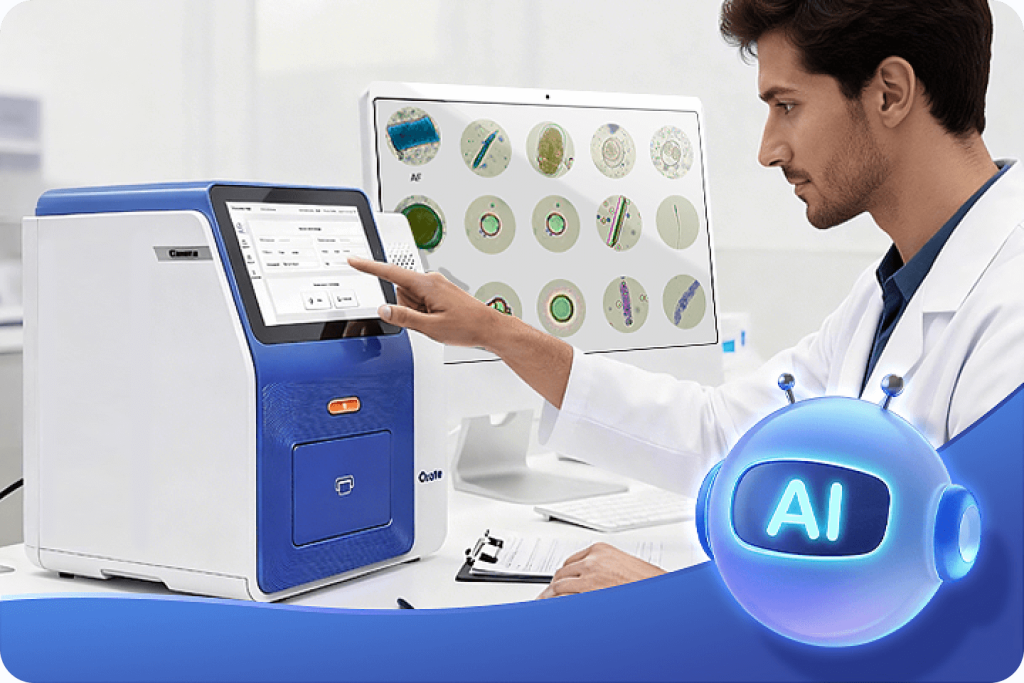
Core elements of lab-grade CBC
- High-precision optics and multispectral imaging for clear cellular detail.
- AI models trained on large, diverse datasets to reduce misclassification.
- Comprehensive panel of parameters (including 7-part differential and advanced indices).
- Rigorous internal QC, often using dry-type QC cards for daily verification.
How Vet Hematology Analyzer Help in Emergency Anemia
In an emergency anemia scenario, a vet hematology analyzer becomes the central tool to confirm diagnosis, identify cause, and guide immediate management. The combination of fast CBC results and, in all-in-one systems, integrated urine, fecal, and immunoassay testing, allows clinicians to evaluate anemia within the broader context of systemic disease.
Clinical decisions the analyzer supports
- Transfusion need: Critically low HCT/HGB and clinical signs support immediate transfusion decisions.
- Regenerative vs non-regenerative: Reticulocyte counts and red cell morphology indicate whether the bone marrow is responding.
- Infectious or immune-mediated causes: WBC differential, inflammatory markers, and sometimes specific immunoassays help uncover triggers like infection or immune-mediated destruction.
- Concurrent organ dysfunction: Integrated testing of kidney markers or urinalysis helps detect hypoperfusion or chronic disease that complicates anemia management.
Example workflow in a critical case
- Draw a small-volume sample (around 100 µL) from a cat with pale mucous membranes and tachypnea.
- Run an in-house CBC on a veterinary hematology analyzer such as the EHVT‑50 (7-diff CBC morphology).
- If available, run cCRP/fSAA or other immunoassays to assess inflammatory status, plus urine or fecal tests when bleeding or hemolysis is suspected.
- Interpret HCT, reticulocytes, WBC differential, and platelets to classify the anemia and decide on transfusion, imaging, or further diagnostics.
Key Features to Look For in a Vet Hematology Analyzer
When the primary use case is emergency anemia, clinics benefit from analyzers designed for speed, accuracy, and minimal sample volumes, especially in small or unstable patients. All-in-one devices that consolidate multiple test types into one footprint also help streamline workflows in crowded treatment areas.
Feature overview table
| Feature | Why it matters in emergency anemia | EHVT‑50 example (vet hematology analyzer) |
| CBC turnaround time | Faster triage and transfusion decisions | ~8–9 minutes per CBC |
| Differential type | Identifies infection, inflammation, and immature cells | AI 7-diff with advanced morphology |
| Sample volume | Safe for small, hypovolemic patients | ~100 µL for CBC |
| Reticulocyte analysis | Distinguishes regenerative vs non-regenerative anemia | RET included |
| Integrated tests (urine/feces) | Finds GI or urinary sources of blood loss | Urine & feces analysis in one device |
| Immunoassay panel | Evaluates pancreatitis, inflammation, infections and comorbidities | cCRP, fSAA, cPL, fPL, etc. |
| AI cell morphology | Lab-grade accuracy without manual smear review in every case | AI-powered CBM |
| Maintenance design | Reliable performance during busy emergency hours | Maintenance-free design |
| Connectivity (LIS/USB) | Stores and shares emergency data quickly | LIS, 2 USB ports |
The EHVT‑50 is designed specifically for veterinary clinics, acting as a compact “AI lab” that consolidates hematology, urine, fecal, and immunoassay testing in one platform, which is particularly useful in emergency care where time and space are limited.
How Ozelle’s EHVT‑50 Supports Emergency Anemia
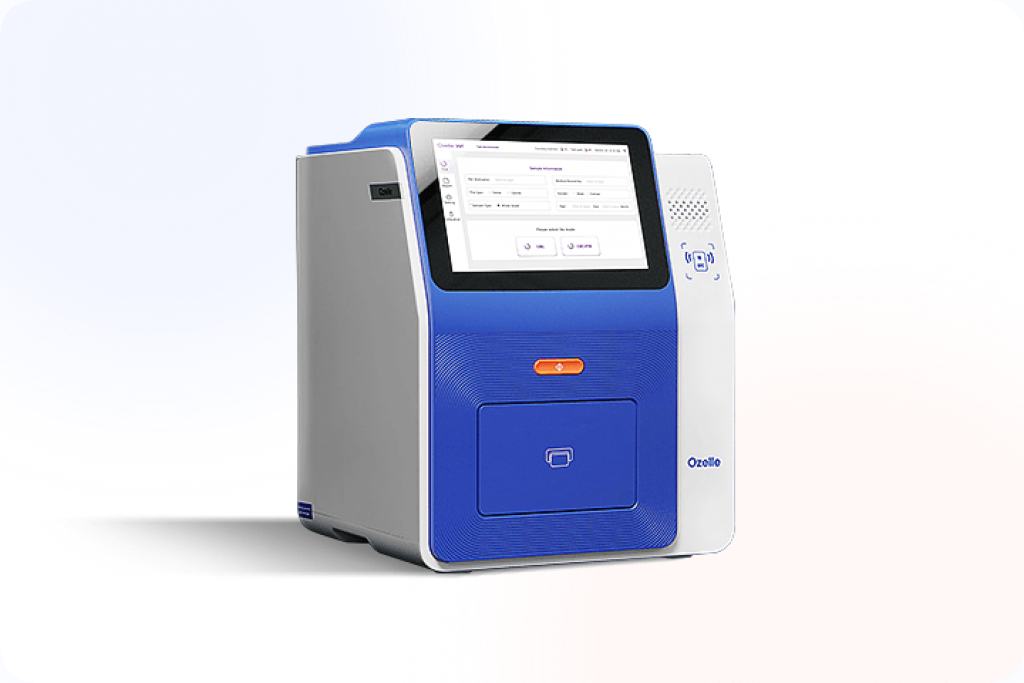
Ozelle’s EHVT‑50 is a multi-functional veterinary hematology analyzer engineered around AI-powered complete blood morphology and integrated multi-sample analysis. It offers 7-differential hematology with 42 parameters, plus urine, feces, and immunoassay testing, helping clinicians understand not only that a patient is anemic, but also why.
In emergency anemia, this matters because many dogs and cats present with overlapping problems such as hidden inflammation, low platelets, or concurrent infection. The EHVT‑50’s parameter set includes NST, NSG, NSH, RET and platelet indices, enabling detection of regenerative anemia, left shift, and true thrombocytopenia in a single run, which directly guides transfusion, immunosuppressive therapy, and antimicrobial decisions.
Integrated diagnostics for complex cases
Emergency cases rarely involve anemia alone, so the EHVT‑50 combines multiple diagnostic streams on one platform. While the 7-diff CBC clarifies anemia type and severity, the same device can simultaneously support:
- Urine formed-element analysis to identify hematuria, urinary tract bleeding, or renal involvement that may contribute to anemia or shock.
- Fecal analysis to detect parasite eggs, protozoa, and GI bleeding markers behind chronic or acute blood loss.
- Immunoassays such as cCRP, fSAA, cPL, fPL, SDMA, and infectious disease markers (FeLV Ag, FIV Ab, CPV Ag, CDV Ag, etc.) to assess inflammation, pancreatitis, kidney stress, and viral causes that complicate anemia.
For a collapsed dog with pale mucous membranes and melena, the clinic can run CBC, fecal and CRP/SAA on the EHVT‑50 without moving the patient, quickly confirming both the presence of severe anemia and a likely GI source with systemic inflammation. This level of integration compresses what used to require several devices and external labs into a single emergency workflow.
AI morphology and visual verification
Traditional analyzers provide only numbers and scatter plots, which can be difficult to interpret under emergency pressure. The EHVT‑50 instead uses high-precision optics and AI cell morphology trained on tens of millions of samples to capture and classify microscope-level images of blood cells.
When a result flags abnormal neutrophils or atypical lymphocytes, clinicians can immediately review actual cell images on the touchscreen rather than guessing from curves and dots. In emergency anemia, this helps differentiate straightforward regenerative blood loss from more sinister causes like sepsis, immune-mediated disease, or hematologic malignancy, even in clinics without on-site pathologists.
Designed for fast, low-volume, species-specific CBC
Speed and sample conservation are critical when dealing with shocked or tiny patients such as kittens and toy-breed dogs. The EHVT‑50 requires only about 100 µL of blood for hematology, supports capillary and venous sampling, and delivers CBC results in roughly 8–9 minutes with throughput up to 8 samples per hour.
The system is calibrated specifically for canine and feline blood, with algorithms tuned for veterinary cell sizes and reference ranges, which improves the reliability of anemia classification. Combined with LIS/USB connectivity and storage for large numbers of cases, clinics can trend serial CBCs in unstable anemic patients and document their response to transfusions or surgery.
FAQ: Vet Hematology Analyzer and Emergency Anemia
What is a vet hematology analyzer?
A vet hematology analyzer is a diagnostic device designed specifically for animal blood testing, typically providing automated CBCs, differentials, and cell morphology data tailored to veterinary species. Advanced systems can also integrate urine, fecal, and immunoassay testing to form a comprehensive diagnostic platform.
How fast can a vet hematology analyzer deliver results in an emergency?
Modern analyzers designed for clinics typically deliver CBC results in under 10 minutes, with sample processing times around 86–9 minutes for systems like the EHVT‑50. This is fast enough to influence real-time decisions such as whether to transfuse before or after imaging, or how aggressively to stabilize the patient.
Can a vet hematology analyzer tell me the cause of anemia?
The analyzer provides critical clues—such as red cell indices, reticulocyte counts, WBC differential, platelet counts, and sometimes abnormal cells or hemoparasites—that narrow down differential diagnoses. However, full diagnosis often requires integration with history, physical exam, imaging, and, when available, additional tests like biochemistry or specific infectious disease assays.
Is AI really useful for emergency anemia cases?
AI-powered morphology allows the analyzer to recognize subtle cellular changes that might otherwise require a pathologist’s expertise, such as shifts in neutrophil maturity or atypical cells. This is particularly valuable in emergencies or in clinics without on-site specialists, because high-quality morphology information becomes available during the initial stabilization period.
How much blood is needed for testing an anemic pet?
Sample volume depends on the device, but AI-powered systems like the EHVT‑50 require approximately 100 µL of blood for CBC testing, which is suitable for small and critically ill animals. This low volume reduces iatrogenic blood loss while still delivering a full panel of hematology parameters.
What other tests should I run alongside a CBC in emergency anemia?
Depending on the case, clinics often combine CBCs with urinalysis, fecal analysis, and specific immunoassays for inflammatory markers (such as CRP or SAA) or infectious diseases. Multi-functional analyzers that integrate these tests on one platform simplify the process, especially when staff and time are limited.
Raising the Standard of Emergency Care with Vet Hematology Analyzers
A vet hematology analyzer has become an essential partner for modern animal clinics, especially when facing life-threatening emergency anemia cases in dogs and cats. By delivering fast, lab-grade CBC results and integrating additional tests like urine, fecal, and immunoassays, systems such as the EHVT‑50 help veterinarians move from guesswork to data-driven decisions in just a few minutes. For any clinic that wants to stabilize critical patients more confidently, improve workflow, and raise the standard of care, investing in a dedicated vet hematology analyzer is no longer a luxury but a practical, everyday necessity. Learn more at https://ozellemed.com/en/.