
 Deutsch
  English
  Français
  Русский
  Español
  Português
  العربية
  Italiano
Einleitung: Die diagnostische Revolution im Gesundheitswesen der Gemeinschaft
Die Reise des Patienten: Ein Fall für den Wandel
Nehmen wir Maria, eine 42-jährige Lehrerin, die wegen anhaltender Müdigkeit und Kurzatmigkeit ihre örtliche Gemeindeklinik aufsucht. Im Rahmen des herkömmlichen Diagnosesystems wird ihr Blut abgenommen und in ein 40 Meilen entferntes regionales Krankenhauslabor gebracht. Sie wartet 48 Stunden auf die Ergebnisse, kehrt zu einem Folgetermin zurück und erhält die Diagnose einer schweren Eisenmangelanämie, die schon Tage zuvor hätte behandelt werden können. Während dieser kritischen Verzögerung verschlechtert sich ihr Zustand, so dass ein Notfalleinsatz erforderlich wird.
Stellen Sie sich nun ein anderes Szenario vor: Marias Probe wird in ihrer Klinik mit einem KI-gesteuerten vollständigen Blutbild und einem multifunktionalen Testgerät analysiert. Innerhalb von sechs Minuten erhält ihr medizinischer Betreuer umfassende Ergebnisse, die nicht nur einen niedrigen Hämoglobinwert, sondern auch eine detaillierte Morphologie der roten Blutkörperchen, Marker für den Eisenstoffwechsel und die Retikulozytenzahl zeigen - Informationen, die die sofortige Einleitung einer Behandlung ermöglichen. Maria verlässt die Klinik mit Medikamenten, Ernährungsempfehlungen und einem Nachsorgeplan, der noch am selben Tag erstellt wird.
Dieser Wandel von diagnostischer Verzögerung zu sofortiger Klarheit verdeutlicht, warum 70% der weltweiten Gesundheitsversorgung durch kommunale Kliniken erbracht werden, aber 40-50% der Krankheiten aufgrund diagnostischer Einschränkungen falsch oder zu spät erkannt werden. KI-gestützte CBC-Testgeräte gehen diese Krise direkt an.
Drei kritische Punkte in der traditionellen Gemeinschaftsdiagnostik

- Die Zugangslücke: Durchlaufzeiten führen zu Verzögerungen bei der Diagnose
Traditionelle Gemeinschaftskliniken sind mit einem Infrastrukturparadoxon konfrontiert. Die meisten verlassen sich auf manuelle Mikroskopie oder Stapelverarbeitung durch zentrale Labors. Die manuelle Analyse erfordert qualifizierte Techniker, dauert 2 bis 4 Stunden pro Probe und hängt ganz von der Erfahrung und Wachsamkeit der Techniker ab. Zentralisierte Laborsysteme führen zu Transportverzögerungen, die zu einer Verzögerung von 24 bis 48 Stunden führen, bevor die Ergebnisse vorliegen. Bei Krankheiten, die ein schnelles Eingreifen erfordern - Sepsis, akute Leukämie, schwere Infektionen - sind diese Verzögerungen katastrophal. Die Sterblichkeitsrate bei Sepsis steigt um 4-9% pro Stunde diagnostischer Verzögerung und macht aus einer behandelbaren Krankheit einen lebensbedrohlichen Notfall.
- Die wirtschaftliche Belastung: Kapital- und Betriebskosten schließen ressourcenbeschränkte Einstellungen aus
Herkömmliche Hämatologie-Analysatoren erfordern ein erhebliches finanzielles Engagement. Herkömmliche automatisierte Analysegeräte kosten $100.000-$150.000 für die Kapitalausstattung, wobei die jährlichen Betriebskosten zwischen $65.000-$133.000 liegen, so dass sich die Gesamtbetriebskosten für fünf Jahre auf etwa $475.000 belaufen. Die meisten kommunalen Kliniken arbeiten mit Jahresbudgets von $50.000-$300.000, so dass herkömmliche Analysegeräte für die Organisationen, die den bedürftigsten Bevölkerungsgruppen der Welt dienen, finanziell unerschwinglich sind.
Wartungsanforderungen erhöhen die Kosten. Herkömmliche Geräte erfordern spezielle Serviceverträge, regelmäßige Kalibrierungen, laufende Schulungen für Techniker und erhebliche Ausfallzeiten bei Reparaturen. Diese versteckten Kosten binden begrenzte Klinikressourcen, die stattdessen für die direkte Patientenversorgung eingesetzt werden könnten.
- Die Qualitätslücke: Begrenzte Parameter übersehen kritische Krankheitsmarker
Herkömmliche dreiteilige und fünfteilige Hämatologie-Analysegeräte bieten nur eine begrenzte Anzahl von Parametern (oft nur 3-5) und weisen Fehlerquoten von etwa 10-15% auf. Das Hauptproblem besteht darin, dass diese herkömmlichen Geräte unreife Zellen (Blasten), abnorme Morphologien oder spezielle Zellpopulationen, die auf eine schwere Krankheit hindeuten, nicht zuverlässig erkennen können. Infolgedessen können Kliniken Blasten, die auf eine akute Leukämie hindeuten, oder eine Linksverschiebung unreifer Neutrophiler, die auf eine schwere Sepsis hinweist, übersehen, was zu einer verzögerten Diagnose und potenziell irreversiblen Folgen führt.
Die Lösung: KI-gesteuerte CBC-Maschinen - eine grundlegend andere Technologie
KI-gestützte CBC-Testgeräte stellen eher einen Paradigmenwechsel als eine schrittweise Verbesserung dar. Diese Systeme kombinieren hochauflösende Bildgebung, fortschrittliche künstliche Intelligenz, die auf Millionen von klinischen Proben trainiert wurde, und vollautomatische Probenverarbeitung, um das zu leisten, was bisher in ressourcenbeschränkten Umgebungen unmöglich war: Geschwindigkeit + Genauigkeit + Erschwinglichkeit = Krankheitsfrüherkennung.
Im Gegensatz zu herkömmlichen automatisierten Analysegeräten, die Proben stapelweise verarbeiten und ständig gewartet werden müssen, liefern moderne KI-gesteuerte CBC-Geräte Ergebnisse in 6-8 Minuten, arbeiten wartungsfrei, funktionieren bei Raumtemperatur und liefern mehr als 37 diagnostische Parameter, einschließlich anspruchsvoller morphologischer Analysen. Sie verwandeln kommunale Kliniken in hochentwickelte Diagnosezentren, die in der Lage sind, schwere Erkrankungen zu erkennen, die von herkömmlichen Systemen systematisch übersehen werden.
Was dieser Artikel behandelt
Diese umfassende Analyse untersucht, warum Gemeinschaftskliniken weltweit KI-gesteuerte CBC-Testgeräte einführen. Wir untersuchen die diagnostische Krise, die den Wandel vorantreibt, erläutern die mehr als 10 Krankheiten, die jetzt durch fortschrittliche Blutanalysen nachweisbar sind, zeigen detailliert auf, wie KI-gestützte Technologie im Vergleich zu herkömmlichen Methoden bessere Ergebnisse erzielt, präsentieren Fallstudien aus der Praxis, die messbare Auswirkungen zeigen, und gehen auf die berechtigte Skepsis gegenüber der Einführung neuer diagnostischer Ansätze ein.
Die Krise der Diagnostik: Warum Veränderung dringend nötig ist
Aktueller Stand der Gemeinschaftsdiagnostik
Die meisten kommunalen Kliniken auf der ganzen Welt verfügen nicht über diagnostische Geräte oder sind auf veraltete Systeme angewiesen. Aufgrund der begrenzten Verfügbarkeit von Technikern und der hohen Betriebskosten sind die meisten Kliniken nicht in der Lage, manuelle Mikroskopie zu betreiben. Infolgedessen fehlt entweder die Vor-Ort-Diagnostik ganz oder es werden veraltete Analysegeräte mit begrenzten Parametern (3-5 Differenzialdiagnosen) verwendet, wodurch erhebliche diagnostische Lücken entstehen, die die Erkennung von Krankheiten verzögern und die Qualität der Patientenversorgung beeinträchtigen.
Wirtschaftliche Realität: Warum herkömmliche Analysegeräte in den meisten Kliniken versagen
Eine kommunale Klinik, die 50.000 Patienten versorgt, kann ein Analysegerät für $150.000 nicht finanzieren. In den meisten ressourcenbeschränkten Umgebungen gibt es einfach keine Budgets für Investitionsgüter. Neben der Erstinvestition erfordern herkömmliche Systeme jährliche Wartungsverträge ($15.000-$25.000), spezielle Technikerschulungen, den Kauf von Reagenzien und Qualitätskontrollmaterialien. Die kumulierten Kosten über fünf Jahre belaufen sich auf $475.000 - etwa das Zehnfache des jährlichen Betriebsbudgets einer typischen Gemeindeklinik in Entwicklungsregionen.
Dieses wirtschaftliche Hindernis bedeutet, dass sich die hochentwickelte Diagnostik nach wie vor auf wohlhabende Krankenhäuser konzentriert, während kommunale Kliniken, die benachteiligte Bevölkerungsgruppen versorgen, weiterhin auf veraltete manuelle Methoden zurückgreifen. Das Ergebnis ist eine systematische diagnostische Ungleichheit, bei der Patienten mit dem größten Bedarf die schlechteste diagnostische Versorgung erhalten.
Fragen zur Qualität und Genauigkeit
Selbst wenn herkömmliche Analysegeräte zur Verfügung stehen, haben sie Schwierigkeiten bei der Erkennung fortgeschrittener Krankheiten. Klassische fünfteilige Differentialdiagnosegeräte liefern nur grundlegende Zählungen (Neutrophile, Lymphozyten, Monozyten, Eosinophile, Basophile) ohne anspruchsvolle morphologische Analyse. Sie können unreife Granulozyten (Banden, Metamyelozyten, Myelozyten), die auf eine akute Infektion oder Knochenmarkbelastung hinweisen, nicht zuverlässig erkennen. Es fehlt die Messung der Retikulozyten, die für die Klassifizierung einer Anämie entscheidend ist. Sie können keine abnormalen Lymphozyten erkennen, die auf eine Virusinfektion oder Malignität hindeuten.
Diese diagnostische Blindheit bedeutet, dass häufige ernsthafte Erkrankungen am Ort der Behandlung nicht erkannt werden und zusätzliche Tests und Überweisungen an Spezialisten erforderlich sind, bevor die Diagnose gestellt werden kann.
Warum jetzt: Der Katalysator für den Wandel
Mehrere Faktoren kommen zusammen, um die Einführung von KI-gesteuerten CBC-Geräten voranzutreiben. Die Richtlinien der Weltgesundheitsorganisation für Point-of-Care-Tests aus dem Jahr 2023 betonen nun die Ausstattung von Kliniken der Primärversorgung mit hochentwickelten Diagnosen. Die KI-Morphologie-Technologie ist von der experimentellen zur klinisch validierten Technologie gereift, mit Genauigkeitsraten von über 97% im Vergleich zu erfahrenen Pathologen. Das Erbe der COVID-19-Pandemie hat den Schwerpunkt auf den Aufbau von Diagnosekapazitäten in unterversorgten Regionen gelegt. Besonders kritisch ist, dass der globale Fachkräftemangel - ca. 500.000 unbesetzte Laborstellen weltweit - die Abhängigkeit von Fachkräften untragbar macht. Vollautomatische, KI-gestützte Systeme beseitigen diese Abhängigkeit von Arbeitskräften vollständig.
10+ Krankheiten und Früherkennung: Klinischer Wert bei verschiedenen Erkrankungen
KI-gestützte CBC-Geräte erkennen Krankheitsmarker in einem bemerkenswert breiten klinischen Spektrum. Das Verständnis dieser Fähigkeiten verdeutlicht, warum Kliniken der Einführung Priorität einräumen.
| Krankheit/Zustand | Wichtige CBC-Marker | Erkennungszeit | Klinische Auswirkungen |
| Bakterielle Infektionen | Erhöhte Leukozytenzahl, Linksverschiebung (NST↑), toxisches Granulat | 6-10 Min. vs. 2-4 Std. | Bewertung des Schweregrads der Sepsis als Richtschnur für die Behandlung; frühzeitige Erkennung verringert die Sterblichkeit 40-50% |
| Virale Infektionen | Relative Lymphozytose, atypische Lymphozyten | 6-10 Minuten vs. 2-4 Stunden | Unterscheidet virale von bakteriellen Erregern; verhindert unnötige Antibiotika |
| Anämie (Eisenmangel, B12, hämolytisch) | Erythrozytenmorphologie, RDW, Retikulozytenzahl | 6-10 Minuten vs. 2-4 Stunden | Automatische Markierung von Anomalien; hohe Prävalenz in Entwicklungsregionen |
| Diabetes-Komplikationen | Erhöhte Leukozytenzahl, abnorme Erythrozyten-Indizes | 6-10 Minuten vs. 2-4 Stunden | Integriertes Blutbild + HbA1c + Glukose; verhindert 60-70% der Komplikationen |
| Leukämie und hämatologische Malignome | Abnormale Anzahl von Leukozyten, Blasten, Auer-Stäbchen | 6-10 Minuten vs. 2-4 Stunden | 98,2% Empfindlichkeit vs. 82% manuell; frühe Überweisung verbessert die 5-Jahres-Überlebensrate dramatisch |
| Thrombozytopenie/Thrombozytose | Thrombozytenzahl, Morphologie | 6-10 Minuten vs. 2-4 Stunden | Steuert die Antikoagulation; sagt das Blutungsrisiko voraus |
| Lymphozytose und Lymphome | Abnorme Lymphozyten, Lymphoblasten | 6-10 Minuten vs. 2-4 Stunden | Unterscheidet zwischen normal und atypisch; ermöglicht eine frühzeitige Überweisung |
| Autoimmunkrankheiten (SLE, RA) | Lymphopenie, Erythrozytenanomalien | 6-10 Minuten vs. 2-4 Stunden | Mustererkennung identifiziert Anomalien mehrerer Parameter |
| Schilddrüsenfunktionsstörung | Integriertes TSH, T3, T4 mit CBC | 6-10 Minuten vs. 2-4 Stunden | Ein-Röhrchen-Tests, die Hämatologie und Immunoassay kombinieren |
| Chronische Nierenerkrankung | Kreatinin, BUN, Harnsäure; Morphologie der roten Blutkörperchen | 6-10 Minuten vs. 2-4 Stunden | Frühzeitige Erkennung von CKD ermöglicht Intervention vor dem Fortschreiten |
| Risiko für Herz-Kreislauf-Erkrankungen | Erhöhung der Leukozyten (Entzündung), Lipidmarker | 6-10 Minuten vs. 2-4 Stunden | Identifizierung von Hochrisikopatienten für präventive Maßnahmen |
| Parasitäre Infektionen | Differenzialmuster der Leukozyten, Morphologie der Erythrozyten | 6-10 Minuten vs. 2-4 Stunden | Kritisch in endemischen Regionen; ermöglicht gezielte Behandlung |
Bewertung und Differenzierung von Infektionen
Bakterielle Infektionen führen zu charakteristischen Signaturen im Blutbild: erhöhte Gesamtzahl der Leukozyten, Neutrophilie und vor allem erhöhte unreife Neutrophilenformen - Bänder, Metamyelozyten, Myelozyten -, die zusammen als "Linksverschiebung" bezeichnet werden. KI-gestützte Systeme erkennen diese Muster automatisch mit 98%+ Genauigkeit innerhalb von Minuten. Diese Fähigkeit ist bei der Behandlung von Sepsis lebensrettend. Wenn ein Patient mit Fieber und Schock eingeliefert wird, lösen schnelle CBC-Ergebnisse, die den Schweregrad der Infektion bestätigen (ausgeprägte Linksverschiebung, toxische neutrophile Veränderungen, Monozytose), sofort Sepsis-Protokolle aus, die Breitbandantibiotika und unterstützende Maßnahmen umfassen - Maßnahmen, die die Sterblichkeit um 40-50% senken, wenn sie frühzeitig eingeleitet werden.
Virusinfektionen zeigen unterschiedliche CBC-Muster: relative Lymphozytose, atypische Lymphozyten mit unregelmäßigen Rändern und reichlich Zytoplasma, manchmal Monozytose. KI-Systeme unterscheiden diese viralen Muster von bakteriellen Signaturen und verhindern so eine unnötige Verschreibung von Antibiotika und leiten die unterstützende Pflege zur Behandlung von Virusinfektionen.
Anämie-Diagnose und morphologische Klassifizierung
Die KI-gestützte CBC-Analyse verändert die Bewertung der Anämie. Während herkömmliche Analysegeräte nur Hämoglobin und Hämatokrit liefern, liefern fortschrittliche Systeme umfassende Erythrozytenindizes, Retikulozytenzahlen (die auf eine Reaktion des Knochenmarks hindeuten) und die Morphologie der Erythrozyten, die hypochrome Zellen, die auf Eisenmangel hindeuten, makrozytäre Zellen, die auf B12-Mangel hindeuten, oder Schistozyten und Sphärozyten, die auf eine hämolytische Anämie hindeuten, anzeigen. Diese umfassende Bewertung ermöglicht eine spezifische Diagnose und gezielte Behandlung bei einem einzigen Klinikbesuch, wodurch Verzögerungen vermieden werden, die den Schweregrad der Anämie verschlimmern.
Frühzeitige Erkennung von Leukämie und hämatologischen Malignomen
Diese Anwendung zeigt den tiefgreifenden klinischen Wert der KI. Herkömmliche impedanzbasierte Analysegeräte können Blastzellen nicht von normalen Leukozyten unterscheiden - beide erzeugen ähnliche elektrische Signale. Die KI-gestützte morphologische Analyse identifiziert Blasten anhand charakteristischer Kern- und Zytoplasma-Merkmale: hohes Kern-zu-Zytoplasma-Verhältnis, feines Chromatinmuster, sichtbare Nukleoli, azurophile Granula.
Die klinischen Auswirkungen sind umwälzend. Bei einem Patienten, der mit Müdigkeit und Fieber vorstellig wird, wird im Blutbild ein WBC-Wert von 89.000/µl mit 58% unreifen Zellen festgestellt - ein Befund, der sofort auf eine akute Leukämie hindeutet. Herkömmliche Analysegeräte können zwar Anomalien aufzeigen, aber keine Blastzellen eindeutig identifizieren. KI-Systeme visualisieren tatsächliche Zellbilder, die eine unverwechselbare Blastenmorphologie zeigen und eine dringende Überweisung an die Hämatologie veranlassen. Eine frühzeitige Leukämiediagnose verbessert die Fünfjahresüberlebensrate bei akuter lymphatischer Leukämie dramatisch von 40% auf 85%+ und bei akuter myeloischer Leukämie von 30% auf 70%+.
Wie AI-gesteuerte CBC-Maschinen funktionieren: Erläuterung der Technologie und überlegene Leistung
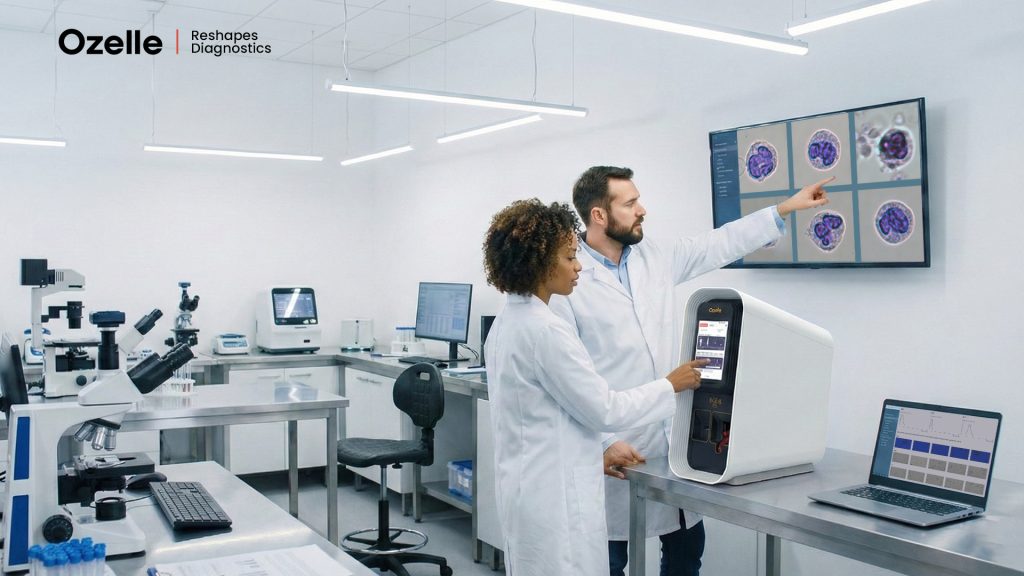
Traditionelle CBC-Analyse vs. KI-gestützter Ansatz
Das Verständnis des technologischen Fortschritts macht deutlich, warum KI-gestützte Systeme bessere Ergebnisse erzielen:
- Manuelle Mikroskopie (1850er Jahre bis heute): 30-120 Minuten, 75-85% Genauigkeit, technikerabhängig, begrenzte Parameter
- Traditionelle automatische Analysegeräte (1970 bis heute): 10-15 Minuten, 85-90% Genauigkeit, begrenzte Morphologie, voreingestellte Parameter
- KI-unterstützte vollständige Blutmorphologie (2017-aktuell): 6-8 Minuten, >95% Genauigkeit, umfassende Morphologie, 37+ Parameter mit automatischer Erkennung von Anomalien
Komponenten der Kerntechnologie
Die KI-gesteuerten CBC-Maschinen umfassen drei entscheidende technologische Elemente:
Hochauflösendes Bildgebungssystem
Die massgeschneiderten Objektive von Swiss Optics® mit einer Auflösung von 4 Megapixeln und 50 Bildern pro Sekunde liefern detaillierte Zellbilder mit einer Ölimmersionsauflösung, die bisher nur durch manuelle Mikroskopie erreicht werden konnte. Diese optische Raffinesse ermöglicht die Visualisierung subtiler zellulärer Merkmale: Kernmerkmale, zytoplasmatische Einschlüsse, Granulatverteilung, Membrananomalien.
AI-Klassifizierungsmaschine
Den analytischen Kern bilden Faltungsneuronale Netze (CNNs), die auf über 40 Millionen de-identifizierten klinischen Proben trainiert wurden. Dieser umfangreiche Trainingsdatensatz umfasst verschiedene Zellpopulationen, pathologische Varianten und morphologische Anomalien. Der aus diesem riesigen Datensatz gelernte KI-Algorithmus erkennt zelluläre Merkmale mit einer Präzision, die der von erfahrenen Pathologen entspricht, und erreicht bei der Zellklassifizierung eine Genauigkeit von >97% bei absoluter Konsistenz - derselbe Algorithmus liefert unabhängig von Tageszeit, Ermüdung des Bedieners oder Umgebungsbedingungen identische Ergebnisse.
Automatisierte Pipeline für morphologische Analysen
Vollautomatische mechanische Arme mit einer Positionierungsgenauigkeit von weniger als 1 Mikrometer gewährleisten eine Wiederholbarkeit, die mit manuellen Techniken nicht möglich ist. Das System verarbeitet Proben durch: automatisierte Probenfärbung mit reiner Flüssigphasen-Wright-Giemsa-Technologie, Hochgeschwindigkeits-Vollfeld-Scanning, das mehrere Fokusebenen erfasst, patentierte Z-Stapel-Technologie, die zelluläre 3D-Bilder erzeugt, multimodale mikroskopische Bildgebungswege, die sichtbare und multispektrale Bildgebung kombinieren, KI-gestützte CNN-Bildverbesserung, die superauflösende Bildgebung jenseits der Beugungsgrenzen ermöglicht.
Diese Integration führt zu einer umfassenden morphologischen Analyse, bei der mehr als 37 Parameter erfasst werden, darunter spezialisierte Populationen (unreife Granulozyten, Retikulozyten, abnorme Lymphozyten, Thrombozytenaggregate), die mit herkömmlichen Analysegeräten nicht identifiziert werden können.
Warum AI-Morphologie besser ist als herkömmliche Ansätze
Konsistenz: Der identische Algorithmus liefert identische Ergebnisse für jede Probe und eliminiert die menschliche Variabilität, die zu 10-20% Unstimmigkeiten zwischen menschlichen Mikroskopikern führt.
Schnelligkeit: Sechs Minuten von der Probe bis zum Bericht ermöglichen die klinische Entscheidungsfindung am Ort der Behandlung und ersetzen die 30- bis 60-minütigen Verzögerungen der zentralen Laborverarbeitung.
Objektivität: Durch die bildbasierte Analyse entfällt die subjektive Interpretation. Jede Zelle wird einheitlich nach denselben gelernten Standards bewertet.
Umfassend: Gleichzeitige Erkennung seltener Anomalien, die bei einer manuellen Überprüfung nicht immer gefunden werden können. Ein Techniker könnte Blastzellen mit geringer Häufigkeit übersehen; das KI-System erkennt sie zuverlässig.
Skalierbarkeit: Einzelne Geräte bedienen über Telehealth-Validierungsmodelle mehr als 10 Kliniken und ermöglichen eine zentrale Qualitätskontrolle bei gleichzeitiger Beibehaltung dezentraler Point-of-Care-Tests.
Validierung und klinische Sicherheit
Unabhängige Validierung bestätigt, dass KI-gestützte CBC-Systeme klinische Standards erfüllen. Die Geräte tragen die CE-Kennzeichnung gemäß der europäischen In-vitro-Diagnostik-Verordnung. Von Fachleuten begutachtete Veröffentlichungen zeigen eine Übereinstimmung von >95% mit der manuellen Goldstandard-Analyse. Der 510(k)-Pfad der FDA durchläuft derzeit das Genehmigungsverfahren. Klinische Validierungsstudien, in denen die automatisierte Analyse mit der von erfahrenen Pathologen verglichen wird, zeigen eine Leistung, die der menschlichen Expertise entspricht oder diese übertrifft.
Korrelationskoeffizienten in Laborqualität bestätigen die Genauigkeit bei verschiedenen Probentypen: WBC-Korrelation r² = 0,9962 (nahezu perfekt), RBC r² = 0,9787, Hämoglobin r² = 0,9867, Thrombozyten r² = 0,9834. Diese Werte übertreffen bei weitem die Akzeptanzkriterien für klinische Labortests und zeigen eine zuverlässige Genauigkeit über das gesamte pathologische Spektrum von schwerer Anämie bis zu extremer Leukozytose.
Praxisnahe Fallstudien: Messbare Auswirkungen in verschiedenen Bereichen des Gesundheitswesens
Fallstudie 1: Ländliche Gemeinschaftsklinik, Südostasien
Einstellung: 50-Betten-Klinik im ländlichen Thailand für 200.000 Einwohner ohne vorherige Diagnosemöglichkeiten
Herausforderung: Zuvor benötigten Patienten 48 Stunden für Bluttests durch Überweisung in ein Bezirkskrankenhaus; 40% der Patienten kamen nicht zu den Folgeterminen; Todesfälle durch vermeidbare Sepsis und behandelbare Infektionen traten aufgrund der verzögerten Diagnose auf
Lösung: EHBT-25 AI-gesteuertes CBC-Analysegerät installiert; zwei Pflegekräfte erhielten ein dreistündiges Schulungsprogramm
Ergebnisse:
- Erhöhung des Testvolumens von 0 auf 25 tägliche Tests
- Die Durchlaufzeit wurde von 48 Stunden auf 15 Minuten verkürzt.
- Die Nachverfolgungsrate der Patienten verbesserte sich von 40% auf 92% (Ergebnisse am selben Tag ermöglichen sofortige Behandlungseinleitung)
- Klinische Auswirkungen: Drei Sepsis-Todesfälle durch frühzeitige Erkennung und rasche Einleitung der antimikrobiellen Behandlung verhindert
- Finanzielle Auswirkungen: Kapitalinvestitionen werden in 4-5 Jahren durch Einnahmen aus Gebühren für Dienstleistungen amortisiert
Wichtige Erkenntnis: Der minimale Schulungsbedarf und der wartungsfreie Betrieb ermöglichten eine schnelle Implementierung in einem ressourcenbeschränkten Umfeld mit geringer technischer Infrastruktur. Die drastische Verbesserung der Nachuntersuchungsraten bei den Patienten zeigt eine tiefgreifende Verhaltensänderung, wenn die Diagnoseergebnisse sofort verfügbar sind.
Fallstudie 2: Städtische Privatklinik, Südasien
Einstellung: 30-Betten-Privatklinik in Bangalore konkurriert mit Krankenhausketten; kostenpflichtige diagnostische Dienstleistungen
Herausforderung: Langsame Ergebnisse (2-3 Tage) führten zu einem Verlust von Patienten an Krankenhauslabors, die eine schnellere Durchlaufzeit bieten.
Lösung: EHBT-50, ein umfassender Multifunktionsanalysator, wird installiert; Programm zur schnellen Implementierung
Ergebnisse:
- Erhöhung des Testvolumens von 15 auf 60 tägliche Tests (400% Erhöhung)
- Die monatlichen Diagnoseeinnahmen stiegen von $5.400 auf $14.400 (267% Anstieg)
- Die Bewertung der Patientenzufriedenheit verbesserte sich von 4,2/5 auf 4,8/5
- Positionierung im Wettbewerb: Anziehung von Patienten, die zuvor zu Krankenhausketten gingen
- Kapitalrückfluss: Investition in 3 Monaten durch erhöhtes Testvolumen amortisiert
- Ausweitung der Überweisungen: Verbesserte Reputation der Klinik, die neue Patienten für die Primärversorgung anzieht
Wichtige Erkenntnis: Selbst in Einrichtungen, in denen Gebühren erhoben werden, schaffen überlegene Geschwindigkeit und Genauigkeit einen Wettbewerbsvorteil, der innerhalb weniger Monate zu einem Umsatzwachstum führt, das die Investitionen in die Ausrüstung übersteigt. Die Verbesserung der Servicequalität verwandelt die Positionierung der Klinik von einer kostenbewussten Wahl zu einem bevorzugten Anbieter.
Fallstudie 3: NRO-gestütztes Netzwerk, Afrika südlich der Sahara
Einstellung: Netz von fünf Kliniken im ländlichen Malawi zur Versorgung von TB-/HIV-Patienten; von Gebern unterstützte kostenlose Dienste
Herausforderung: Begrenztes Budget; nicht in der Lage, routinemäßige TB/HIV-Überwachung durchzuführen; Ausfälle von Geräten führten zu Versorgungslücken; hohe Technikerfluktuation aufgrund begrenzter Ressourcen
Lösung: Zwei EHBT-25-Analysegeräte werden im Hub-Modell eingesetzt; Satellitenkliniken reichen Proben über einen mobilen Kurier ein; telemedizinische Validierung durch einen geschulten Supervisor vom zentralen Standort aus
Ergebnisse:
- Das monatliche Testvolumen stieg von 1.500 auf 4.000 Tests
- TB-Diagnose verbessert: 40 → 120 Fälle monatlich ermittelt (Verdreifachung)
- HIV-CD4-Screening ermöglicht: Zuvor nicht möglich; jetzt wird die Eignung für ART bei mehr als 200 Patienten monatlich geprüft
- Kosten pro Test durch zentralisiertes Hub-Modell um 60% gesunken
- Die Kosteneffizienz der Spender wurde drastisch verbessert
- Auswirkungen auf die öffentliche Gesundheit: Schnellere Fallfindung, die einen früheren Behandlungsbeginn ermöglicht; geringere Übertragung in der Gemeinschaft; bessere Behandlungsergebnisse
Wichtige Erkenntnis: Das Hub-and-Spoke-Modell ermöglicht es ressourcenbeschränkten Netzen, durch strategische Zentralisierung der Technologie mit verteilten klinischen Diensten eine anspruchsvolle Diagnostik zu erreichen. Durch die Validierung der Telemedizin wird die Qualität aufrechterhalten und gleichzeitig die Nutzung der Geräte optimiert.
Warum diese Fälle wichtig sind
Diese verschiedenen Fallstudien belegen die universelle Anwendbarkeit in städtischen und ländlichen Gebieten, bei privaten und öffentlichen Diensten sowie in Industrie- und Entwicklungsregionen. Alle zeigen eine rasche Amortisation (2-5 Jahre, selbst in ressourcenarmen Gebieten), messbare klinische Auswirkungen (gerettete Leben, Verhinderung des Krankheitsverlaufs, geringere Sterblichkeit) und betriebliche Nachhaltigkeit, wobei die Einnahmen aus den verbesserten Diagnosediensten den laufenden Betrieb unterstützen. Das übereinstimmende Muster in den verschiedenen Umgebungen zeigt, dass die Hindernisse für die Einführung nicht technischer oder fähigkeitsbezogener Natur sind, sondern eher organisatorischer und finanzieller Art - sobald die Geräte verfügbar sind und das Personal geschult ist, folgen eine schnelle Akzeptanz und positive Ergebnisse.
Der Skepsis begegnen: Allgemeine Bedenken über KI-Diagnostik zerstreuen
Einwand 1: "KI-gestützte Diagnostik ist zu komplex für unser Personal"
Die Realität: Die KI-gesteuerten CBC-Geräte von Ozelle erfordern nur drei Stunden Schulung des Pflegepersonals. Das System verfügt über grafische Tasten, eine automatische Kameraerkennung zur korrekten Platzierung der Verbrauchsmaterialien und eine Ein-Klick-Bedienung. Empirische Belege aus Fallstudien zeigen, dass das Pflegepersonal schnell die nötige Kompetenz erreicht. Es ist kein spezieller technischer Hintergrund erforderlich - Krankenschwestern, Gesundheitspersonal und geschultes Klinikpersonal bedienen diese Systeme weltweit erfolgreich.
Reaktionsstrategie: Der Schwerpunkt liegt auf dem minimalen Schulungsbedarf (3 Stunden im Vergleich zu Wochen für die Bedienung eines herkömmlichen Analysegeräts), der einfachen Bedienung (grafische Benutzeroberfläche, Testen mit nur einem Mausklick) und dem nachweislichen Erfolg der Implementierung bei unterschiedlichen Bildungshintergründen.
Einwand 2: "Wir können der KI nicht mehr vertrauen als erfahrenen Technikern".
Die Realität: KI, die anhand von mehr als 40 Millionen echten Proben trainiert wurde, liefert eine Genauigkeit von >95% im Vergleich zu einer Übereinstimmung von 70-85% zwischen menschlichen Beobachtern. Selbst erfahrene Techniker weisen bei der Überprüfung derselben Proben 10-20% Unstimmigkeiten auf. Die künstliche Intelligenz eliminiert menschliche Ermüdung, subjektive Interpretationen und die Varianz der individuellen Fähigkeiten - Faktoren, die zu menschlicher Variabilität führen. Das effektivste Modell nutzt die KI als Diagnoseassistent, nicht als Ersatz: Die KI zeigt Anomalien an, der Techniker prüft die Bilder zur Bestätigung, beide tragen zur endgültigen Diagnose bei.
Reaktionsstrategie: Bereitstellung von Validierungsdaten, die zeigen, dass die KI-Genauigkeit höher ist als die des Menschen, Erklärung der Variabilität zwischen den menschlichen Beobachtern, Vorschlag eines kollaborativen Diagnosemodells, bei dem die KI als Zweitmeinung und Entscheidungshilfe dient.
Einwand 3: "Die Integration mit Altsystemen ist zu kompliziert"
Die Realität: Moderne KI-gesteuerte CBC-Geräte unterstützen HL7/DICOM-Standards, die eine Integration mit Krankenhaus- und Laborinformationssystemen (LIS/HIS) ermöglichen. Die Anbieter bieten IT-Unterstützung, um die Integration zu erleichtern. In kleinen Kliniken arbeiten die Geräte eigenständig, wobei die manuelle Ergebniseingabe für den Klinikbetrieb akzeptabel ist. Die Komplexität der Integration ist mit Unterstützung des Anbieters überschaubar.
Reaktionsstrategie: Betonen Sie die Unterstützung der Anbieterintegration, heben Sie die Möglichkeit des eigenständigen Betriebs für kleinere Kliniken hervor und geben Sie Beispiele für erfolgreiche Integrationsimplementierungen.
Einwand 4: "Ergebnisse in 6 Minuten passen nicht zu unserem Stapelverarbeitungs-Workflow"
Die Realität: Während schnelle Ergebnisse zunächst unvereinbar mit Batch-Workflows zu sein scheinen, ermöglichen sie tatsächlich eine größere Workflow-Flexibilität. Kliniken können die Stapelverarbeitung fortsetzen, wenn sie dies bevorzugen, und erhalten gleichzeitig die Möglichkeit, in dringenden Fällen (Verdacht auf eine Infektion, mögliche Leukämie) schnell zu reagieren. Schnelle Ergebnisse ergänzen die Stapelverarbeitung, anstatt mit ihr in Konflikt zu geraten.
Reaktionsstrategie: Stellen Sie die Schnelligkeit als Verbesserung des Arbeitsablaufs dar, die eine flexible Bearbeitung ermöglicht, beschreiben Sie die Möglichkeit, dringende Fälle statistisch zu prüfen, und heben Sie die Möglichkeit hervor, bestehende Batch-Prozesse neben der neuen Schnelligkeit beizubehalten.
Einwand 5: "Reagenzienkosten sind versteckt; die Gesamtkosten können höher sein"
Die Realität: Transparente Preise pro Probe ermöglichen eine vorhersehbare Kostenmodellierung. Langfristige Verträge binden die Preise und verhindern überraschende Kosteneskalationen. Das wartungsfreie Design verhindert unerwartete Servicekosten, die bei herkömmlichen Geräten anfallen. Die Gesamtbetriebskosten sind über einen Zeitraum von fünf Jahren wesentlich niedriger als bei herkömmlichen Analysegeräten.
Reaktionsstrategie: Transparente Kostenberechnungen pro Probe, Fünf-Jahres-Vergleiche der Gesamtkosten, einschließlich der Wartungskosten, zeigen die Vorhersehbarkeit der Kosten auf und ermöglichen eine Budgetierung für Kliniken.
Einwand 6: "Wir haben bereits in aktuelle Ausrüstung investiert"
Die Realität: Versunkene Kosten sind zwar real, aber eine vorausschauende Bewertung der Technologie ist finanziell sinnvoll. Der parallele Betrieb ermöglicht einen schrittweisen Übergang - das neue KI-System wird während der Überschneidungsphase parallel zu den vorhandenen Geräten betrieben, und die älteren Geräte werden nach und nach außer Betrieb genommen, sobald sich das Personal daran gewöhnt hat. Dieser stufenweise Ansatz minimiert die Unterbrechungen.
Reaktionsstrategie: Erkennen Sie versunkene Kosten an, ohne sich darauf zu versteifen, fassen Sie die Entscheidung prospektiv auf und betonen Sie zukünftige Kosten und Vorteile, anstatt vergangene Investitionen zu berücksichtigen, schlagen Sie eine schrittweise Umsetzung vor, die einen allmählichen Übergang ermöglicht.
Schlussfolgerung: Globale Diagnostik im Wandel
Gemeinschaftskliniken auf der ganzen Welt stehen vor einer entscheidenden Entscheidung. Herkömmliche Diagnoseverfahren können den dringenden Bedarf nicht decken: Verzögerungen von 48 Stunden bei zeitkritischen Diagnosen, unerschwingliche Gerätekosten, die die meisten ressourcenbeschränkten Umgebungen ausschließen, begrenzte diagnostische Möglichkeiten, die schwerwiegende Erkrankungen übersehen, die mit herkömmlichen Systemen systematisch nicht erkannt werden.
KI-gesteuerte CBC-Testgeräte lösen diese Einschränkungen durch eine grundlegend überlegene Technologie: sechs Minuten Bearbeitungszeit ermöglichen eine Point-of-Care-Diagnostik, 37+ diagnostische Parameter bieten eine umfassende Krankheitsbeurteilung, eine Genauigkeit von >95%, die mit der von erfahrenen Pathologen übereinstimmt, erschwingliche Kapitalkosten, die einen weit verbreiteten Einsatz ermöglichen, und ein wartungsfreier Betrieb, der in ressourcenbeschränkten Umgebungen nachhaltig ist.
Die Beweise für die Durchführbarkeit und die klinische Wirksamkeit sind in verschiedenen praktischen Anwendungen erbracht worden. Ländliche Kliniken verhindern Sepsis-Todesfälle durch Früherkennung. Städtische Kliniken gewinnen Wettbewerbsvorteile durch überlegene Dienstleistungen. NRO-Netzwerke erzielen eine Wirkung im Bereich der öffentlichen Gesundheit, die mit begrenzten Ressourcen bisher nicht möglich war. Diese Ergebnisse sind nicht theoretisch, sondern stellen dokumentierte klinische Veränderungen bei tatsächlichen Patientengruppen dar.
Der Weg in die Zukunft ist klar. Gemeinschaftskliniken, die die KI-gestützte CBC-Technologie einsetzen, erhalten diagnostische Möglichkeiten, die bisher nur in teuren Zentrallabors verfügbar waren. Die Patienten erhalten eine frühere Diagnose, eine genauere Krankheitsklassifizierung und einen schnelleren Behandlungsbeginn. Gesundheitssysteme erzielen bessere Ergebnisse durch eine verbesserte Diagnostik am Ort der Behandlung.
Die diagnostische Revolution ist im Gange. KI-gesteuerte CBC-Testgeräte sind keine zukünftige Möglichkeit, sondern gegenwärtige Realität, die die Gesundheitsversorgung weltweit verändert.
Über Ozelle
Ozelle ist ein Anbieter digitaler Diagnoselösungen, der 2014 im Silicon Valley gegründet wurde und heute mit mehr als 50.000 installierten Geräten in verschiedenen Gesundheitseinrichtungen weltweit tätig ist. Das Unternehmen hat sich auf KI-gestützte Hämatologie-Analysegeräte spezialisiert, die modernste künstliche Intelligenz, Präzisionsoptik und vollautomatische Probenverarbeitung kombinieren. https://ozellemed.com/en/
Haftungsausschluss: Dieser Artikel dient zu Informationszwecken und stellt keine medizinische Beratung dar. Klinische Entscheidungen sollten in Absprache mit qualifiziertem medizinischem Fachpersonal getroffen werden. CBC-Testergebnisse sollten im klinischen Kontext von zugelassenen Ärzten interpretiert werden.