
 Deutsch
  English
  Français
  Русский
  Español
  Português
  العربية
  Italiano
When clinic and laboratory buyers evaluate a blood test analyser, the decision usually involves more than selecting a test menu or comparing an initial quotation. The analyser needs to fit the tests performed each day, the information required from each sample, the way staff manage the workflow, and the resources available to operate and support the system over time.
These considerations can be organised into four connected dimensions: testing requirements, operational parameters, long-term cost, and regulatory and after-sales support. Reviewing them together helps clinics, laboratories, distributors, and local partners identify an analyser configuration that fits both current services and practical operating conditions.
Testing Requirements
Routine CBC Requirements
Routine complete blood count (CBC) testing is central to many clinical hematology workflows. Automated hematology analyzers can generate quantitative blood-cell parameters, leukocyte differentials, calculated indices, and instrument-specific flags or graphical outputs.
The required reporting scope varies by facility. Some clinics primarily need routine CBC information, while laboratories may need more detailed differential results, defined review criteria, or morphology-related information. The appropriate reporting level depends on the testing services provided and the laboratory’s ability to review results consistently.
The analyser should reflect the work performed in the facility. In smaller in-house laboratories, this often means matching routine CBC needs with a workflow that remains practical for the available staff and daily sample volume.
Broader Testing Menus
Hematology may form part of a broader in-house testing service. General clinics, health-check centers, and small laboratories may organise CBC testing alongside immunoassay, dry chemistry, or other in-house diagnostic testing.
An integrated analyser can be relevant where the combined menu reflects routine clinical demand and can be managed within the same staffing, workspace, and quality-control framework. The value of a test menu depends on how closely it matches the facility’s routine testing demand, staffing model, and quality-control workflow.
Facilities with established specialist analyzers may use an additional system to complement existing testing activities. The relevant value lies in how it supports required test categories and coordinates routine laboratory tasks within the available workspace and staffing structure.
Diagnostic Assessment and Laboratory Review
Automated hematology results provide quantitative and cell-related information that contributes to diagnostic assessment when interpreted alongside sample quality, previous laboratory findings, other relevant tests, and clinical information.
Facilities using extended differential or morphology-related outputs benefit from defined procedures for instrument flags, repeat testing, additional review, and escalation. These arrangements can be incorporated into local SOPs, quality-management practices, and the laboratory team’s routine review process.
Before routine use, laboratories should also determine what verification or validation is required under local accreditation, quality-management, and regulatory requirements.
Operational Factors That Shape Daily Operations
CBC and Differential Outputs
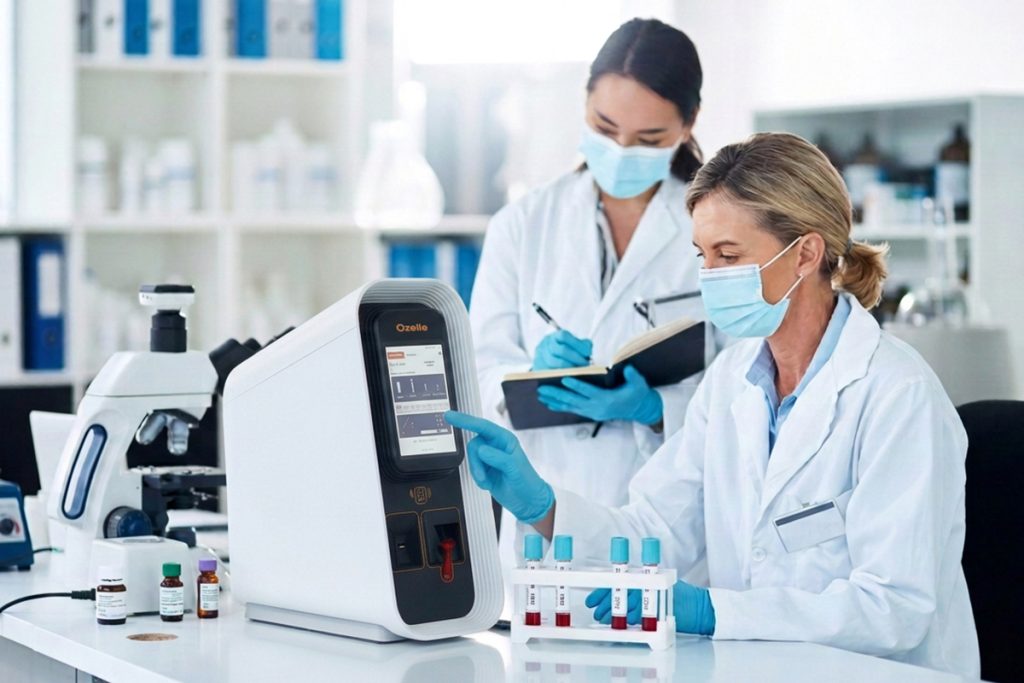
CBC parameters and differential capability should align with the information needed for routine testing and laboratory review. A more detailed leukocyte classification can add hematology information, but it also requires suitable review rules, staff training, and escalation procedures.
For a compact clinic laboratory, the focus may be routine CBC reporting within a manageable workflow. A hospital-based laboratory may require more detailed differential outputs and a structured process for reviewing flagged or unusual results. Both use cases call for different analyser configurations and support arrangements depending on its clinical services and review requirements.
Morphology-Related Information
Image-based or morphology-related outputs can add another information layer to automated hematology workflows. They can support a more structured review of cell-related findings alongside CBC results and instrument flags.
AI-assisted imaging and classification can make morphology-related information available within routine hematology workflows. This information can add visual context for laboratory review and subsequent clinical correlation.
Sample Type and Volume
Accepted sample types, required sample volume, and handling steps affect collection, labelling, mixing, loading, and repeat testing. A blood test analyser should fit the facility’s normal collection practice and pre-analytical process.
For clinics with limited laboratory staffing, handling requirements can have a direct effect on daily usability. If the collection process requires additional manual steps or does not align with normal sample flow, the analyser may create avoidable pressure during busy periods.
Laboratories also need to consider compatibility with existing tube types, sample tracking rules, rejection criteria, and repeat-testing procedures. Sample-volume requirements should be considered together with collection conditions, rather than as an isolated product specification.
Workload and Throughput
Throughput should be assessed against workload patterns rather than average daily volume alone. Morning collections, health-check batches, repeat tests, QC procedures, and review of flagged samples can all create short-term peaks.
Compact analyzers may suit moderate in-house workloads where staff need a manageable routine process. Laboratories with larger CBC volumes may need scalable automation, automated loading, or expanded capacity to maintain smooth operation during peak demand.
The relevant measure is not simply how many tests an analyser can process in one hour. It is whether the full process—including loading, QC, retesting, review, and result release—can support the laboratory’s actual workload pattern.
| Parameter area | What it means in practice | Why it matters for selection |
| CBC reporting | Defines the quantitative hematology information available for routine testing | Reported results should align with the facility’s service scope and review process |
| Differential capability | Determines the level of WBC classification | More detailed outputs require suitable SOPs, training, and result-review capacity |
| Morphology-related information | Adds image-based or morphology-related context where supported | Findings can be integrated into review, escalation, and further-assessment procedures |
| Musteranforderungen | Covers sample type, volume, and handling steps | These factors affect collection, pre-analytical handling, and repeat testing |
| Durchsatz | Indicates potential processing capacity | It should be evaluated against routine volume, peak demand, QC, reruns, and staffing |
| Data management | Covers result transfer, storage, and traceability | Data processes must fit local laboratory and information-system requirements |
Price and Long-Term Operating Costs
Purchase Price and Operating Costs
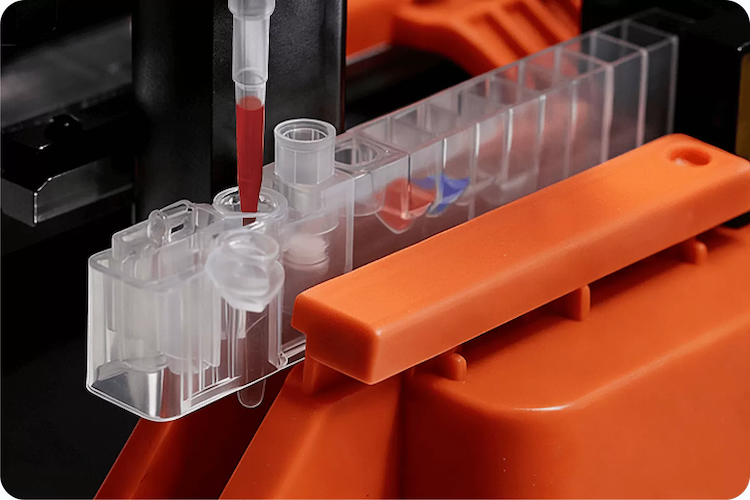
The purchase price is only one part of the financial evaluation of a blood test analyser. Reagents, consumables, quality-control materials, maintenance, training, and technical service all contribute to long-term operating costs.
Together, these elements contribute to the total cost of ownership (TCO), which extends beyond the initial purchase price to include implementation, consumables and QC, maintenance, technical service, routine operating requirements, and the cost of maintaining testing continuity over the analyser’s expected period of use.
These costs vary by testing volume, reagent configuration, local supply arrangements, and service model. A meaningful budget assessment considers the complete operating environment rather than the instrument quote alone.
The analysis should also account for operational conditions that may not appear in an initial quotation. These can include consumable storage, staff time, routine maintenance responsibilities, operator training, software support, and arrangements for continued testing if an instrument is temporarily unavailable.
Test Volume and Consumable Planning
Consumable planning should reflect expected test volume and the way samples arrive during the day. Low-volume clinics may place particular emphasis on reagent storage, inventory control, and reducing avoidable waste.
Laboratories with larger workloads may focus more on supply continuity, QC scheduling, maintenance windows, and backup arrangements. These considerations influence both routine cost control and service continuity.
Test volume also affects the practical value of an analyser’s functions. A broad test menu may be appropriate if each channel is used regularly. Where usage is occasional or unpredictable, facilities need to assess how consumables, staff training, and workflow complexity will be managed over time.
The Value of Workflow Fit
The most appropriate analyser is not defined by its initial price or the number of available functions.Its suitability depends on how well its testing capacity, workflow, consumables, and support requirements fit day-to-day operations.
An analyser that matches actual demand can support more predictable planning for staffing, reagent use, quality procedures, and service coverage. This approach also helps distributors and local partners develop proposals that reflect the customer’s operating environment rather than focusing only on device specifications.
Regulatory Readiness, After-Sales Support and Service Continuity
Local Authorization and Regulatory Readiness
Regulatory readiness is an essential part of evaluating a blood test analyser for a specific market. Before procurement or installation, the organisation should confirm whether the analyser is appropriately registered, authorised, or otherwise permitted for the intended use in the relevant country or region.
Commercial and operational responsibilities should also be clear. This includes identifying the manufacturer-authorized distributor or local commercial channel where applicable, the party responsible for registration or market-access documentation, and the organisation responsible for installation, training, technical service, and post-market support.
For distributors and local partners, regulatory capability is closely connected to service capability. A complete market-entry and support arrangement should define how product documentation, local compliance requirements, user training, consumable supply, complaint handling, and service escalation will be managed throughout the product lifecycle. Buyers should also confirm that the specific analyzer configuration, test menu, software functions, and consumables proposed for the project are locally registered or commercially available where required.
Installation, Training and QC
Simplified operation does not remove the need for installation planning, staff training, SOPs, and quality-control procedures. Operators need to understand sample handling, routine operation, result review, consumable management, and the limits of on-site troubleshooting.
Training should cover the QC procedures applicable to the system, including routine QC operation, interpretation of QC results, documentation, and escalation when predefined acceptance criteria are not met. Technical support should complement—not replace—the laboratory’s own quality-management responsibilities. External quality assessment or proficiency-testing requirements should also be considered where applicable
Technical Service and Local Support
After-sales support includes installation assistance, routine technical guidance, issue-escalation routes, replacement-part planning, and software support where applicable. The availability of these services depends on the local market, distributor arrangement, and formal service terms.
For distributors and local partners, application knowledge is as important as product knowledge. They need to understand how an analyser fits into sample handling, QC, routine operation, and laboratory review so that they can support customers beyond the initial installation.
Facilities should assess whether local service arrangements align with their operating hours, geographic location, expected sample volume, and internal technical resources. Response times, parts availability, and service coverage should be confirmed through the applicable distributor arrangement and formal agreement.
Reagent Supply and Data Implementation
Reliable access to reagents, consumables, and quality-control materials is part of service continuity. Storage conditions, ordering cycles, supply routes, and the operational impact of potential delays should be considered alongside the analyser itself.
Data connectivity also needs to be defined during implementation. Result fields, sample or patient identification, traceability, interface deployment, and local IT responsibilities should be confirmed according to the analyser configuration and the facility’s own information-system environment.
LIS connectivity can be evaluated according to the analyser configuration, local information systems, required data structure, and available technical resources for implementation.
Matching Ozelle Analysers to Different Laboratory Needs
Different clinics and laboratories place different weight on testing scope, reporting detail, daily workload, budget planning, regulatory readiness, and service requirements. The examples below highlight three Ozelle analyzer configurations relevant to different clinic and laboratory workflows.
EHBT-50, EHBT-75, and O-Cyte 1 differ in their testing integration, hematology workflow, automation level, and capacity. Together, they provide options for facilities evaluating the required test menu, operational parameters, long-term operating model, regulatory readiness, and available support arrangements.
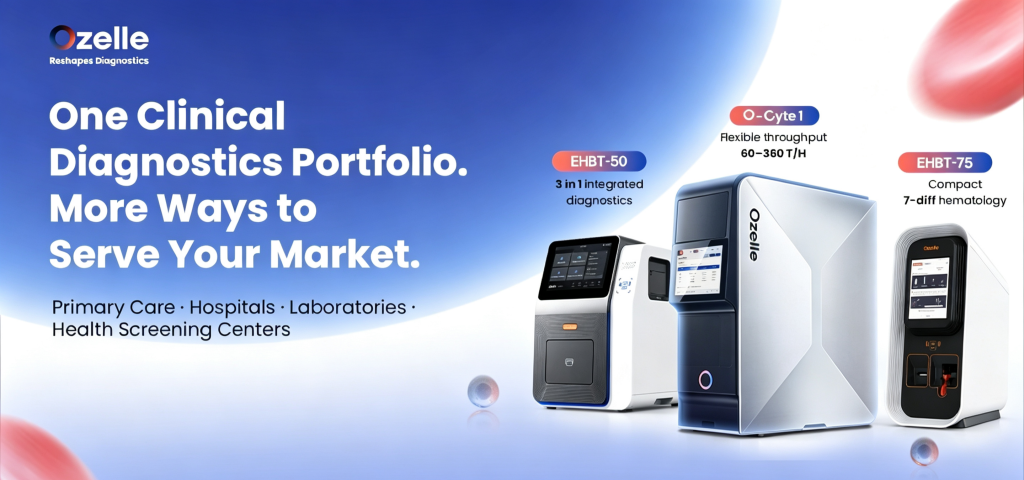
EHBT-50 for Integrated Mini-Lab Testing
Die EHBT-50 multi-functional analyser combines 7-part CBC with Complete Blood Morphology (CBM), immunoassay, and dry chemistry in a compact small-laboratory analyzer. This configuration supports facilities that want to coordinate selected hematology, immunoassay, and biochemistry tests within one in-house workflow.
For hematology testing, EHBT-50 provides 42 reportable parameters, including NST, NSG, NSH, NLR, PLR, ALY, PAg, and RET. It supports a whole-blood sample-volume range of 30–100 μL, allowing facilities to align sample collection and handling requirements with their routine workflow.
EHBT-50 is relevant where the combined testing menu matches routine demand. Its operating model can be considered through the expected use of each testing channel, consumable planning, quality-control procedures, staff training, and available local support.
EHBT-75 for Compact 7-Part Hematology and Morphology Support
Die EHBT-75 hematology analyser is designed for compact 7-part hematology workflows that incorporate morphology-related information. Its process combines liquid-based staining, image-based detection, high-resolution imaging, and AI-assisted cell classification.
EHBT-75 provides 37 hematology parameters, including NST, NSG, NSH, ALY, PAg, and RET-related outputs. These results add cell-related information to routine hematology testing and support structured laboratory review of extended CBC outputs.
With a throughput of 10 samples per hour, EHBT-75 fits laboratories assessing compact in-house hematology workflows rather than high-throughput central-laboratory operation. Its compact footprint and room-temperature reagent storage support routine planning around bench space, reagent handling, and daily laboratory logistics.
O-Cyte 1 for Scalable Automated Hematology Workflows
Die O-Cyte 1 automated hematology analyser supports laboratories that need greater automation and capacity for routine CBC testing. It combines 7-diff CBC with AI-assisted, image-backed morphology information, linking morphology-related findings with corresponding cell images for laboratory review.
As a standalone analyzer, O-Cyte 1 supports up to 60 tests per hour. In a six-analyser cascade configuration, capacity can expand to up to 360 tests per hour. Auto Loader Mode supports standalone workflows, while automated loading and unloading modules with a centralised operation console support unified operation across a cascaded configuration.
O-Cyte 1 supports whole blood, capillary blood, and predilution modes. Whole-blood and capillary-blood testing use 80 μL samples. These conditions can be assessed together with the laboratory’s collection practice, pre-analytical workflow, rack-loading process, and approach to urgent samples.
| Modell | Primary workflow fit | Key selection reason |
| EHBT-50 | Integrated in-house mini lab | 7-diff hematology + immunoassay + dry biochemistry |
| EHBT-75 | Dedicated compact hematology | 7-diff + image-based morphology, 10 samples/h |
| O-Cyte 1 | Automated scalable hematology | 60 T/H standalone, up to 360 T/H cascaded |
Conclusion: Turn Selection Criteria Into a Practical Plan
Choosing a blood test analyser is most effective when technical capabilities are assessed together with the conditions required for routine operation. A clear view of testing requirements, workflow parameters, operating cost, regulatory readiness, and service support makes it easier to compare configurations on a consistent basis.
Ozelle supports clinics, laboratories, distributors, and local partners in evaluating hematology workflows that align with their application needs and operating plans. To discuss product configuration, local availability, regulatory documentation, or distribution opportunities, Kontakt zu Ozelle or email info@ozellepoct.com.