
 Deutsch
  English
  Français
  Русский
  Español
  Português
  العربية
  Italiano
Why Animal Clinics Are Upgrading Their Hematology Analyzers
Animal clinics and veterinary hospitals are dealing with increasingly complex cases, rising client expectations, and pressure to deliver fast, accurate diagnostics for dogs and cats. Common presentations such as vomiting, diarrhea, lethargy, weight loss, and urinary problems all require timely laboratory data to guide decisions, but sending samples to external labs often delays treatment and can reduce owner compliance.
Traditional animal hematology analyzers focus mainly on complete blood count (CBC), leaving urine sediment, fecal parasites, and infectious disease testing to separate devices or manual methods. This segmented approach adds cost, consumes bench space, and complicates training and maintenance for veterinary staff.
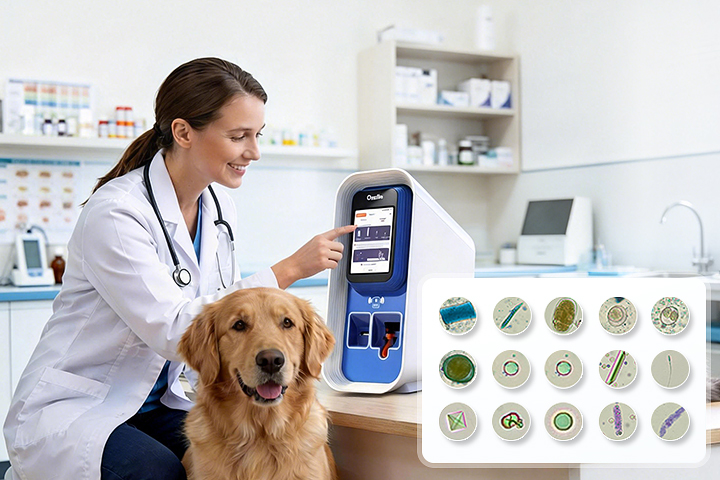
Die EHVT‑50 from Ozelle addresses these challenges by acting as an AI‑powered veterinary mini lab, integrating 7‑diff hematology, urine sediment microscopy, fecal microscopy, and veterinary immunoassay testing on one platform. Clinics can see where this device sits in the overall portfolio on Ozelle’s AI veterinary diagnostics page, which introduces the EHVT series for animal care.
What Makes an Animal Hematology Analyzer “Multi‑Functional”
Ein modernes animal hematology analyzer is no longer limited to counting blood cells; it increasingly functions as a compact lab station for multiparametric diagnostics in veterinary patients. The EHVT‑50 is explicitly positioned as a Multi‑Functional Analyzer for Vet, integrating four key modules:
- 7‑diff hematology with Complete Blood Morphology (CBM) for dogs and cats.
- Automated urine sediment analysis based on cell morphology and particle recognition.
- Stuhlmikroskopie for parasite eggs, protozoa, microbiota patterns, and digestive residues.
- Veterinary immunoassays for inflammation, pancreatitis, kidney function, hormones, cardiac markers, and infectious disease antigen/antibody testing.
This all‑in‑one concept allows clinics to run CBC, urinalysis, fecal analysis, and targeted rapid tests from a single analyzer rather than relying on multiple separate instruments.
Inside the EHVT‑50: Hematology, Urine, Feces, and Immunoassay in One Device
7‑Diff Hematology With AI‑Based Complete Blood Morphology (CBM)
The EHVT‑50’s hematology module is based on AI cell morphology and CBM, similar in principle to Ozelle’s human analyzers but optimized for veterinary use. According to the product data, the CBM channel offers about 38–42 hematology parameters for canine and feline patients, including:
- WBC and differential:
- Total WBC
- NEU, LYM, MON, EOS, BAS
- 7‑part differential with subpopulations such as NST (stab neutrophils), NSG (segmented neutrophils), NSH (hypersegmented neutrophils), and abnormal lymphocytes.
- RBC and indices:
- RBC, HGB, HCT
- MCV, MCH, MCHC
- RDW‑CV, RDW‑SD, HDW‑CV, HDW‑SD for anisocytosis and hemoglobin distribution.
- Reticulocytes and special RBC forms:
- RET#, RET%
- Spherocytes (SPH#, SPH%), ETG#/ETG% and other morphological categories that inform anemia workup.
- Platelets and indices:
- PLT, MPV, PDW, PCT
- APLT#, P‑LCC, P‑LCR for platelet size distribution and large platelet counts.
The CBM engine is backed by AI trained on a large database of real veterinary blood cell images, and the system can display visual cell images alongside numerical results for review by veterinarians.
Automated Urine Sediment Analysi
EHVT‑50 includes a dedicated urine analysis channel that identifies formed elements and particles in veterinary urine samples. The urine module covers roughly 29 parameters, organized into categories such as:
- Casts: Hyaline (HYA), cellular casts, granular casts, waxy casts (RBC‑C, LC, RTC, GRA, WAC, FC, BC).
- Cells: Red blood cells, white blood cells, renal tubular epithelial cells, squamous and transitional epithelial cells (RBC#, WBC#, RTE#, SEC#, TEC#, SPE#).
- Crystals: Magnesium ammonium phosphate (MAP), calcium oxalate monohydrate and dihydrate (COMC, COD), calcium phosphate, uric acid, cystine crystals and others (CP, UAC, CYSC, CC, BilC, AUC).
- Microorganisms: Various bacteria and yeast forms (COS#, BAC#, SAC#, FUN#).
- Other urine elements: Fat droplets and mucus (FAT#, PHL#).
This capability allows veterinary teams to evaluate urinary tract infections, crystalluria, and renal conditions quickly, without needing a separate microscope workflow for each sample.
Fecal Microscopy for Parasites, Protozoa, and Digestive Health
EHVT‑50 also offers an automated fecal analysis channel that can assess parasite eggs, protozoa, bacterial forms, and digestive residues in animal stool samples. The fecal module also lists roughly 29 parameters, covering:
- Parasite eggs: ALE, ANE, CEE, DIP, SPI, TtE, TRE, corresponding to different nematodes, cestodes, and trematodes.
- Intestinal protozoa: TRI, FLA, COD, COD0, COD1, COD2, Tg, representing various protozoal forms and stages.
- Microorganisms: COS, BACI, C/B, CAM, BAC, SS1, SS2, YEA for different bacterial morphologies and yeast.
- Cells and residues: RBC#, WBC#, EPC#, plus markers for starch granules, lipids, plant fiber, and muscle fiber (STA#, LFAT#, PLA#, AF#).
This multi‑parameter fecal analysis is particularly valuable in animals presenting with chronic diarrhea, weight loss, or suspected parasitic infections.
Veterinary Immunoassays for Systemic and Organ‑Specific Diseases
The EHVT‑50 integrates an immunofluorescence immunoassay module tailored for veterinary medicine. The immunoassay menu covers several key categories:
- Inflammation: cCRP, fSAA, AGP.
- Pancreatitis: cPL, fPL for canine and feline pancreatic disease.
- Kidney disease: cSDMA, fSDMA, cCys‑C, fCys‑C.
- Hormones: Cortisol, T4, HbA1c, TSH, cProg, LH.
- Cardiac markers: cTnI, NT‑proBNP.
- Infectious disease tests: FeLV Ag, FIV Ab, FCoV Ag, FPV Ag, CCV Ag, CPV Ag, CDV Ag, Giardia Ag, HW Ag, E.canis Ab, Anaplasma Ab, Lyme Ab, feline toxoplasma Ab, CIV Ag, Leptospira Ag.
- Antibody titers: CPV Ab, CDV Ab, FHV Ab, FCV Ab, FPV Ab, RV Ab, ICH Ab, CAV Ab (under the “immuno function antibody titer” group).
This panel enables clinics to run in‑house tests for systemic inflammation, organ function, and infectious diseases commonly seen in dogs and cats, directly on the same platform used for hematology, urine, and fecal analysis. More menu details can be found on the EHVT‑50 veterinary mini lab page.
Technical Specifications That Matter in Animal Clinics
The EHVT‑50 is designed for veterinary practice environments, not as a modified human analyzer. Key specifications relevant to daily use include:
- Species: Currently supports canine and feline, with options to extend to more species.
- Sample types: Blood, urine, feces.
- Sample volume: Around 55 μL for CBC, and approximately 200 μL for urine and feces modules.
- Throughput: Approximately 5–8 samples per hour, depending on workflow and test combinations.
- Storage: Capacity for up to around 10,000 results, helpful for record‑keeping and follow‑up.
- Display and control: 10.1‑inch full‑color touchscreen with an intuitive user interface.
- Connectivity: LIS, USB, and LAN connectivity, plus built‑in and external printer support.
- Dimensions and weight: Around 350–400 × 400 × 450 mm and about 15 kg, suitable for most veterinary lab benches.
Veterinary hospitals and clinics can review the full technical specification sheet on the official EHVT-50 Produktseite when planning installation and integration with existing systems.
Maintenance‑Free Design and Cost of Ownership
For many veterinary practices, the decision to adopt an animal hematology analyzer depends not only on analytical performance but also on day‑to‑day maintenance and lifecycle costs. EHVT‑50 is structured around a maintenance‑free, tubeless design to address these concerns.
Single‑Use Kits and Closed Wet‑Staining Technology
The system uses single‑use wet‑staining kits and individual test kits for hematology, urine, feces, and immunoassay, which prevents cross‑contamination and reduces bio‑hazard exposure. Reagents and sample preparation occur inside sealed cartridges, and waste is collected internally, improving biosafety and simplifying disposal.
Tubeless, No‑Maintenance Architecture
EHVT‑50 employs a tubeless architecture with no internal liquid pipelines, which means there are no hoses to flush and no rinse cycles that consume technician time. This design minimizes the risk of clogs and leaks, supporting reliable operation in busy or resource‑limited veterinary settings.
One‑Button Workflow and Minimal Training
From a workflow perspective, the analyzer supports one‑button automated testing, with an automated mechanical arm, high‑speed imaging, and AI analysis that handle the full process from sample loading to report. Veterinary staff follow guided on‑screen instructions for placing individual kits and sample cups, and the device takes over staining, scanning, recognition, and result compilation. This reduces training requirements and helps clinics maintain performance even when staff turnover is high.
Clinical Scenarios: How EHVT‑50 Supports Everyday Animal Patients
Vomiting, Diarrhea, and GI Cases
For dogs and cats presenting with vomiting, diarrhea, or weight loss, EHVT‑50 allows veterinarians to run:
- CBC with 7‑diff and morphology to assess systemic inflammation, anemia, or infection.
- Fecal analysis with parasite egg counts, protozoa detection, and microbiota pattern recognition.
- Immunoassays for infectious diseases such as FPV Ag, CPV Ag, CDV Ag, CCV Ag, Giardia Ag, and others, depending on regional disease profiles.
This combination provides a deeper picture of GI disease in a single visit and reduces dependence on external labs for routine parasite and infection workups.
Urinary Issues and Renal Disease
In cases of dysuria, hematuria, or suspected renal disease, the analyzer can be used to perform:
- CBC for systemic evaluation and signs of infection or inflammation.
- Urine sediment microscopy for casts, crystals, bacteria, and epithelial cells.
- Renal immunoassays such as cSDMA, fSDMA, cCys‑C, and fCys‑C for earlier detection of kidney dysfunction.
This helps veterinarians detect renal disease earlier and differentiate between lower urinary tract disease and systemic nephropathy.
Emergency and Critical Care
For emergency anemia, shock, or respiratory cases, EHVT‑50 can deliver rapid CBC, reticulocyte data, and cardiac markers such as cTnI and NT‑proBNP. Combined with quick urine or fecal tests when needed, the analyzer helps emergency teams triage animals and monitor response to treatment within the clinic. The use cases and emergency workflow examples are discussed in Ozelle’s dedicated veterinary CBC and EHVT‑50 articles.
How EHVT‑50 Compares to Single‑Function Animal Hematology Analyzers
The table below outlines how an integrated system like EHVT‑50 differs from traditional standalone animal hematology analyzers and manual microscopy setups.
| Aspekt | Traditional animal hematology analyzer | EHVT‑50 veterinary mini lab |
| Test scope | CBC only, limited parameters and no integrated urinalysis or fecal testing | 7‑diff CBC with ~42 parameters plus urine, feces, and veterinary immunoassay testing in one device |
| Morphology insight | Numeric results only, manual smear required for morphology | AI‑based CBM with cell images for RBC, WBC, PLT and abnormal forms |
| Additional tests | Separate devices or send‑out for parasites, protozoa, and rapid tests | Automated fecal and urine microscopy plus broad veterinary immunoassay menu |
| Wartung | Fluidic maintenance, manual cleaning and calibration cycles | Tubeless, maintenance‑free design with single‑use kits |
| Workflow | Multiple instruments, manual microscopy, longer turnaround | All‑in‑one automated workflow with one interface |
For clinics that want to move toward an integrated animal hematology analyzer with broader diagnostic coverage, EHVT‑50 is positioned as a veterinary‑specific AI mini lab rather than a simple CBC device.
Conlusion: When EHVT‑50 Is the Right Animal Hematology Analyzer for Your Clinic
Choosing an animal hematology analyzer is now less about basic CBC counts and more about how well the device supports real‑world veterinary workflows. The EHVT-50 Multifunktions-Analysator für Tierärzte integrates 7‑diff hematology, urine, feces, and veterinary immunoassay testing into a compact, maintenance‑free platform designed specifically for dogs and cats.
Its AI‑driven CBM, automated microscopy for urine and feces, and comprehensive immunoassay menu help animal clinics move diagnostics closer to the point of care, reduce reliance on external laboratories, and improve decision‑making in both routine and emergency cases. Veterinary professionals who want to evaluate this type of equipment in detail can review Ozelle’s EHVT-50 Produktseite and the broader AI veterinary diagnostics overview to determine how this veterinary mini lab fits their clinical and operational needs.