
 Deutsch
  English
  Français
  Русский
  Español
  Português
  العربية
  Italiano
For patients living with diabetes, every follow-up appointment carries a long list of required tests: a complete blood count (CBC) to check for anemia or infection, HbA1c to track glycemic control, fasting glucose, and a renal panel to watch for early signs of diabetic nephropathy. Traditionally, these tests involve multiple requisition forms, separate laboratory visits, and days of waiting — a process that exhausts patients, burdens clinic workflows, and quietly erodes adherence over time.
The answer to the question above is yes. A new generation of multi-functional hemo analyzers, led by the Ozelle EHBT-50, can consolidate all of these critical panels into a single point-of-care session, delivering results in 65-10 minutes from a small capillary blood sample.
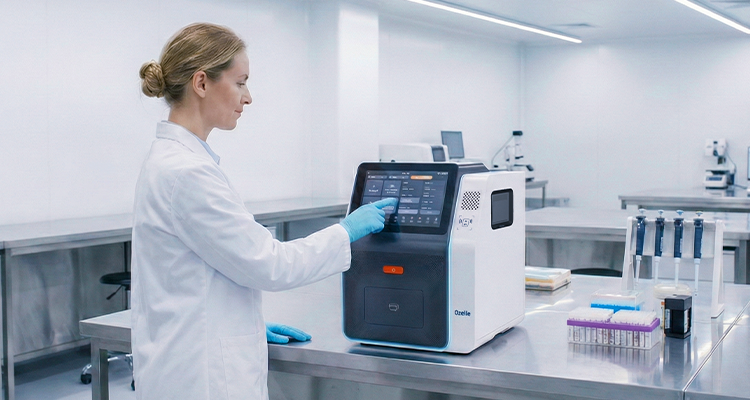
The Problem With Fragmented Diabetic Testing
Chronic disease management for diabetic patients relies on the timely and consistent interpretation of several interconnected biomarkers. When those biomarkers are scattered across different laboratories, different appointments, and different billing events, the entire picture becomes fragmented. A physician reviewing an HbA1c result from last Tuesday and a renal panel from three weeks ago is not managing the patient’s current health — they are stitching together a mosaic from the past.
Beyond the clinical limitation, fragmented testing creates a patient compliance problem. Studies consistently show that patients with diabetes who are required to visit multiple testing facilities or schedule follow-up appointments for results are significantly less likely to complete the full diagnostic cycle. The friction of additional visits translates directly into missed data, delayed interventions, and poorer long-term outcomes.
This is where the concept of the all-in-one hemo analyzer changes the equation entirely. By placing hematology, immunoassay, and biochemistry capabilities inside a single compact device, clinicians can capture the complete metabolic and hematological portrait of a diabetic patient within one consultation — and act on it immediately.
What Is a Hemo Analyzer, and Why Does It Matter for Diabetic Care?
A hemo analyzer — short for hematology analyzer — is a medical device that counts and classifies blood cells, measures hemoglobin, and characterizes red blood cell and platelet populations from a blood sample. In its traditional form, a hemo analyzer delivers only CBC data. Modern multi-functional analyzers have expanded far beyond that definition.
For diabetic patients specifically, blood analysis is only one layer of what’s needed. Glycated hemoglobin (HbA1c) reflects average blood glucose over the past 2–3 months and is the gold-standard marker for long-term glycemic management. Blood glucose (GLU) measures current metabolic status. Kidney function markers such as uric acid (UA), creatinine (CREA), and blood urea nitrogen (BUN/UREA) are essential for early detection of diabetic nephropathy, which affects approximately 40% of people with type 2 diabetes over time.
When a hemo analyzer can perform all of these tests simultaneously — from a single fingertip blood draw — the clinical value is multiplied dramatically. The physician receives a holistic snapshot: how well the patient’s blood cells are functioning, whether glycemic control has improved or deteriorated, and whether the kidneys are showing early signs of stress.
The Ozelle EHBT-50: A Multi-Functional Hemo Analyzer Built for Complete Diabetic Monitoring
Die Ozelle EHBT-50 Minilab Multi-Functional Analyzer is designed precisely for this scenario. It combines 7-Diff hematology (CBC), immunoassay testing including HbA1c, and dry chemistry biochemistry, including glucose and renal panels into a single tabletop device that requires no laboratory infrastructure, no cold-chain reagent storage, and minimal training required.
The device runs on AI-powered Cell Blood Morphology (CBM) technology, with an algorithm trained on more than 40 million real clinical samples and recognized at the 2022 World Artificial Intelligence Conference (WAIC). This is not a simplified point-of-care strip reader — it is a lab-grade analyzer that produces results comparable to leading international brands, validated in clinical correlation studies.
From a single 30 µL capillary blood sample — drawn from a fingertip — the EHBT-50 can simultaneously process CBC blood cell parameters, immunoassay markers like HbA1c, and biochemistry panels like glucose and renal markers.The full report is ready in approximately 10 minutes per sample, with a throughput of 6 samples per hour.
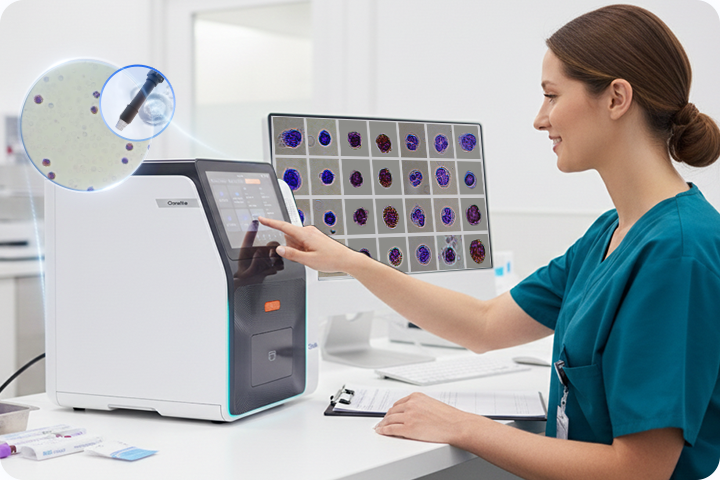
Complete Test Coverage for Diabetic Patients: What the EHBT-50 Measures
The following table summarizes what the Ozelle EHBT-50 can test within the context of a standard diabetic monitoring protocol:
| Test Category | Parameter | Clinical Relevance for Diabetes |
| 7-Diff CBC (Hematology) | WBC, NEU, LYM, MON, EOS, BAS, NST, NSG, NSH, RBC, HGB, HCT, MCV, MCH, MCHC, RDW, PLT, MPV, PDW, RET, NLR, PLR (41 total) | Detect anemia (common in diabetics), infection, immune status; RET monitors bone marrow response |
| Diabetes Panel (Immunoassay) | HbA1c | Gold-standard long-term glycemic control indicator |
| Blood Glucose & Lipids (Biochemistry) | GLU, TG, TC, UA | Immediate metabolic snapshot; lipid monitoring for cardiovascular risk |
| Renal Panel (Biochemistry) | UA, CREA, UREA (BUN) | Early-stage diabetic nephropathy detection |
| Kidney Function (Immunoassay) | mALB (microalbumin), NGAL, β2-MG | Sub-clinical kidney damage markers not detectable by standard panels |
| Entzündungsmarker | CRP, hs-CRP, SAA, IL-6, PCT | Chronic low-grade inflammation monitoring, common in type 2 diabetes |
The operational difference is stark. In the traditional model, a single complete diabetic checkup requires the patient to engage with the healthcare system multiple times before a physician can draw any actionable conclusions. With the EHBT-50, the entire diagnostic picture is assembled and interpreted — with AI-assisted clinical recommendations — before the patient leaves the consultation room.
AI-Assisted Reporting: Turning Raw Data Into Clinical Insight
One of the most distinctive features of the EHBT-50 is not just the breadth of testing, but what happens after the data is collected. The device’s integrated AI diagnostic engine, trained on 40 million samples, automatically generates a clinical interpretation for each result — flagging abnormal values, and suggesting differential diagnoses for the physician to consider.
For a diabetic patient, this means the report doesn’t simply flag an elevated creatinine — it contextualizes the finding alongside the HbA1c trend, the CBC inflammation markers, and the microalbumin level to suggest whether the combined picture is consistent with early nephropathy, suboptimal glycemic control, or both. This AI-assisted layer of reasoning supports the physician without replacing clinical judgment, and is especially valuable in primary care settings where specialist access may be limited.
The EHBT-50 also connects to LIS and HIS systems via LAN, Wi-Fi, and USB, ensuring that every result is automatically logged into the patient’s record — eliminating manual transcription errors and building a continuous longitudinal dataset for trend tracking.
Who Benefits Most From This Approach?
The single-visit diabetic monitoring model enabled by the EHBT-50 is particularly valuable in these healthcare settings:
- General practice (GP) clinics managing large diabetic patient populations on tight appointment schedules
- Specialist endocrinology or nephrology clinics where time is limited and multi-panel assessment is standard of care
- Community health centers and primary care facilities in areas with limited access to central laboratories
- Mobile health units and ambulance services requiring portable, maintenance-free diagnostic capability
- Pharmacies with diagnostic services in markets such as Brazil, the US, Italy, and Australia, where pharmacy-based testing is permitted
In all of these settings, the ability to complete a comprehensive diabetic panel with a fingertip blood sample and receive results before the end of the consultation is a meaningful clinical and operational upgrade.
Häufig gestellte Fragen (FAQs)
Q1: How much blood does the EHBT-50 require?
The device requires only 30 µL of blood for testing, collected from a fingertip capillary sample. This makes it minimally invasive and practical for elderly patients, those with difficult venous access, and frequent monitoring scenarios.
Q2: How long does it take to get results from the EHBT-50?
Results are delivered in approximately 6 minutes per sample. The device supports a throughput of 10 samples per hour, making it suitable for busy clinic environments.
Q3: Does the device require a trained laboratory technician to operate?
No. The EHBT-50 is designed for effortless operation with a graphical user interface, automatic consumable detection via built-in camera, and no sample pre-treatment required. It requires minimal training and is suitable for use by clinical staff without dedicated lab experience.
Q4: What makes the EHBT-50 different from a basic point-of-care HbA1c strip reader?
A standard HbA1c strip reader measures a single biomarker. The EHBT-50 is a full hemo analyzer platform that simultaneously delivers 41-parameter CBC results with AI cell morphology analysis, immunoassay results (including HbA1c), and biochemistry results — in a single run, from a single drop of blood, with AI-powered clinical interpretation.
Q5: Can the EHBT-50 be customized to run only the diabetes-relevant panels?
Yes. The device supports configurable test combinations, allowing clinicians to select the specific combination of hematology, immunoassay, and biochemistry tests relevant to each patient’s condition. For diabetic monitoring, a Diabetes Panel combining CBC + HbA1c + GLU + TG + TC + UA + CREA + UREA can be run as a single configured test.
Q6: Is the Ozelle EHBT-50 certified for clinical use?
Yes. The EHBT-50 holds CE certification for clinical use in Europe and meets ISO 13485:2016 quality management standards. Ozelle has installed more than 50,000 units globally.
Q7: Where can I learn more or request a demo of the Ozelle EHBT-50?
You can explore the full product range and contact the Ozelle team directly at https://ozellemed.com/en/.
The Bottom Line for Diabetic Patient Management
Diabetes management is a longitudinal discipline. Every follow-up visit is an opportunity to catch a trend early — a rising creatinine, a deteriorating HbA1c, an emerging anemia from chronic kidney disease — and intervene before the complication escalates. Fragmented testing across multiple visits and laboratories introduces delays, gaps, and drop-off that can cost patients dearly.
The Ozelle EHBT-50 hemo analyzer eliminates that fragmentation. By consolidating the complete diabetic monitoring panel into a single point-of-care device that operates from a fingertip blood sample and delivers AI-interpreted results in 6 minutes, it enables clinicians to do more for each patient in less time — and empowers patients to complete their full diagnostic workup without additional burden.
For GPs, specialists, and community health providers looking to upgrade their diagnostic capability without the cost and complexity of a traditional laboratory setup, the EHBT-50 represents a clinically sound and operationally practical answer to the question that opened this article. One device. One visit. The complete picture.
Learn more at https://ozellemed.com/en/.