
 Deutsch
  English
  Français
  Русский
  Español
  Português
  العربية
  Italiano
The Shift to Point-of-Care (POC) Diagnostics
In 2025, in-house hematology diagnostics have evolved from a “luxury convenience” into a fundamental standard of care that directly influences clinical outcomes and practice profitability. The global veterinary point-of-care diagnostics market, valued at $2.96 billion in 2025, is projected to reach $6.55 billion within the decade, reflecting a sector-wide commitment to rapid, facility-based testing. For modern veterinary hospitals, the ability to generate a Complete Blood Count (CBC) in fewer than 10 minutes is no longer merely expedient—it has become a primary revenue driver and competitive differentiator.
This acceleration is fueled by three converging forces: client expectations for immediate diagnostic answers, the clinical necessity to identify pre-surgical risks and acute infections before a patient leaves the exam room, and the substantial financial advantage that in-clinic testing provides over centralized reference laboratory services. Practices performing just 50 tests daily can generate approximately $90,000 in annual savings by maintaining an in-house analyzer rather than outsourcing to external laboratories.
This guide provides transparent, head-to-head comparison of the market’s four most significant players—IDEXX, Zoetis, Seamaty, and Ozelle—enabling clinic owners and managers to calculate return on investment (ROI), understand true ownership costs, and identify the optimal operational fit.
Selection Criteria: How We Ranked the Analyzers
Veterinary hematology analyzers differ dramatically in underlying technology, workflow integration, and total cost of ownership. Effective evaluation requires systematic assessment across multiple dimensions.
Core Technology Options
Impedance (Traditional Foundation): Uses electrical current to size cells as they pass through a charged aperture. This proven technology reliably counts red blood cells but struggles fundamentally with white blood cell differentiation, particularly distinguishing eosinophils from neutrophils when cell volumes overlap. Impedance-based systems remain competent for basic screening but lack the diagnostic depth increasingly expected in clinical practice.
Laser Flow Cytometry: Measures cell complexity, internal density, granularity, and nuclear lobularity using laser light scatter from multiple angles. This multidimensional analysis enables accurate eosinophil counting, reticulocyte identification, and robust handling of problematic samples such as feline platelet clumps and hemolyzed or icteric blood. IDEXX’s ProCyte platform and some Seamaty models employ this approach.
AI Digital Morphology (Emerging Frontier): The newest entrants, exemplified by Ozelle, employ high-speed cameras and artificial intelligence trained on millions of clinical samples to visually photograph and classify individual cells. This approach mimics a pathologist’s manual morphology review—the traditional gold standard—but executes it automatically and documents findings with visual images that clinicians can inspect.
Sample and Workflow Constraints
Sample volume requirements represent a critical operational constraint, particularly in pediatric and geriatric populations where collection challenges are substantial. Analyzers requiring less than 30µL offer superior flexibility compared to units needing 100µL. Closed-tube (cap-piercing) sampling systems are strongly preferable to open-tube approaches, as they eliminate spill risk and biohazard exposure in high-volume settings.
Workflow efficiency extends beyond raw speed. “Load-and-go” capability—the ability to place a sample tube and walk away while the analyzer autonomously completes the test—is essential for understaffed clinics managing competing demands. Integration with Practice Information Management Systems (PIMS) and seamless bi-directional data flow to electronic medical records determines whether the analyzer becomes a time-saving asset or a data-entry burden.
Gesamtbetriebskosten (TCO)
Equipment price represents only 30-40% of five-year ownership costs; consumables and maintenance dominate true operating expenses. The “razor and blades” business model—where vendors place expensive equipment cheaply in exchange for premium reagent pricing—requires careful analysis. Pack-based reagent systems offer convenience but at substantially higher per-test costs than bulk liquid systems. Maintenance architecture, specifically whether the analyzer requires daily cleaning cycles, monthly calibration, or service contracts for hydraulic system repairs, profoundly affects operational costs and downtime risk.
The Top 4 Veterinary Hematology Analyzers: Detailed Analysis
IDEXX ProCyte One: The Reference Standard for Premium Clinics
Core Technology: Laser Flow Cytometry + Optical Fluorescence with 5-Dimensional Cell Classification
The ProCyte One represents the most widely adopted hematology analyzer in high-performing veterinary practices. Its dual-technology approach—combining laser scatter analysis with optical fluorescence detection—delivers extraordinary capability for identifying and counting reticulocytes and distinguishing feline platelet clumps from red blood cells, two persistent challenges in veterinary hematology.
Operational Performance
Results are delivered in five minutes or less, establishing IDEXX as the speed leader in the point-of-care segment. The analyzer provides 24 whole blood parameters including true five-part white blood cell differential (neutrophils, lymphocytes, monocytes, eosinophils, basophils), reticulocyte counts as both percentage and absolute numbers, and sophisticated indices including mean cell volume and red blood cell distribution width.
The onboard smart camera automatically verifies sample integrity by scanning QR codes on reagent packs for expiration dates, detecting tube type and cap status, and flagging potential issues before analysis begins—eliminating a common source of operator error.
Financial Model
IDEXX’s “pay-per-run” pricing structure represents a deliberate business philosophy: practices avoid large upfront capital expenditure in exchange for per-test charges typically ranging from $9.25 to $9.50. The model aligns practice expenses directly with diagnostic volume, though it generates higher long-term costs for high-volume clinics compared to equipment-purchase alternatives. Monthly invoicing based on actual runs performed provides cash flow transparency but requires ongoing vendor engagement through IDEXX SmartService Solutions, which monitors usage and automatically replenishes inventory.
Clinical Advantages
The optical fluorescence technology addresses one of veterinary hematology’s most persistent technical challenges: feline platelet clumps. Cats have a biological tendency toward platelet aggregation, causing impedance-based analyzers to miscount platelets or mistakenly identify clumps as erythrocytes. IDEXX’s approach detects platelet granule characteristics optically, enabling accurate platelet counts even in clump-prone samples. The analyzer’s HD laser and optical fluorescence combination also excels at identifying reticulocytes—immature red blood cells whose counting is critical for assessing bone marrow response in anemic patients.
Best For: High-volume, multi-doctor practices where speed (results in ~5 minutes) and immediate diagnostic confidence justify the premium per-test cost. Emergency hospitals with rapid patient throughput and specialists trained to interpret sophisticated histograms represent ideal use cases. The extensive IDEXX ecosystem integration (VetConnect PLUS creates historical trending of patient hematologic profiles) appeals to forward-thinking practices seeking client-facing diagnostic documentation.
Wichtige Spezifikationen:
- Result time: 5 minutes or less
- Parameters: 24 (whole blood parameters)
- Differential: 5-part
- Sample volume: ~30µL
- Throughput: Highest in class (~100+ samples/day possible)
- Maintenance: Virtually none beyond pack/filter changes
- Support: 24-hour network with rapid replacement logistics
Zoetis VetScan HM5: The Flexible Workhorse for Mixed Practices
Core Technology: Impedance + Chemical Differentiation
The VetScan HM5 has maintained market presence for years by delivering straightforward, reliable hematology without the complexity or cost premium of laser systems. It uses impedance technology for cell counting but supplements this with chemical differentiation—selective lysis of cell populations—to enhance white blood cell classification accuracy beyond basic impedance discrimination.
Performance Specifications
The analyzer generates 22-parameter complete blood counts with five-part or three-part differentials in 3-4 minutes. Direct eosinophil measurement (not estimation, which is common in impedance analyzers) provides accurate parasitic infection assessment—clinically important for mixed-animal practitioners managing helminth infections. Sample requirements of 50µL for five-part differential and 25µL for three-part differential are moderate, accommodating most patients while remaining reasonable for pediatric cases.
Processing capacity reaches 16-20 samples per hour in five-part mode, making it suitable for small-to-medium clinics handling 30-80 daily tests. The touch-screen interface displays cellular histograms that verify differential counts and help identify uncommon disease processes at a glance.
Reagent System and Maintenance
The HM5’s “smart pack” reagent system provides simplicity: reagent tubing kits and sample adapters snap in place without complex setup procedures. The analyzer performs automated internal cleaning with minimal daily operator intervention. Unlike systems requiring manual daily flushes or bleach cleaning protocols, the VetScan maintains baseline functionality through built-in automated cycles. The analyzer requires blank measurements every 12 hours to establish baseline performance and detect any fluidics contamination—a straightforward quality control procedure requiring approximately two minutes.
Best For: Independent small animal practices, mixed-animal hospitals, and rural veterinarians who prioritize reliable baseline diagnostics over advanced morphology analysis. The compatibility with diverse sample types—including peritoneal and synovial fluids for infection assessment—appeals to practitioners managing trauma, surgical, and acute infectious cases where rapid cell counts guide immediate treatment decisions.
Financial Profile
Equipment cost approximates $4,995—a substantive but manageable capital investment more favorable than premium laser systems. Consumable costs per test are competitive with IDEXX despite the purchase model. The lower upfront barrier enables smaller practices to justify in-house testing based on more modest test volumes (15-20 daily tests can achieve break-even within 18-24 months).
Wichtige Spezifikationen:
- Result time: 2-3 minutes (per manufacturer claims of 3-4 minute run time overall)
- Parameters: 22
- Differential: 5-part or 3-part options
- Sample volume: 50µL (5-part), 25µL (3-part)
- Throughput: 16-20 samples/hour
- Species validation: 15 different species
- Data storage: 5,000 records with trending capability
Seamaty SMT-50: The Compact Innovator for Budget-Conscious Practitioners
Core Technology: Laser Scattering + Impedance (3-Angle Laser Scatter)
Seamaty has fundamentally disrupted the veterinary hematology market by shrinking five-part laser differentiation technology into an exceptionally compact unit (approximately shoebox-sized), challenging the conventional assumption that “laser means large and expensive.” The SMT-50 represents the company’s premium 5-part model and demonstrates that advanced optical analysis need not command premium pricing.
Technology and Performance
The analyzer employs three-angle laser scatter technology—measuring how laser light reflects from cells at multiple angles to assess size, complexity, and granularity—combined with impedance counting for complete cellular assessment. The result is legitimately five-part differential analysis at a price point accessible to independent clinics, mobile veterinary units, and startup facilities that would otherwise invest in older impedance-only equipment.
Sample volume requirements of approximately 20µL represent the lowest in the field, making the SMT-50 exceptionally suited for feline medicine, exotic animal practice, and pediatric cases where sample collection is inherently challenging. The “maintenance-free” design philosophy emphasizes simplicity: the analyzer incorporates no complex liquid pipelines requiring daily flushing, no elaborate calibration routines, and no service contracts for hydraulic repairs.
Throughput and Workflow
Processing capacity reaches 60 samples per hour—exceptional throughput for a compact unit. While individual result time may extend to 6-10 minutes depending on operator workflow, the parallel processing capability enables practices with moderate test volumes to achieve excellent per-hour efficiency without investing in a second analyzer.
Best For: Independent clinics with capital constraints, mobile veterinary units serving multiple remote locations, startup hospitals establishing initial diagnostic capabilities, and specialized exotic animal practices where sample volume constraints would otherwise necessitate external laboratory reliance. Practices prioritizing 5-part laser accuracy without premium equipment costs find the SMT-50 compelling.
Wichtige Spezifikationen:
- Sample volume: ~20µL (ultra-low)
- Result time: 6-10 minutes
- Differential: 5-part
- Throughput: 60 samples/hour capacity
- Footprint: Extremely compact (significant space savings)
- Maintenance: Minimal by design philosophy
- Technology: Laser scatter with impedance integration
Ozelle EHVT-50: The AI-Powered All-in-One Solution

Core Technology: AI-Powered Complete Blood Morphology (CBM) with High-Precision Optical Imaging
Ozelle represents the next generation of veterinary diagnostics, moving definitively beyond simple cell counting toward actual image recognition and morphological analysis. The EHVT-50 doesn’t merely count cells; it employs high-precision optics (SwissOptic® lens technology with 4-megapixel resolution, 50 frames-per-second image acquisition) and artificial intelligence algorithms trained on 40 million clinical samples to photograph and classify individual cells based on morphological characteristics.
Comprehensive Multi-Modal Platform
Unlike single-function analyzers, the EHVT-50 consolidates four separate laboratory machines into one integrated unit: hematology (7-part differential with AI classification), immunoassay (canine C-reactive protein, feline serum amyloid A), urine analysis (29 parameters including cells, casts, crystals, microorganisms), and fecal analysis (29 parameters including parasites, bacteria, formed elements). This architectural consolidation addresses a fundamental inefficiency in traditional laboratory design—the requirement to move samples between multiple devices, each with separate maintenance protocols and reagent requirements.
AI Morphology and Visual Verification
The analyzer’s defining advantage lies in visual cell verification. Rather than presenting abstract scatter diagrams or histograms that require specialized interpretation training, the EHVT-50 provides actual photographs of analyzed cells alongside numerical results. AI classification algorithms identify morphological abnormalities—band neutrophils, toxic cytoplasmic changes, atypical lymphocytes, potential neoplastic cells—and flag them for clinician review with supporting imagery. This approach solves the “black box” problem inherent in traditional automated hematology: when results look unusual, clinicians can immediately visualize the cells that generated those numbers.
Operational Excellence: Pipeline-Free Architecture
The EHVT-50 employs single-use wet staining cartridges and eliminates entirely the liquid pipelines present in traditional analyzers. This architectural choice carries profound operational implications:
- Maintenance: Zero daily maintenance. Traditional analyzers require daily flushing of liquid lines with distilled water or saline, typically consuming 10-15 minutes. The EHVT-50 requires no startup cycles, no shutdown procedures, and no scheduled flushing protocols.
- Reagent Waste: Single-use cartridges prevent expired reagent waste inherent in bulk liquid systems. There is no risk of contaminated tubing causing false results or requiring service calls.
- Cross-Contamination: Individual samples use separate cartridges, eliminating sample carryover risk entirely.
- Storage: Dry QC (quality control) cards stored at room temperature eliminate the cold-chain complexity of traditional liquid QC materials requiring refrigeration.
Throughput and Clinical Workflow
Despite analytical complexity, the analyzer maintains 12 samples per hour throughput with individual test times of 6-8 minutes. This speed balances comprehensive diagnostic depth—full morphology imaging plus multi-modal analysis—with reasonable clinical workflow integration. For practices where diagnostic thoroughness is prioritized over raw speed, this represents an optimal trade-off.
Best For: Forward-thinking clinics prioritizing diagnostic depth and operational efficiency over raw speed. Ideal for practices seeking to eliminate manual microscopy, provide comprehensive workups (CBC + immunoassay + urine + feces) from a single station, and consolidate laboratory infrastructure. Specialty and emergency hospitals that benefit from AI morphology imaging for oncology screening, infection severity assessment, and bone marrow dysfunction detection.
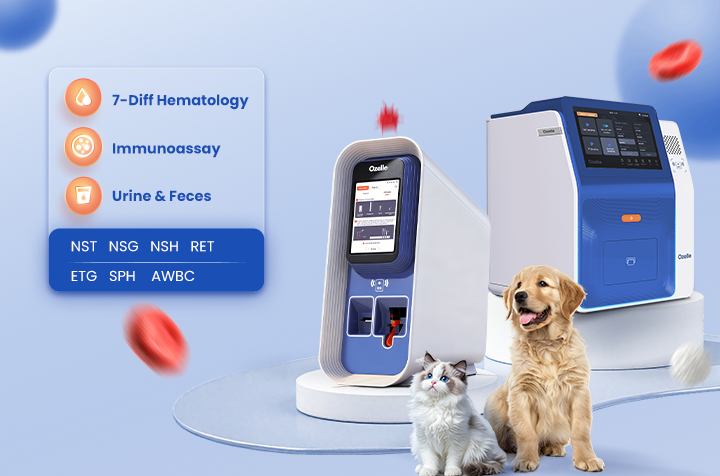
Wichtige Spezifikationen:
- Technology: AI Digital Morphology with optical imaging
- Result time: 8-9 minutes
- Differential: 7-part (AI-classified)
- Sample volume: 30-55µL
- Parameters: 7-part CBC + immunoassay + 29-parameter urine + 29-parameter feces
- Throughput: 6-7 samples/hour
- Maintenance: Zero (pipeline-free)
- QC: Dry cards at room temperature
Comparative Analysis: Head-to-Head Evaluation
| Merkmal | IDEXX ProCyte One | Zoetis VetScan HM5 | Seamaty SMT-50 | Ozelle EHVT-50 |
| Primary Technology | Laser Flow Cytometry + Optical Fluorescence | Impedance + Chemical Differentiation | Laser Scatter + Impedance | AI Digital Morphology |
| Differential Typ | 5-teilig | 5-part or 3-part | 5-teilig | 7-part (AI) |
| Parameters Reported | 24 | 22 | ~21 | 42+ (including morphology) |
| Ergebnis Zeit | 5 minutes | 3-4 minutes | 6-10 Minuten | 8-9 minutes |
| Probe Volumen | ~30µL | 50µL (5-part), 25µL (3-part) | 20µL | 30-55µL |
| Durchsatz | High (~100+/day) | 16-20/hour | 6-10/hour | 6-7/hour |
| Multi-Modal | Nein | Nein | Nein | Yes (CBC + Immunoassay + Urine + Feces) |
| Equipment Cost | Low/Free (Pay-per-run) | ~$4,995 | Entry-level laser | Mid-tier |
| Cost-per-Test | $9.25-9.50 | $0.75-1.00 | $0.60-0.80 | Higher (but consolidates 4 machines) |
| Wartung | Minimal | Mäßig | Minimal | Zero (pipeline-free) |
| Platelet Clump Handling | Excellent (optical) | Gut | Gut | Excellent (visual verification) |
| Species Validation | Multiple | 15 species | Multiple | Canine, Feline (customizable) |
| Visual Morphology | Nein | Nein | Nein | Yes (AI images) |
Financial Analysis: The Cost-of-Ownership Imperative
Equipment price is only the first dimension of ownership costs. True financial evaluation requires analyzing consumables, maintenance, support, and opportunity cost.
The Pay-Per-Run vs. Equipment Purchase Decision
IDEXX’s Strategic Model: The ProCyte One’s pay-per-run pricing eliminates capital equipment cost but generates ongoing per-test charges. For practices running high volumes (100+ tests daily), cumulative per-test costs exceed $1.00 (including quality control materials), resulting in total annual expenses that dwarf upfront equipment purchase in traditional models. However, the model offers profound cash-flow advantages: practices avoid $5,000-$8,000 initial capital outlay and don’t carry inventory risk. This works well for established practices with stable cash flow and predictable testing volumes.
Equipment Purchase Model: Seamaty and Zoetis emphasize equipment ownership. A $4,995 VetScan HM5 with $0.75-per-test consumables generates approximately $10,000 in first-year costs (equipment + 12,500 annual tests). A practice running 50 tests daily (12,500 annually) achieves break-even within 4-6 months relative to reference laboratory pricing ($8-$15 per external test), then generates $7,000-$9,000 in annual savings thereafter.
Total Cost of Ownership Calculation
A practical example clarifies the financial case for in-house testing:
Mixed Animal Clinic Running 50 Daily Tests (12,500 Annually)
| Kostenkategorie | In-House Analyzer | Reference Laboratory |
| Equipment (5-year amortized) | $1,000/year | $0 |
| Consumables | $9,375/year | $0 |
| Maintenance/Service | $500/year | $0 |
| Gesamtkosten | $10,875/year | $100,000/year |
| Savings | $89,125/year |
The analyzer pays for itself within approximately two weeks—a stunningly rapid ROI that explains the industry’s aggressive adoption of point-of-care hematology.
Consumable Cost Optimization
Consumable expenses represent 60-70% of five-year operating costs. Practices must evaluate:
- Pack vs. Bulk: Self-contained reagent packs offer convenience but cost 15-30% more per test than bulk reagent bottles requiring more inventory management.
- Waste and Expiration: Bulk systems risk reagent expiration and waste; cartridge-based systems eliminate this entirely.
- Maintenance Consumables: Traditional analyzers consume distilled water and cleaning solutions in daily maintenance; pipeline-free analyzers eliminate these consumables entirely.
The Business Case by Practice Type
Startup or Single-Doctor Clinic (1-3 Veterinarians)
Recommendation: Seamaty SMT-50 or Ozelle EHVT-50
Rationale: Capital expenditure must be minimized while diagnostic capability remains credible. The Seamaty offers 5-part laser accuracy at the lowest equipment cost, with break-even economics at 20-25 daily tests. The Ozelle is compelling if the practice prioritizes comprehensive diagnostics (CBC + urine&feces+ immunoassay from one device) despite higher per-test costs, as equipment consolidation reduces total counter space and training requirements.
Financial Reality: 20-30 daily tests support either choice. Seamaty breaks even faster; Ozelle offers superior diagnostic breadth and operational integration.
24-Hour Emergency Hospital
Recommendation: IDEXX ProCyte One
Rationale: Throughput is non-negotiable. When three hit-by-car cases arrive simultaneously, physicians need CBC results in five minutes, not ten. IDEXX’s speed advantage and proven reliability in high-stress environments justify premium per-test costs. Seamless VetConnect integration ensures critical data reaches electronic medical records instantly, supporting rapid clinical decision-making.
Financial Reality: 100+ daily tests render IDEXX’s per-test cost structure economically neutral compared to alternatives while delivering superior speed and support reliability.
Mixed-Animal Practice (50-150 Daily Tests)
Recommendation: Zoetis VetScan HM5 or Ozelle EHVT-50 (depending on species diversity)
Rationale: The HM5 offers proven reliability, species validation across 15 animal types, and reasonable capital cost. The EHVT-50 excels if the practice regularly performs urinalysis and immunoassay (parasitism screening, infectious disease detection), as equipment consolidation eliminates redundant devices while ensuring seamless sample management.
Financial Reality: Both models achieve break-even within 4-6 months. The HM5 emphasizes lower per-test cost; the EHVT-50 emphasizes diagnostic breadth and operational simplification.
Clinical Technology Trends Reshaping Hematology in 2025
Digital Morphology Replaces Manual Smear Review
The traditional workflow—run a CBC, see an unusual result, make a glass slide, stain it, dry it, squint through a microscope—is becoming obsolete. Modern analyzers like Ozelle capture digital images during the run, automatically flag abnormalities, and provide visual verification without manual intervention. This represents a fundamental paradigm shift: automated morphology analysis is moving from a “nice-to-have” feature to a standard of care expectation.
Zoetis responded to this trend by developing the AI Masses tool on its Vetscan Imagyst platform, enabling detection of potential cancers in minutes versus days for traditional laboratory review. IDEXX has introduced its own digital analysis tools, but these remain add-on devices rather than integrated systems. The trend clearly favors platforms that integrate image capture and AI analysis from the initial test run.
Parasite Identification and Allergic Response Screening
Five-part and seven-part analyzers excel at eosinophil counting—critical for parasitic infection detection and allergic response assessment. As parasitic resistance to conventional treatments accelerates in certain regions, accurate eosinophil trending helps practitioners modify treatment protocols based on objective cell response rather than presumptive diagnosis. The 5-part differential has become the pragmatic minimum for mixed-animal practices.
Reticulocyte Counting for Chronic Disease Monitoring
Reticulocyte counting—assessment of immature red blood cell production—has transitioned from specialty laboratory procedure to routine clinical parameter. For anemic patients, reticulocyte counts indicate whether bone marrow is appropriately responding to blood loss or whether aplastic anemia or chronic kidney disease is suppressing red blood cell production. Analyzers with reticulocyte capability (IDEXX’s optical fluorescence method or equivalent) are increasingly expected.
Selection Framework: Matching Analyzer to Practice
Ask these questions before finalizing purchase:
- What is your realistic daily testing volume? Conservative estimates should be used; practices tend to underestimate peak demand. Include all testing modalities—CBC, urine, fecal, immunoassay.
- What species does your practice serve? Confirm species-specific reference ranges are available. Cats require optical or AI-based platelet handling; exotics require specialized protocols.
- What is your capital budget versus operating budget preference? Pay-per-run models preserve capital but generate higher long-term costs; equipment purchase requires upfront outlay but lower ongoing expenses.
- What is your practice management system? Verify LIS compatibility before purchase. Incompatible analyzers create manual workarounds negating time-savings benefits.
- How stable is your laboratory staffing? High turnover argues for user-friendly interfaces and minimal maintenance procedures; stable teams can invest in feature-rich systems requiring deeper expertise.
- What is your diagnostic scope? Single-function analyzers suit basic screening; multi-functional platforms serve comprehensive diagnostics with space efficiency.
- What is your support infrastructure? Rural practices require analyzers designed for independence; urban centers benefit from premium support networks.
Conclusion: Strategic Recommendations for 2025
The veterinary hematology analyzer market in 2025 is characterized by genuine technological divergence rather than incremental feature refinement. There is no single “perfect” analyzer—only the best fit for specific practice needs, diagnostic scope, and business priorities.
For High-Volume Emergency and Specialty Hospitals: IDEXX ProCyte One remains the strategic choice. Superior speed, ecosystem integration, and proven reliability justify premium per-test pricing when throughput exceeds 80-100 daily tests.
For Value-Focused Independent Practices: Seamaty SMT-50 delivers legitimate 5-part laser accuracy at a capital cost and per-test expense that make in-house testing economically rational even for modest test volumes (15-25 daily).
For Established Mixed-Animal Practices: Zoetis VetScan HM5 offers proven reliability and species-specific validation without premium pricing. The traditional impedance technology adequately serves general screening, and 22 parameters provide sufficient diagnostic depth for routine cases.
For Forward-Thinking Clinics Prioritizing Diagnostic Innovation: Ozelle EHVT-50 represents the future trajectory of veterinary diagnostics—consolidated multi-modal analysis, AI-assisted morphology interpretation, and maintenance-free operation. The trade-off between speed and diagnostic breadth favors comprehensive workups over raw throughput.
In 2025, the transition from external reference laboratory dependence to in-house point-of-care hematology is financially inevitable for all but the smallest practices. The upgrade from older impedance-only analyzers to 5-part or 7-part systems is a clinical and financial imperative. The choice among modern analyzers should reflect your practice’s diagnostic philosophy, patient population, staffing capability, and long-term strategic vision.
The best analyzer is the one that gives you clinical confidence while fitting seamlessly into your daily workflow—delivering results that guide immediate patient care decisions while strengthening your practice’s diagnostic reputation.