
 العربية
  English
  Français
  Русский
  Español
  Deutsch
  Português
  Italiano
ADLM 2026 as a Reference Point for Haematology Equipment
إن ADLM 2026 Annual Meeting and Clinical Lab Expo will again serve as a key global forum for laboratory medicine, including hematology and coagulation. From July 26 to 30 in Anaheim, the meeting will bring together scientific sessions, plenary lectures, and an expo floor covering analyzers, automation, and digital technologies used in clinical laboratories worldwide. Haematology equipment will be part of this broader landscape, with new systems presented alongside sessions on workflow design, quality management, and artificial intelligence in diagnostics.
For many laboratory leaders, ADLM 2026 will therefore act as a snapshot of where hematology is heading in terms of technology and deployment models. Exhibits in hematology and coagulation typically span from high-throughput central-lab analyzers to compact systems intended for decentralized sites, illustrating how complete blood count (CBC) and morphology testing are being redistributed across networks of care. The environment at ADLM makes it possible to compare different approaches to automation, digital morphology, and near-patient testing on a single platform.
Market Growth and the Move to Decentralized Hematology
Market analyses estimate that the global hematology analyzer segment was worth about 4.33 billion USD in 2025 and may reach roughly 7.28 billion USD by 2034, reflecting steady demand growth. Rising test volumes are linked to demographic change, expanded health screening programs, and the increasing role of laboratory data in chronic disease management and treatment monitoring. At the same time, economic and staffing pressures are prompting health systems to reconsider where haematology equipment is installed and how workflows are organized.
Instead of routing most samples through a single central laboratory, many organizations are creating tiered structures with regional hospitals, satellite labs, and health screening centers performing part of the hematology workload. In these environments, decentralized hematology can shorten turnaround times, reduce transport needs, and align testing more closely with patient pathways. As a result, demand is rising for haematology equipment that can operate reliably in smaller facilities while still integrating with central data and quality systems.
This shift is especially visible in human health screening centers and regional hospitals. Screening centers often handle predictable morning peaks in sample volume, followed by lower activity later in the day, which calls for analyzers that can manage high short-term throughput within compact footprints. Regional hospitals require 24-hour availability for inpatient and emergency testing, with stable performance and manageable maintenance needs. Haematology equipment for these sites must bridge the gap between small point-of-care devices and large central-lab platforms.
AI and Morphology Intelligence in Laboratory Hematology
Artificial intelligence is now a consistent theme in hematology research and laboratory practice. Reviews of AI in hematologic diagnostics describe how machine learning models are being applied to blood cell morphology, flow cytometry, and integrated multi-modal analysis. In laboratory workflows, AI algorithms can support automated white blood cell differentials, detect blasts or atypical cells, and prioritize smears for manual review, while final interpretation remains with hematologists and laboratory physicians.
For haematology equipment, this development has led to systems that pair numerical CBC parameters with image-based morphology. High-resolution images of blood cells are acquired within the analyzer and processed by AI models that have been trained on large labeled datasets. The outputs include pre-classified cell populations, flagging of abnormal distributions, and visual evidence that can be reviewed on demand. These structured outputs are intended to support clinical assessment in anemia, infection, and other hematologic conditions, functioning as part of a broader diagnostic context rather than as independent diagnostic decisions.
في ADLM 2026, AI-enabled morphology is expected to be reflected both in scientific sessions and on the expo floor. Presentations on digital morphology, workflow optimization, and AI in hematology laboratories will sit alongside demonstrations of analyzers that incorporate AI models into routine sample processing. This context sets the stage for new systems that use Morphology Intelligence as a central design principle rather than an optional add-on.
Compact Design and Modular Throughput in Haematology Equipment
As hematology testing becomes more distributed, many facilities require haematology equipment that can be installed in constrained spaces without sacrificing performance. Compact analyzers address this requirement by reducing footprint, power, and infrastructure demands, making it possible to place them in health screening centers, outpatient hubs, and regional hospital labs. These analyzers typically accept small sample volumes and are optimized for straightforward workflows so that non-specialist staff can operate them after appropriate training.
Modular architectures extend the concept of compact design by allowing laboratories to scale throughput over time. Instead of choosing between a small analyzer and a large high-throughput line, organizations can start with one compact unit and then cascade additional units as demand increases. This strategy spreads capital expenditure over multiple phases and reduces the risk of over- or under-sizing capacity. For regional networks, modular haematology equipment can also be used to create consistent platforms at multiple sites, simplifying training and maintenance.
In practice, this means that haematology equipment is planned not only for absolute peak throughput but also for flexibility. A health screening center might initially install a single analyzer for up to several dozen tests per hour, then add second or third units as its programs expand. A regional hospital laboratory might use cascaded units to ensure redundancy: if one module is down for service, others can maintain essential operations. This modular deployment model is increasingly visible in vendor roadmaps and is likely to be a recurring theme in hematology exhibits at ADLM 2026.
Maintenance, Uptime, and Fluidics Contained in Consumables
Operational continuity is critical when haematology equipment is distributed across multiple sites. Downtime in a decentralized analyzer can delay clinical assessment and force samples to be rerouted to other locations, increasing complexity and turnaround time. At the same time, many facilities have limited access to on-site biomedical engineering support, which makes maintenance requirements a decisive factor in equipment selection.
One design approach to address these constraints is to place critical fluidic components inside consumables. Reagent packs and closed cartridges with integrated fluidic paths can reduce the need for manual cleaning, minimize carryover and contamination risks, and standardize performance across different sites. For haematology equipment, this architecture reduces daily maintenance burden and can make installation more feasible in smaller laboratories or health screening centers where technical staff may not specialize in analyzer servicing.
Another element is service-ready modular design. When analyzers are built from discrete modules, service teams can replace a module quickly rather than performing extended on-site repairs, thereby shortening service recovery times. In modular haematology equipment, this concept can be combined with cascaded throughput: units can be swapped or rotated while the network maintains overall capacity. Together, fluidics contained in consumables and modular service design help laboratories maintain stable hematology operations even under staffing and resource constraints.
Clinical Use Cases for Haematology Equipment in Human Medicine
In human medicine, haematology equipment supports a broad spectrum of clinical use cases. CBC and morphology results contribute to baseline health assessments, disease monitoring, and evaluation of acute conditions in hospitals and outpatient settings. Health screening centers rely on haematology equipment for routine check-ups, occupational health programs, and population-based screening initiatives. In these environments, numerical indices and morphology flags can indicate when further investigation is needed, while stable results are documented for long-term follow-up.
Regional hospitals and emergency departments depend on rapid CBC and morphology testing for pre-operative evaluation, sepsis workups, and management of hematologic and oncologic conditions. In such settings, haematology equipment must deliver consistent results with short turnaround times and integrate with hospital information systems for timely reporting. AI-enabled morphology can help identify atypical findings that warrant further specialist review, but final decisions remain embedded in clinical assessment workflows that also involve biochemistry, coagulation, imaging, and clinical examination.
Independent laboratories and diagnostic networks use haematology equipment to process referred samples from multiple collection points. Compact analyzers deployed at regional nodes can handle routine CBC and initial morphology, while more complex cases are escalated to central laboratories with advanced platforms and specialist teams. Digital morphology and AI outputs can be transmitted electronically for remote review, supporting collaborative assessment across locations.
O-cyte 1 as an Example of Next-Generation Haematology Equipment
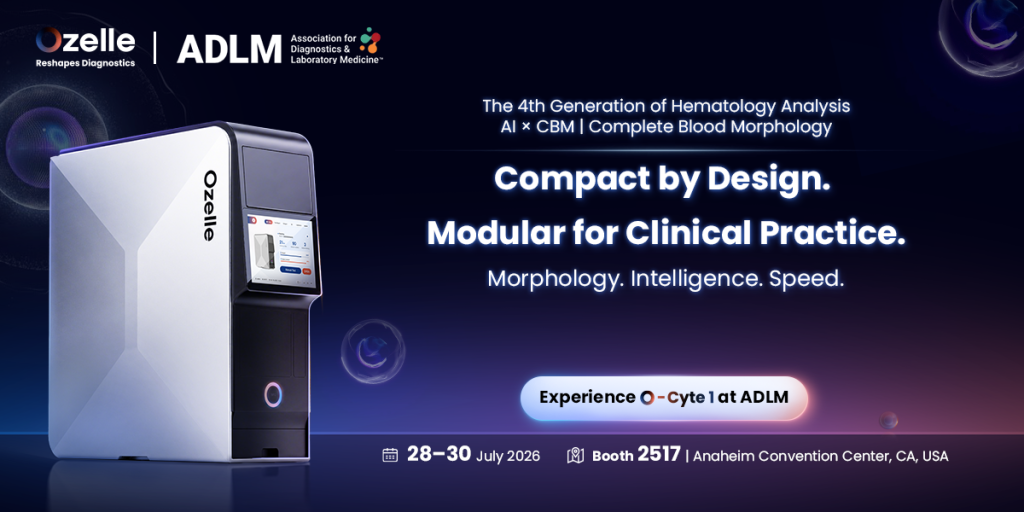
Within these broader trends, Ozelle will launch O-cyte 1 at ADLM 2026 as an example of how haematology equipment is evolving toward AI-enabled, compact, and modular designs. The system is centered on Morphology Intelligence, combining AI with Complete Blood Morphology to transform cell images into structured patterns, indicators, and reviewable image sets. These outputs are intended to complement numerical CBC results and can be incorporated into laboratory reports that support clinical assessment in various care settings.
From an operational standpoint, a single O-cyte 1 analyzer is planned to support approximately 60 tests per hour. When higher throughput is needed, multiple units can be cascaded to reach around 360 tests per hour within the same architecture, providing a scalable option for health screening centers, regional hospitals, and medium-size laboratories. Fluidics contained in consumables aim to reduce daily maintenance requirements, while service-ready modular components are designed to shorten service recovery times.
For institutions exploring AI-enabled haematology equipment, O-cyte 1 illustrates how Morphology Intelligence, compact design, modular throughput, and maintenance-simplified operation can be combined in a single platform for human medicine. The system aligns with a broader portfolio of AI-driven diagnostic solutions described on the أوزيل website, which focuses on decentralized testing, integrated workflows, and CBM-based architectures for clinical laboratories.
Outlook After ADLM 2026
Scientific literature and market analyses suggest that AI integration, compact form factors, and decentralized testing networks will continue to influence haematology equipment beyond 2026. AI-assisted morphology and digital workflows are expected to become more common in routine practice, particularly for pre-classification, triage of smears, and standardized reporting. In parallel, health systems will likely expand the use of compact, modular analyzers at health screening centers, regional hospitals, and satellite labs, while central laboratories retain high-complexity platforms for challenging cases and advanced integration with molecular and cytogenetic data.
In this environment, haematology equipment will increasingly be evaluated as part of an ecosystem rather than as isolated instruments. Considerations such as data interoperability, networked quality control, AI model governance, and service strategies will stand alongside traditional analytical specifications. Manufacturers such as أوزيل are developing systems that reflect this shift, combining Morphology Intelligence, modular throughput expansion, and maintenance-simplified designs into platforms like O-cyte 1 for human health screening centers, regional hospitals, and laboratory networks. As ADLM 2026 approaches, these directions will frame discussions about how haematology equipment will support clinical assessment in the second half of 2026 and in the years that follow.