
 العربية
  English
  Français
  Русский
  Español
  Deutsch
  Português
  Italiano
Every pediatrician has faced this moment: a young child, pale and feverish, who screams and twists away the moment a needle approaches their arm. Venous blood collection in children is not just an emotional challenge — it is a genuine clinical barrier. Missed draws, repeat attempts, and traumatized patients can delay critical diagnoses and undermine trust in healthcare settings. The real clinical question becomes: can a modern haematology analyzer deliver a full, clinically reliable complete blood count (CBC) from nothing more than a single drop of blood from a fingertip — without compromising diagnostic accuracy?
The answer, in many clinical scenarios, is increasingly yes — with modern AI-powered analyzers demonstrating strong agreement with venous laboratory standards. AI-powered haematology analyzers like the Ozelle EHBT-50 and EHBT-75 are specifically engineered to perform a 7-part differential (7-diff) CBC using as little as 30 µL of capillary blood, delivering results that are comparable to venous-blood laboratory standards. This article breaks down how that technology works, why it matters for pediatric patients, what parameters are measured, and how clinicians can make the most informed device choice.
Why Pediatric Blood Collection Is a Persistent Clinical Problem
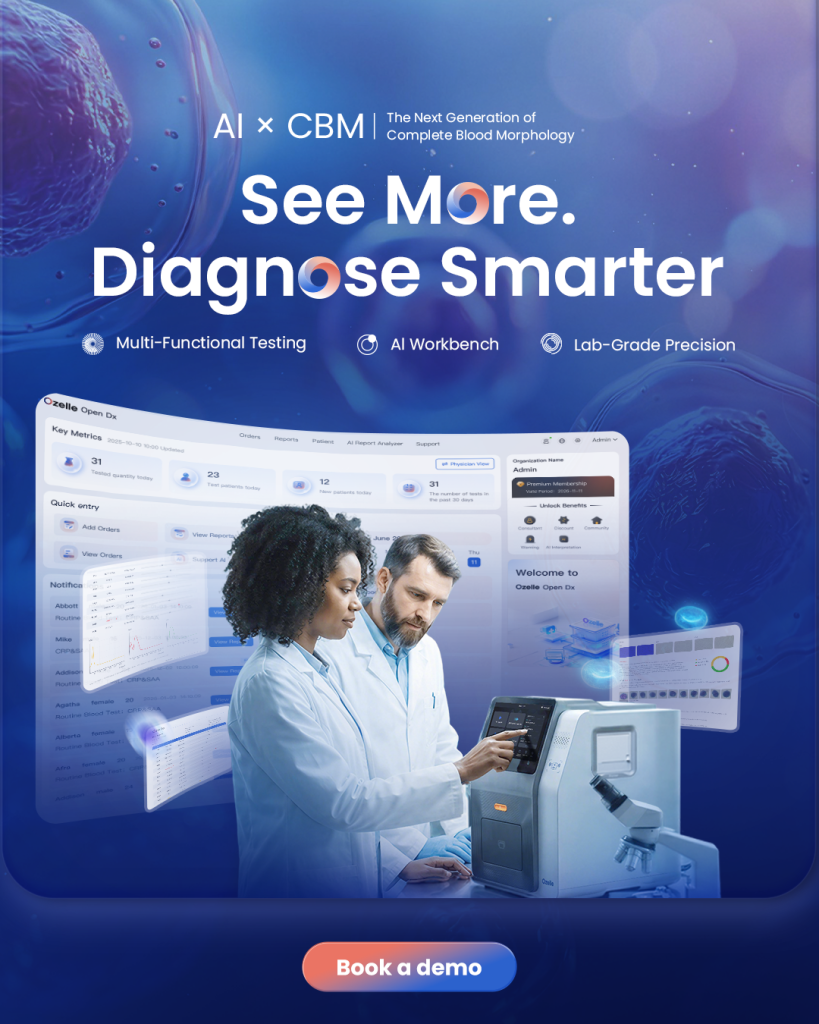
Blood tests are among the most ordered diagnostic procedures in pediatric medicine, used to detect anemia, infection, leukemia, immune disorders, and dozens of other conditions. Yet standard laboratory CBC testing relies on venous whole blood — typically collected via antecubital or dorsal hand veins — a process that is inherently distressing for young children.
Pediatric patients, particularly those under the age of six, have smaller, more fragile veins that are difficult to access even under optimal conditions. The psychological distress of venous puncture can cause significant procedure-related anxiety, breath-holding, syncope, and even long-term needle phobia. For clinicians working in primary care clinics, rural health centers, or busy outpatient settings without specialist phlebotomy support, the failure rate of venous draws in young children is a real operational concern.
The clinical impact is not trivial. A delayed or incomplete CBC can mean missing early signs of bacterial sepsis, iron-deficiency anemia, or abnormal white cell differentials that indicate underlying disease. Healthcare providers need a better option — and a point-of-care haematology analyzer designed for capillary blood sampling is exactly that.
How a Haematology Analyzer Works with Capillary Blood
Traditional haematology analyzers based on impedance (Coulter) or flow cytometry methods were designed almost exclusively around venous EDTA tube samples. Capillary blood, obtained from a fingertip or heel stick, has historically been considered less reliable for automated analysis due to the potential for tissue fluid dilution, platelet activation, and cell morphology distortion.
Because this approach analyzes discrete cell images rather than large volumes of cells in flow, it can operate effectively with smaller sample volumes, making it more adaptable to capillary blood collection scenarios.
In practice, a small-volume capillary sample (e.g., ~30 µL) can provide sufficient cellular material for comprehensive analysis, when supported by appropriate system design and validation.
Ozelle EHBT-50 and EHBT-75: Designed for Capillary-First Diagnostics
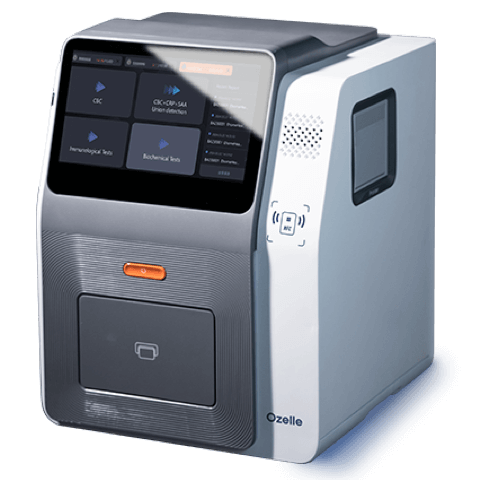
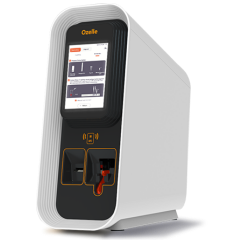
Ozelle, a digitally-driven diagnostics company founded in 2014 with roots in Silicon Valley, has built its haematology analyzer product line around capillary blood compatibility from the ground up. Two flagship devices — the EHBT-50 Minilab Multi-Functional Analyzer and the EHBT-75 7-Diff Auto Haematology Analyzer — are purpose-built to address the challenge of blood collection in vulnerable patient populations, including children and the elderly.
Both devices accept capillary or venous whole blood with a minimum sample requirement of just 30 µL for testing, collected using a disposable capillary blood collector. This tiny volume is equivalent to one standard fingertip prick. There is no need for a trained phlebotomist, no EDTA tubes, and no centrifugation — the child’s caregiver or clinic nurse can collect the drop directly at the point of care.
The sample is loaded into a single-use, sealed test kit cartridge. The device then performs fully automated sample processing — including auto-loading, liquid-based Wright-Giemsa staining, mixing, high-speed full-field scanning, and AI-powered classification — all without manual intervention. Results are delivered within approximately 6 minutes per sample.
You can explore these devices in detail at ozellemed.com/ar.
What Parameters Does a 7-Diff Capillary CBC Actually Measure?
A critical concern when using capillary samples is whether the full breadth of hematological information is preserved. The table below compares what Ozelle’s EHBT-50 and EHBT-75 deliver versus a standard 5-diff CBC panel from conventional laboratory analyzers:
| فئة المعلمة | Standard 5-Diff CBC | Ozelle EHBT-50 / EHBT-75 (7-Diff CBM) |
| White Blood Cell Total (WBC) | ✓ | ✓ |
| Neutrophils (NEU) | ✓ | ✓ |
| الخلايا اللمفاوية (LYM) | ✓ | ✓ |
| Monocytes (MON) | ✓ | ✓ |
| Eosinophils (EOS) | ✓ | ✓ |
| Basophils (BAS) | ✓ | ✓ |
| Band Neutrophils / Stab (NST) | ✗ | ✓ |
| Mature Neutrophils (NSG) | ✗ | ✓ |
| Hypersegmented Neutrophils (NSH) | ✗ | ✓ |
| Atypical Lymphocytes (ALY) | ✗ | ✓ |
| Platelet Aggregates (PAg) | ✗ | ✓ |
| الخلايا الشبكية (RET) | Separate test | ✓ |
| NLR / PLR Ratios | ✗ | ✓ |
| RBC, HGB, HCT, MCV, MCH, MCHC | ✓ | ✓ |
| PLT، MPV، PDW، PDW، PCT، P-LCR | ✓ | ✓ |
| إجمالي المعلمات | ~25 | 37 |
The addition of NST, NSG, and NSH parameters is particularly significant in pediatrics. Elevated NST (band neutrophils) signals bone marrow stress and is an early indicator of bacterial sepsis — one of the most time-critical diagnoses in pediatric medicine. Detection of these parameters without requiring a separate manual blood film review is a major clinical advantage.
The AI Engine Behind the Accuracy
Accuracy is the non-negotiable requirement when using capillary samples in place of venous draws. Ozelle’s haematology analyzers address this through three interlocking technology layers:
- Expert Brain: A deep-learning algorithm trained on over 40 million real clinical blood samples, recognized at the 2022 World Artificial Intelligence Conference (WAIC). The model continuously self-improves through Auto-ML iteration.
- Precision Eyes: A SwissOptic-customized lens with 4-megapixel resolution and 50 frames per second capture speed, delivering oil-immersion-quality microscopic imaging.
- Technician Hands: A fully automated mechanical arm with a positioning repeatability accuracy of 1 µm, ensuring each cell is imaged with laboratory-grade precision.
Correlation data from clinical validation demonstrates strong agreement with established reference analyzers (Beckman Coulter DxH900, Sysmex NX-10): WBC correlation coefficient R = 0.9962, RBC R = 0.9787, HGB R = 0.9867, PLT R = 0.9834. These figures confirm that fingertip capillary results produced by the EHBT-50 are clinically equivalent to venous reference standards.
EHBT-50 vs. EHBT-75: Choosing the Right Pediatric Device
While both devices share the same core cell morphology platform and capillary blood compatibility, there are key differences that affect suitability for different clinical settings:
| الميزة | أوزيل EHBT-50 | أوزيل EHBT-75 |
| الاستخدام الأساسي | All-in-one minilab | Dedicated haematology analyzer |
| معلمات CBC | 37 (7-diff CBM) | 37 (7-diff CBM) |
| Additional Testing | Immunoassay (27 items), Biochemistry, | CBC فقط |
| حجم العينة | 30 µL (capillary) / 100 µL (EDTA) | 30 µL (capillary) / 60 µL (venous) |
| العرض | 10.1-inch touch screen | 7-inch touch screen |
| الأبعاد | 400 × 350 × 450 mm | 415 × 203 × 483 mm |
| الاتصال | LIS, HIS, WiFi, LAN, USB, SIM | USB, Ethernet, WiFi, Bluetooth |
| الطابعة | Built-in thermal | External thermal or A4 |
| الوزن | 15 kg | Compact design |
| الأفضل لـ | GP clinics, pharmacies, multi-discipline POC | Focused haematology in clinics, labs |
For a pediatric GP clinic that needs to run CBC alongside CRP or thyroid panels in a single visit, the EHBT-50 is the superior all-in-one choice. For a dedicated pediatric haematology unit or a mobile health setting where compact size and focused CBC performance are priorities, the EHBT-75 is the more targeted instrument.
Practical Workflow: How a Capillary CBC Works in a Pediatric Setting
The end-to-end process for performing a CBC on a distressed child using the Ozelle EHBT-50 or EHBT-75 takes less than 10 minutes from blood collection to printed report:
- Preparation: Insert the single-use test kit and counting chamber into the device. The built-in smart camera automatically confirms correct placement.
- Collection: A nurse or clinician performs a standard fingertip prick and collects 30 µL of capillary blood using the disposable capillary blood collector.
- Loading: The capillary tube is placed into the designated slot. No sample pre-treatment, no reagent mixing, and no centrifuge step are required.
- Processing: The device automatically performs sample loading, liquid-phase staining, and cellular imaging. The sealed cartridge design stores all waste liquid internally, ensuring bio-safe handling.
- Results: A full AI-generated CBM report with 37 parameters, cell morphology images, histogram distributions (WBC/RBC/PLT), and AI-assisted diagnostic inference is delivered within 6 minutes.
- Review: The clinician reviews the report on-screen or via the printed output. Abnormal flags — including elevated NST, low LYM, or PLT morphology — are highlighted with AI-generated clinical guidance notes.
This workflow requires no specialized laboratory training, making it appropriate for use in primary care clinics, school health services, outpatient pediatric units, and even mobile health vans.
Beyond Hematology: Combined Pediatric Testing on One Device
One often-overlooked advantage of the EHBT-50 for pediatric use is the ability to run clinically meaningful combined panels from a single capillary or minimal venous sample. This means a child who has already undergone a fingertip prick for CBC can, in the same visit, receive results for:
- CBC + CRP/SAA — to distinguish bacterial from viral infection
- CBC + PCT — for sepsis severity assessment
- CBC + Ferritin — anemia workup with iron stores
- CBC + TSH/FT3/FT4 — thyroid function panel for growth or developmental concerns
- CBC + HbA1c + Glucose — metabolic screening
This eliminates the need for a second, separate blood draw — a significant benefit when the first draw was already a challenge.
الأسئلة الشائعة (FAQs)
Q1: Is capillary blood from a fingertip reliable for a full 7-diff CBC on a haematology analyzer?
Yes. When using an AI-powered cell morphology analyzer such as the Ozelle EHBT-50 or EHBT-75, capillary blood collected from a fingertip prick delivers results with correlation coefficients of R > 0.97 across key parameters (WBC, RBC, HGB, PLT) compared to venous reference analyzers. The optical imaging-based CBM method does not depend on flow dynamics, making it inherently more compatible with small capillary volumes than traditional impedance-based analyzers.
Q2: How much blood is needed for the test?
As little as 30 µL is required for testing — equivalent to approximately one or two standard fingertip blood drops. This minimal invasive requirement makes the test ideal for infants, toddlers, and elderly patients.
Q3: How long does it take to get results?
The full AI morphological report is generated within approximately 6 minutes from sample loading. The built-in or external thermal printer can produce a hard-copy report immediately.
Q4: Does the device require laboratory staff to operate?
No. The EHBT-50 and EHBT-75 are designed for minimal training requirements. The intuitive touch screen interface, smart camera for consumable detection, and fully automated processing mean that a clinic nurse or trained healthcare assistant can operate the device without specialist laboratory knowledge.
Q5: What abnormal cell types can be detected from a capillary sample?
Both the EHBT-50 and EHBT-75 can detect NST (band neutrophils), NSG (segmented neutrophils), NSH (hypersegmented neutrophils), ALY (atypical lymphocytes), PAg (platelet aggregates), and RET (reticulocytes) — cell types that a standard 5-diff analyzer cannot identify, and that previously required a manual blood film review.
Q6: Is the device certified for clinical use?
Yes. Ozelle’s haematology analyzers hold CE marking, FDA registration, ISO 13485:2016 certification, and ISO 9001:2015 certification, making them suitable for clinical diagnostics in healthcare settings across Europe, the Americas, and beyond.
Q7: Can the EHBT-50 be used for patients other than children?
Absolutely. While the capillary blood feature is especially beneficial for children and the elderly, the EHBT-50 is designed for multi-application scenarios including GP clinics, hospital laboratories, emergency departments, pharmacies, ambulances, and cosmetic centers.
Q8: Where can I learn more or request a product demonstration? Full product specifications, clinical data, and global distributor information are available at ozellemed.com/ar.
A New Standard for Pediatric Blood Diagnostics
The era of forcing frightened children through difficult, repeated venous blood draws for a basic CBC is rapidly ending. AI-powered haematology analyzers like the Ozelle EHBT-50 and EHBT-75 deliver a clinically superior 7-diff CBC with 37 parameters — including advanced morphological markers unavailable on conventional 5-diff analyzers — from a single 30 µL fingertip sample, with results in 6 minutes.
For pediatric clinicians, this technology does not represent a compromise. It represents an upgrade: faster results, less patient distress, broader parameter coverage, and built-in AI-assisted interpretation that supports better clinical decisions at the point of care. Whether your setting is a busy urban clinic, a rural health post, or a mobile pediatric unit, the question is no longer whether a haematology analyzer can work from a fingertip — but whether your clinic can afford to keep asking children to sit still for venous draws when a better solution already exists.
Learn more about Ozelle’s full diagnostics portfolio at ozellemed.com/ar.