

Automated hematology has been central to routine laboratory medicine for decades, but traditional analyzers were mainly designed around numerical CBC results and basic white blood cell differentials. As clinical services expand and testing volumes grow, laboratories are looking for instruments that combine reliable CBC performance with digital cell morphology, integrated testing options and more scalable workflows.
In this context, AI-assisted hematology analyzers have emerged as an evolving generation of hematology systems that apply artificial intelligence to image acquisition, cell classification and workflow automation while still operating within established hematology principles. These are full IVD systems that analyze blood samples under laboratory quality and regulatory requirements, and in some industry materials they may also be described using broader phrases such as an “AI blood test analyzer”.

From conventional CBC to AI-assisted hematology analyzers
For decades, automated hematology analyzers focused mainly on complete blood count and basic white blood cell differentials, with detailed morphology relying on manual smear review. This setup remains effective but can be time-consuming and difficult to scale when sample volumes increase or when testing expands beyond central laboratories.
Selected AI-assisted hematology analyzers combine automated counting with digital imaging and machine learning, helping laboratories pre-classify cells, flag unusual patterns and, in some systems, integrate hematology with selected immunoassay or biochemistry tests. In this segment of the market, Ozelle develops AI-assisted hematology analyzers for different clinical environments, and its solutions for complete blood morphology and automation are described on the Ozelle diagnostics platform.
Core capabilities of AI-assisted hematology analyzers
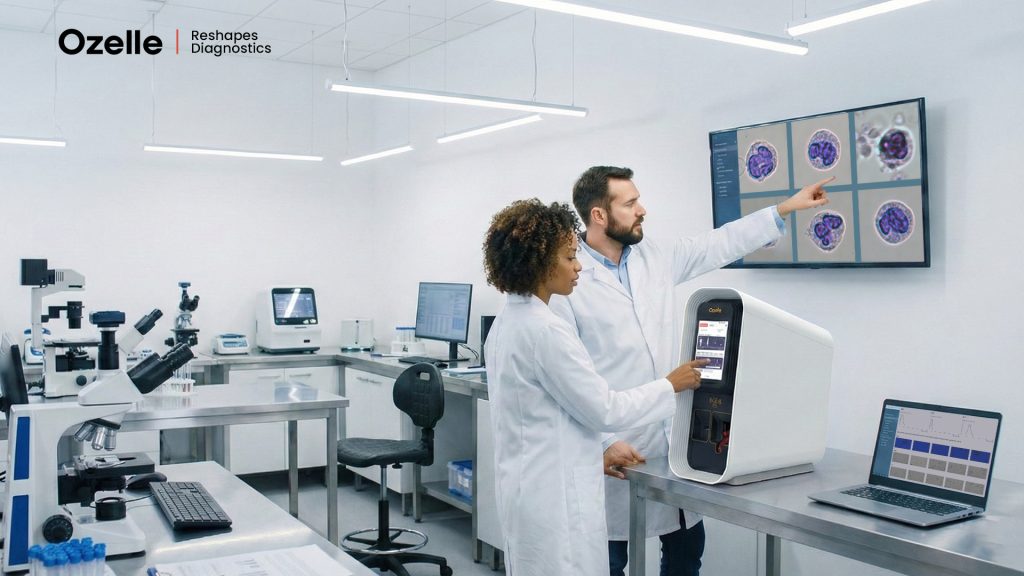
From numerical parameters to digital cell morphology
Modern AI-assisted hematology analyzers extend beyond numerical CBC parameters to deliver digital cell morphology, where automated classifications can be linked to underlying cell images. Deep learning models distinguish standard white cell populations and maturation stages while also highlighting morphology patterns that may warrant further review by trained personnel. This image-backed approach improves traceability and supports more consistent interpretation across different operators and institutions.
Instead of relying only on flags and numeric thresholds, clinicians and laboratory staff can see visual evidence aligned with each result set. AI-assisted morphology helps standardize how laboratories triage smears, reducing variability when deciding which samples need manual review for potential infection, anemia or other hematologic disorders, always within established review criteria. In practice, the AI-assisted hematology analyzer becomes a bridge between traditional automated counting and digital microscopy, rather than a completely separate step in the diagnostic chain.
Integrating Hematology with Additional Diagnostic Modules
A parallel development in decentralized diagnostics is the integration of hematology with immunoassay and dry chemistry in selected multi-functional platforms. Instead of performing CBC on one analyzer and sending samples to multiple additional instruments, multi-panel designs can combine inflammatory markers, cardiac biomarkers, thyroid hormones, diabetes markers and basic chemistry in a single run.
This integrated model is relevant for emergency care, internal medicine and outpatient settings that require both rapid blood counts and targeted biomarker profiles. By embedding AI into the hematology component, the AI-assisted hematology analyzer contributes not only counts and differentials, but also morphology-based context for interpreting abnormal values seen in immunoassay and chemistry results. Over time, laboratories can use this richer dataset to streamline diagnostic pathways and reduce purely sequential testing steps.
EHBT-75 and EHBT-50: AI-assisted hematology analyzers in daily practice
EHBT-75: Compact AI-Assisted 7-Diff Hematology Analyzer
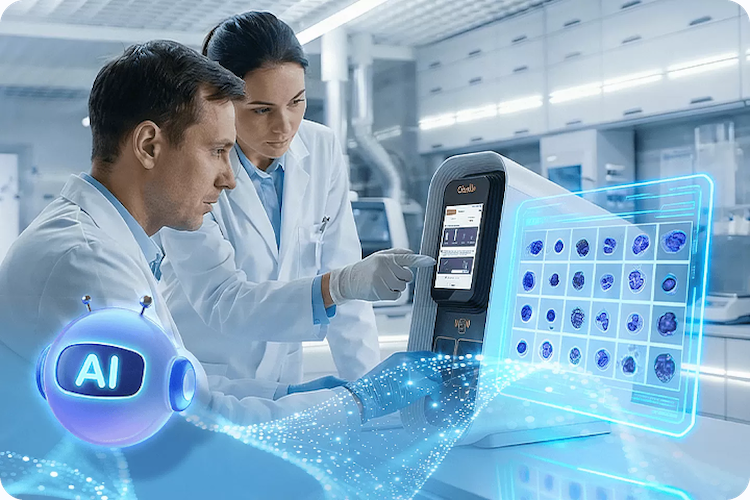
EHBT-75 is a compact 7-diff auto hematology analyzer that uses AI-assisted morphology to extend beyond standard CBC parameters. The system integrates cell morphology for white blood cells, red blood cells and platelets with photoelectric colorimetry for hemoglobin, delivering a combined numerical and image-based report from a small volume of capillary or venous blood. Using single-use cartridges and liquid-based staining, the analyzer automates mixing, staining and image acquisition with limited manual intervention.
Its deep learning algorithms recognize multiple leukocyte subtypes, including NST, NSG and NSH, alongside extended parameters such as ALY, PAg and RET, as well as indices like NLR and PLR. High-resolution imaging provides clear visualization of cellular structures, enabling laboratories to review flagged cells directly on screen rather than preparing separate smears for every sample. As a result, this AI-assisted hematology analyzer can support community hospitals, outpatient labs and satellite sites that require more information than a basic CBC provides, while keeping workflows relatively straightforward.
EHBT-50 Minilab: CBC with integrated immunoassay and dry chemistry
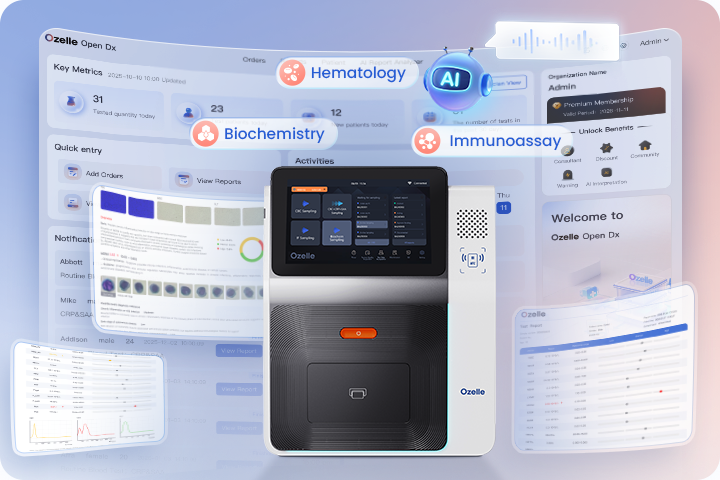
مختبر EHBT-50 الصغير is a multi-functional AI-assisted hematology analyzer that supports combined testing across 7-part differential hematology, immunoassay and dry chemistry. Users can configure single, dual or triple test combinations within one batch, selecting panels based on the clinical question they need to answer. This flexibility allows laboratories to tailor strategies for inflammation, cardiology, thyroid function, diabetes, anemia, liver and kidney function, and lipid assessment.
The hematology channel provides 7-diff CBC with AI-driven cell morphology recognition and extended parameters such as NST, NSG, NSH, ALY, PAg, RET and multiple derived ratios. Immunoassay and chemistry channels use immunofluorescence and dry chemistry technologies, enabling quantitative measurement of markers including CRP, IL-6, PCT, SAA, NT-proBNP, cTnI, HbA1c, thyroid hormones and other commonly requested tests. The system supports venous whole blood, capillary blood, serum and plasma, which makes it suitable for regional hospitals and multi-disciplinary outpatient laboratories handling diverse sample types.
O-Cyte 1: modular AI-assisted hematology analyzer for higher-volume workflows
Design evolution: compact, modular and morphology-centric
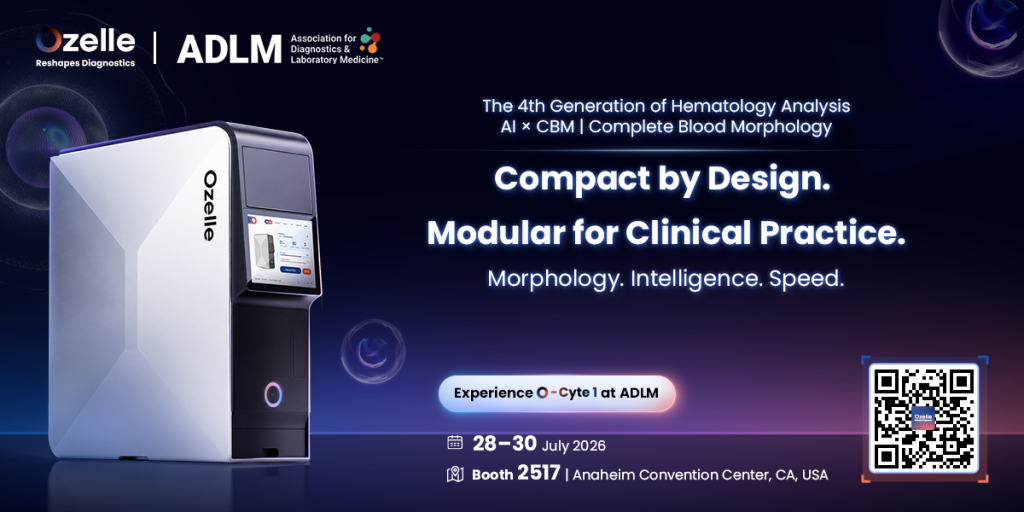
O-Cyte 1 represents a newer generation of AI-assisted hematology analyzer, focusing on complete blood morphology within a compact and modular architecture. The instrument combines AI-based cell morphology with Complete Blood Morphology (CBM) to turn cell images into clinically useful insights, emphasizing not only parameter counts but also traceable visual evidence behind each classification. Fluidics are contained within consumables and the internal structure follows a modular concept, so key components can be replaced more easily when needed.
The analyzer is intended to fit into health check-up centers, regional hospitals and busier laboratories where bench space is limited but sample volumes are substantial. It supports whole blood and capillary blood, with automated loading and image acquisition designed to reduce operator workload. In this way, O-Cyte 1 extends the reach of AI-assisted hematology analyzers into environments that require both morphology detail and a higher level of automation.
Throughput and workflow for busier laboratories
Compared with smaller compact AI-assisted systems, O-Cyte 1 places particular emphasis on supporting higher workloads in routine operation. The autoloader accommodates 25 samples arranged in racks, with random tube placement and automatic barcode identification for efficient batch loading. In standalone mode, the system can process up to 60 tests per hour, and when cascaded with additional units, total capacity can be increased to suit higher demand.
Hands-free sample handling includes automated mixing, closed-tube piercing and a STAT mode that allows priority samples to be processed without fully interrupting routine batches. The imaging pipeline is engineered for minimal cell overlap and consistent image acquisition, which helps maintain morphology performance when sample volumes are high. By combining these workflow features with AI-based recognition, the O-Cyte 1 automated hematology analyzer is positioned for health check-up centers, regional hospitals and reference laboratories that need more continuous and scalable operation.
Application scenarios: health check-ups, regional hospitals and reference labs
The design and operating profile of O-Cyte 1 support several application scenarios in human hematology. In health check-up centers, the analyzer can process daily volumes of CBC samples for annual assessments or corporate programs, with AI-supported morphology review for flagged results that may require further investigation. For regional hospitals, O-Cyte 1 can function as a main hematology platform in the central laboratory, delivering standardized CBC and morphology reports for inpatient, outpatient and emergency departments.
Reference laboratories and specialized centers can make use of the modular architecture and scalable throughput to manage samples from multiple institutions. In these settings, O-Cyte 1’s image-backed classifications can support consultation and quality review, since cell images can be assessed alongside numerical results and control data. The analyzer is planned to be showcased at ADLM 2026, providing a practical example of how what some materials call an “AI blood test analyzer” is implemented in practice as a modular, AI-assisted hematology platform for human diagnostics.
Comparative view of EHBT-75, EHBT-50 and O-Cyte 1
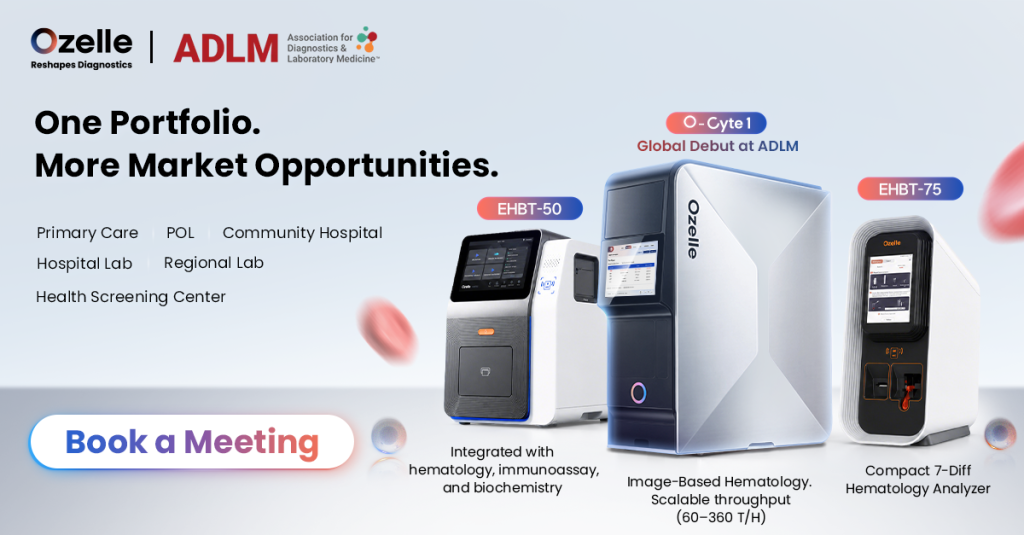
The three instruments discussed here represent different roles for AI-assisted hematology analyzers in human diagnostics. EHBT-75 is a compact 7-diff analyzer with digital morphology support, EHBT-50 combines hematology with immunoassay and dry chemistry in one platform, and O-Cyte 1 is a modular, higher-throughput automated hematology analyzer designed for scalable workflows in busier laboratories.
| الطراز | Role as AI-assisted hematology analyzer | Typical laboratory setting |
| EHBT-75 | Compact 7-diff CBC with digital morphology support | Community hospitals, outpatient labs, satellite sites |
| EHBT-50 | CBC with integrated immunoassay and dry chemistry | Regional hospitals, multi-disciplinary routine laboratories |
| O-Cyte 1 | Modular CBC and morphology for higher-volume labs | Health check-up centers, regional and reference laboratories |
Future directions for AI-assisted hematology analyzers
Data integration, decision support and longitudinal monitoring
As AI-assisted hematology analyzers become more closely linked with hospital information systems, their role in data integration and longitudinal monitoring becomes more visible. Structured CBC and morphology outputs can be connected with clinical records, enabling trends in white cell counts, red cell indices and platelet parameters to be tracked across multiple visits. When combined with biomarkers from immunoassay and chemistry channels, this information can help clinicians view hematology results in the context of broader diagnostic findings.
AI models trained on multi-site datasets may also refine how analyzers flag complex or borderline cases, supporting laboratories in prioritizing which samples require manual review. In some settings, image-backed reports and standardized morphology outputs can facilitate consultation between smaller facilities and larger reference centers.
Standardization, validation and regulatory considerations
The expansion of AI in hematology raises questions around method validation, quality control and regulatory expectations. Comparative studies against established analyzers and manual microscopy are needed to document accuracy, precision, linearity and flagging performance across different patient populations. Internal quality control, external quality assessment and clear documentation of analytical performance remain central to maintaining confidence in AI-assisted morphology.
For new platforms such as O-Cyte 1, engineering features like closed fluidics, internal morphology QC and modular components need to be matched with transparent performance data and well-defined evaluation protocols. As guidance continues to develop, there is ongoing interest in how AI-assisted hematology analyzers record their classification steps and link algorithm outputs with raw image information, so that laboratories can review and audit results when necessary.
الخاتمة
The development of AI-assisted hematology analyzers is changing how hematology results are produced, reviewed and combined with other diagnostic data. Digital cell morphology, automated CBC and closer integration with immunoassay and dry chemistry have expanded the information available from a single blood sample. At the same time, designs now range from compact 7-diff analyzers for smaller facilities to modular platforms that can be used in health check-up centers, regional hospitals and reference laboratories.
Across these different configurations, a common direction is the use of AI to support more reproducible morphology assessment and more structured hematology data, rather than to replace established principles of blood cell analysis. As laboratories adopt these systems, careful attention to validation, workflow integration and quality assurance will remain essential to translating technical capabilities into reliable clinical practice
 English
  Français
  Русский
  Español
  Deutsch
  Português
  العربية
  Italiano