

Traditional hematology analyzers were built around complex internal fluidics: multiple reagent lines, pumps, valves, and waste routes that all have to be flushed, calibrated, and monitored. Every day brings a list of tasks—startup rinses, shutdown cycles, background checks, cleaning probes and tubing, replacing filters, checking waste bottles, running QC panels. When sample volumes are high and staffing is tight, these tasks do not just feel like routine maintenance; they become hard downtime that directly competes with testing capacity.
Over time, this creates a quiet but constant drain on lab performance. You lose hours of productive time each week to procedures that do not generate a single reportable result. You depend heavily on a few “maintenance experts” whose absence can paralyze a shift. And you burn budget on service contracts, spare parts, and emergency engineer visits just to keep aging systems at an acceptable level of reliability.
At some point, the question stops being “How do we maintain this CBC line better?” and becomes “Is there a different way to design a blood testing machine so most of this maintenance disappears?” That is the question behind a new generation of maintenance‑free, cartridge‑based analyzers.

A Different Architecture: Maintenance‑Free, Cartridge‑Based CBC
Modern systems like the Ozelle EHBT‑75 are built on a radically different idea: instead of routing all reagents and samples through complex internal tubing, move most of the fluidics into sealed, single‑use cartridges and keep the instrument itself almost dry.
In practice, this means each CBC test runs inside its own disposable cartridge. The sample enters the cartridge, staining and processing happen in a controlled micro‑environment, and waste stays inside that same sealed unit. The analyzer focuses on optics, mechanics, and AI analysis rather than being a maze of internal liquid pathways.
For a lab manager, the implications are significant:
- No daily probe and tubing cleaning rituals
- No reagent lines to flush or de‑bubble
- Far fewer clog‑related errors and emergency shutdowns
- Room‑temperature cartridge storage instead of cold‑chain logistics
Instead of shutting down an analyzer for 30–60 minutes of manual maintenance, technologists simply load cartridges, run CBCs, and move on. Planned downtime shrinks, and unplanned downtime becomes the exception instead of the norm. That change alone can give you back entire days of productive capacity over the course of a month, especially in high‑volume or extended‑hours labs.
Why a Maintenance‑Free EHBT‑75 Can Actually Replace an Aging CBC Line
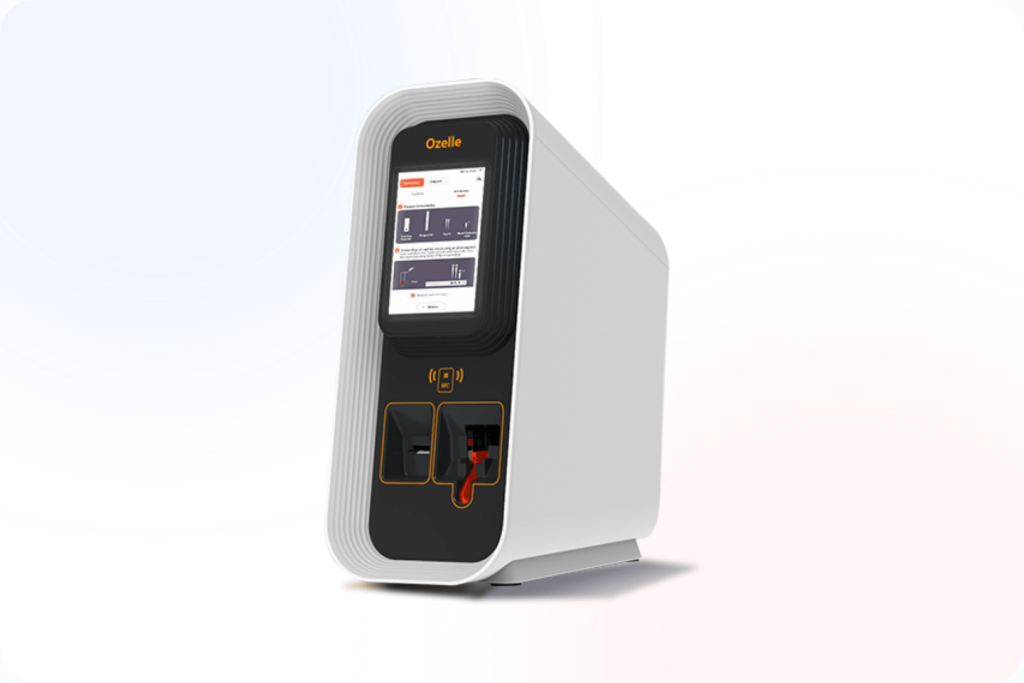
Replacing a long‑standing hematology system is not just about convenience. You need to be sure a new platform can match or exceed the diagnostic performance, handle your daily volume, integrate into your existing LIS, and fit your staffing reality. The EHBT‑75 is designed with that reality in mind: a maintenance‑free architecture paired with deep 7‑diff performance and AI‑powered morphology.
Deep Hematology, Not a “Lite” CBC
EHBT‑75 is built as a professional 7‑diff auto hematology analyzer with a strong focus on detailed blood cell morphology and AI‑enhanced interpretation. Its design centers on delivering rich diagnostic information from a single CBC run, combining advanced differential counts, morphology‑aware analysis, and intelligent flagging to support confident clinical decisions.
From a single small sample, the analyzer delivers around 37 hematology parameters, including:
- Full WBC differential with advanced subsets like NST, NSG, NSH and ALY
- Red cell indices, RDW, RET#, RET% for anemia classification and bone marrow response
- Platelet parameters including PLT, MPV, PAg, and ratios like NLR and PLR that support risk stratification
It uses high‑resolution liquid‑based cytology imaging and AI‑powered Complete Blood Morphology (CBM) to generate morphology‑aware reports that, in many cases, support more efficient morphology assessment workflows. You are not trading maintenance savings for weaker diagnostics; you are upgrading to an AI‑driven blood testing machine that sees more, not less.
In practice, this means the EHBT‑75 can:
- Highlight left shifts via NST (band neutrophils) and flag hypersegmented neutrophils (NSH) that point to specific pathologies
- Detect schistocytes, echinocytes, teardrop cells, and reticulocytes in RBC populations, supporting more precise differential diagnoses
- Provide platelet morphology and activation insights via PAg and related indices, which can be critical in thrombocytopenia or clotting risk assessments
For clinicians and hematologists, this richer data helps shorten the path from “abnormal CBC” to a focused diagnostic hypothesis and targeted follow‑up testing.
True Maintenance‑Free Operation That Cuts Downtime
The point of a maintenance‑free design is not marketing—it is measurable time and cost recovery. By moving to single‑use cartridges and a no internal fluidic path architecture, EHBT‑75 removes most daily and weekly maintenance tasks that older analyzers require.
Labs using this model can:
- Eliminate large portions of scheduled downtime for cleaning, flushing, and decontamination
- Reduce the frequency of service calls triggered by clogs, leaks, or pump failures
- Shrink their reliance on a small group of “maintenance specialists,” since routine operation becomes more standardized and training‑friendly
From a lab manager’s perspective, this directly translates into more predictable throughput, fewer bottlenecks on busy days, and a more resilient operation when key staff are away. Instead of planning shift coverage around maintenance windows, you plan around testing demand.
Financially, the shift is just as important. When a significant part of your cost of ownership is tied to service contracts, spare pumps, valves, and periodic rebuilds, moving to a cartridge‑based system can flatten maintenance expenses and make budgeting far more predictable. Cartridges themselves are consumables, but you replace complexity and emergency engineer visits with a straightforward, per‑test supply model.
Compact Footprint and Flexible Deployment
Aging CBC lines often occupy large bench areas, require dedicated utility connections, and resist reconfiguration when the lab layout changes. The EHBT‑75, by contrast, is designed as a compact standalone analyzer with a small footprint, minimal installation requirements, and room‑temperature consumables.
This offers several strategic options:
- Place one EHBT‑75 in the core lab and another in a satellite area (for example, ED, oncology, or day surgery) to offload urgent work and reduce turnaround times
- Reclaim bench space previously reserved for reagent racks, large waste containers, and maintenance access clearance
- Scale up capacity incrementally by adding more units as volume grows, instead of over‑investing in a single, monolithic CBC line
The flexibility makes it easier to redesign your lab around workflow rather than around the constraints of legacy hardware. For networks with multiple sites, a standardized EHBT‑75 footprint and cartridge model also simplify deployment across locations, training, and shared protocols.
AI‑Assisted Interpretation That Supports Staff
Downtime is not only about hardware. Every ambiguous result that triggers manual smear review, repeat testing, or senior review is a form of cognitive downtime for your team. EHBT‑75 addresses this by embedding an intelligent diagnostic workbench directly into the analyzer interface.
The system links CBC parameters, morphology images, and AI guidance in a single screen, highlighting patterns associated with infections, inflammatory states, hematologic disorders, and complex anemias. AI does not replace your hematologists, but it helps junior staff interpret results more quickly and reduces the number of borderline cases that stall the workflow.
Examples include:
- Flagging profiles that suggest bacterial vs viral infection patterns, based on NEU, LYM, MON, EOS, and inflammatory markers where integrated
- Pointing out combinations of low lymphocytes and high monocytes or NST that may indicate early or progressive infection or immune dysfunction
- Summarizing key abnormalities with plain‑language clinical hints that guide further review and correlation with the patient’s context
Over hundreds of tests per week, faster, more confident interpretation is another way a modern blood testing machine quietly returns time to your lab. It also supports more consistent quality across shifts and sites, which is critical when experienced hematology staff are in short supply.
What a Maintenance‑Free Platform Changes in Everyday Lab Life

When you put these elements together, a maintenance‑free architecture like EHBT‑75 does more than simplify the technologist’s daily checklist. It changes how the whole lab operates.
- Scheduling becomes simpler. You no longer have to “reserve” mid‑day blocks for cleaning or run long overnight maintenance cycles that can fail and delay morning startup.
- Staff training becomes easier. New technologists can focus on sample handling, quality control, and interpretation rather than learning complex mechanical procedures.
- Downtime risk drops. If a cartridge fails, you discard it and run another test; you are much less likely to be facing a clogged internal line that takes an analyzer out of service.
It also changes how you think about redundancy. Instead of relying on one large, complex CBC line that must never fail, you can deploy multiple compact analyzers and accept that any one unit can be taken offline for updates, validation, or rare repairs without paralyzing operations.
So, Can a Maintenance‑Free Blood Testing Machine Really Replace Your Old CBC Line?
If your current hematology analyzers are reliable, easy to maintain, and rarely down, there is less urgency to change. But many central labs now face the opposite reality: aging CBC lines with rising maintenance costs, frequent interruptions, and workflows that no longer fit today’s staffing and volume pressures.
A maintenance‑free, cartridge‑based platform like the EHBT‑75 AI hematology analyzer offers a different path. It keeps the diagnostic depth of a professional 7‑diff system while stripping away much of the plumbing, cleaning, and downtime that used to be accepted as “just part of hematology.”
For lab managers, the decision is ultimately about which constraint you want to live with over the next five to ten years: an aging CBC line that consumes more and more maintenance time, or a new‑generation blood testing machine designed from day one to be compact, AI‑driven, and effectively maintenance‑free.
If you are planning a replacement or expansion in the coming years, evaluating a cartridge‑based system like the EHBT‑75 alongside traditional analyzers can make the trade‑offs much clearer—not just in terms of technical specs, but in terms of uptime, staffing, and long‑term cost of ownership.
 English
  Français
  Русский
  Español
  Deutsch
  Português
  العربية
  Italiano