
 العربية
 English
 Français
 Русский
 Español
 Deutsch
 Português
 Italiano

A complete blood count (CBC) is often one of the first laboratory tests performed when a patient presents with nonspecific symptoms. While individual abnormalities may have many possible causes, the relationship between multiple parameters—and the cellular findings behind them—can provide important clues for further clinical evaluation.
This case describes a 65-year-old woman whose initial hematology assessment raised concern for an underlying blood disorder. Subsequent specialist investigations confirmed chronic myeloid leukemia (CML).

Case Report
Clinical Presentation
Patient:
65-year-old woman
Chief Complaint:
Fatigue and decreased appetite for approximately two months, with a sensation of fullness in the left upper abdomen during the preceding month.
History of Present Illness:
The patient experienced fatigue, reduced exercise tolerance, and decreased appetite. She subsequently developed early satiety and occasional mild left upper abdominal distention. She reported no obvious fever, chills, symptoms of infection, or bleeding manifestations. She had lost approximately 4 kg over the previous three months.
Past Medical History:
Previously healthy, with no known history of hematologic disease.
A Markedly Abnormal Hematology Profile
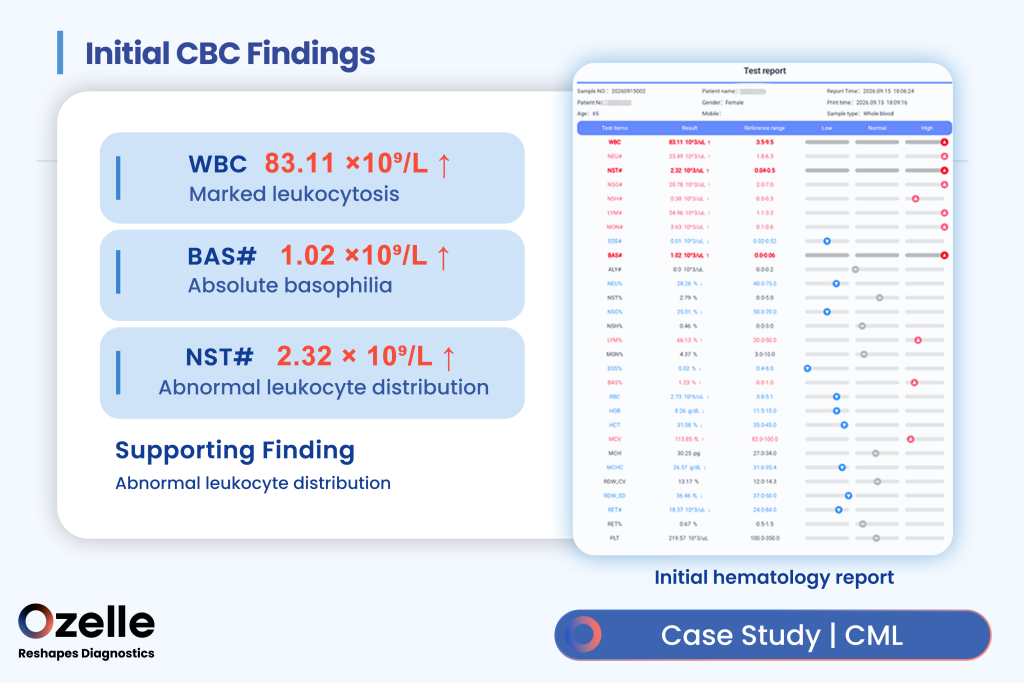
Initial testing on the Ozelle EHBT-50 Mini Lab revealed marked leukocytosis, with a white blood cell count of 83.11 ×10⁹/L, NST count of 2.32 × 10⁹/L and significant absolute basophilia (BAS# 1.02 ×10⁹/L).
Red cell parameters indicated anemia, with an RBC count of 2.73 ×10¹²/L and hemoglobin of 8.26 g/dL. The leukocyte distribution was also markedly abnormal, while the platelet count remained within the reference range at 219.57 ×10⁹/L.
Although these findings were not sufficient to establish a diagnosis, their combination—particularly the pronounced leukocytosis, basophilia, and anemia—raised concern for an underlying hematologic disorder requiring further evaluation.
AI-Assisted Interpretation
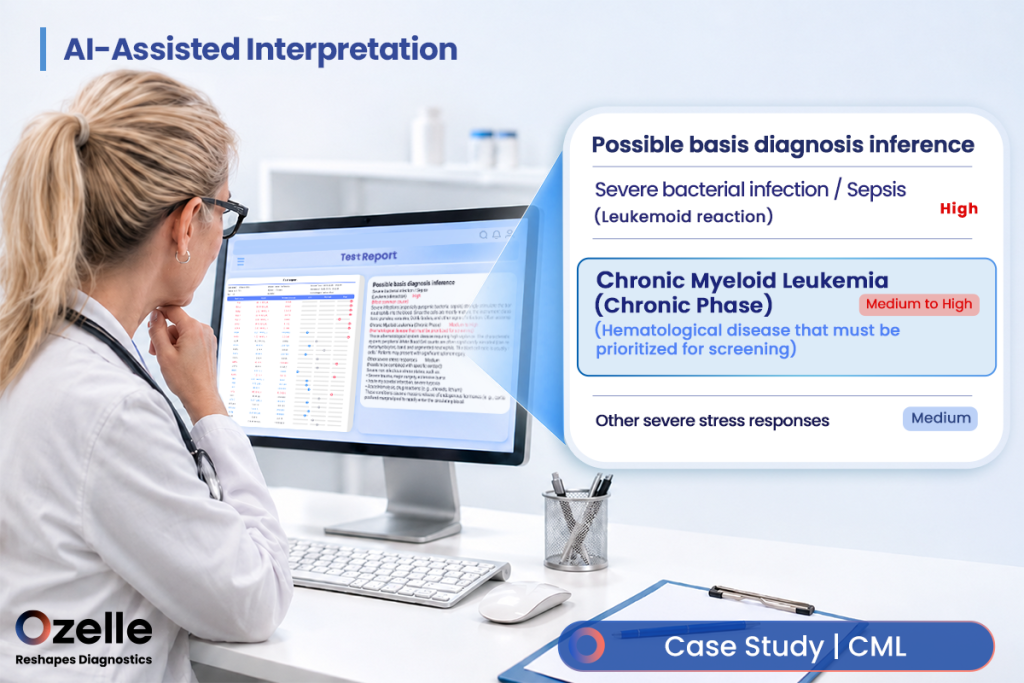
During the initial assessment, Ozelle’s AI-assisted interpretation function analyzed the hematology findings and presented possible underlying conditions.
Notably, it highlighted CML as a hematologic disease that should be prioritized for further screening. The interpretation also considered other possible explanations, including severe infection and a leukemoid reaction, indicating the need for further clinical differentiation.
Further Investigation and Diagnosis
The patient was subsequently referred to a specialist hospital. Further evaluation included a peripheral blood smear, bone marrow cytomorphology, cytochemical staining, flow cytometry, chromosomal karyotype analysis, and molecular testing.
Following this work-up, chronic myeloid leukemia (CML) was confirmed.
Discussion
Looking Beyond Cell Counts
The initial CBC revealed abnormalities that clearly warranted medical attention. The more complex question was how to interpret these findings together and distinguish between possible underlying conditions.
Marked leukocytosis can occur in severe infections, reactive processes, and hematologic malignancies. In this patient, the accompanying basophilia, anemia, and abnormal leukocyte distribution provided additional information beyond the elevated WBC count alone. Taken together, these findings raised concern for a myeloproliferative disorder.
The Ozelle EHBT-50 Mini Lab, powered by الذكاء الاصطناعي × CBM (التشريح الكامل للخلايا الدموية), combines quantitative blood cell analysis with digital cell morphology in a single testing workflow. Its hematology report also includes AI-assisted interpretation, which considers the findings together and presents possible underlying conditions for further clinical evaluation.
In this case, the AI interpretation highlighted CML as a hematologic condition requiring priority consideration, while also identifying other possible explanations, including severe infection and a leukemoid reaction. Rather than simply identifying abnormal blood counts, it helped place the findings in a broader clinical context and provided relevant diagnostic possibilities for further investigation.
Implications for Routine Hematology
Patients with hematologic diseases may initially present with symptoms that overlap with many common conditions. Fatigue, appetite changes, and weight loss do not necessarily suggest a specific diagnosis, making laboratory testing an important part of the initial clinical assessment.
The clinical significance of a CBC often extends beyond individual cell counts. Abnormalities in leukocyte distribution, red cell parameters, and cellular morphology can provide additional clues when considered together, helping clinicians determine which findings require closer investigation.
This is particularly relevant in primary care clinics, routine laboratories, and decentralized healthcare settings, where immediate access to experienced morphology specialists or advanced hematologic testing may be limited.
By integrating CBC, digital cell morphology, and AI-assisted interpretation into a compact diagnostic system, the مختبر EHBT-50 الصغير makes more comprehensive hematologic information available during initial testing. This approach can support the assessment of abnormal blood results, help clinicians consider relevant diagnostic possibilities, and inform decisions about further specialist evaluation.
Bringing these capabilities into routine testing is an important step toward making advanced hematology more accessible across different healthcare settings. The aim is to provide clinicians and laboratory professionals with meaningful information at the initial point of care, supporting appropriate investigation when clinically significant abnormalities are identified.
المراجع
- Cross NCP, Ernst T, Branford S, et al. European LeukemiaNet laboratory recommendations for the diagnosis and management of chronic myeloid leukemia. Leukemia. 2023;37:2150–2167. doi:10.1038/s41375-023-02048-y.
- Kratz A, Lee SH, Zini G, Riedl JA, Hur M, Machin S. Digital morphology analyzers in hematology: ICSH review and recommendations. Int J Lab Hematol. 2019;41(4):437–447. doi:10.1111/ijlh.13042.