
 Français
  English
  Русский
  Español
  Deutsch
  Português
  العربية
  Italiano
L'adoption de l'IA dans les diagnostics vétérinaires s'accélère rapidement, le marché mondial des diagnostics vétérinaires étant en train de se développer. devrait atteindre 5,36 milliards d'USD d'ici 2030, contre 3,68 milliards d'USD en 2025 (CAGR 7,8%). Pourtant, une incertitude majeure persiste parmi les professionnels vétérinaires : L'IA fonctionne-t-elle aussi bien pour le sang animal que pour le sang humain ?
La réponse est sans équivoque oui, et les implications sont transformatrices pour les soins de santé animale.
Traditionnel analyseurs de sang vétérinaire s'appuient sur des méthodes d'impédance et de cytométrie de flux qui ne fournissent que des comptages cellulaires de base. L'interprétation manuelle de la microscopie reste subjective, prend du temps et dépend fortement de l'expertise de chaque technicien. Parallèlement, les propriétaires d'animaux de compagnie exigent de plus en plus des capacités de diagnostic équivalentes à celles des soins de santé humains, s'attendant à ce que leurs animaux bénéficient de la même technologie médicale avancée que celle dont ils disposent eux-mêmes.
Cet article explique comment les analyseurs d'hématologie vétérinaire alimentés par l'IA modifient fondamentalement l'analyse sanguine en médecine vétérinaire. Nous présentons des applications spécifiques à certaines espèces, des preuves cliniques d'une précision supérieure et des améliorations réelles de la vitesse de diagnostic, en particulier dans des scénarios d'urgence vitale. À la fin, vous comprendrez que les analyseurs alimentés par l'IA sont de plus en plus adoptés comme outils de diagnostic avancés dans les pratiques vétérinaires progressives.
L'évolution : De la microscopie manuelle à l'analyse assistée par ordinateur
Pour comprendre ce saut technologique, il faut examiner près de 170 ans d'évolution du diagnostic.
1850s : L'ère de la microscopie manuelle
Au départ, l'analyse du sang se faisait entièrement au microscope manuel, en fonction du technicien et de manière très subjective. Les résultats variaient considérablement d'un opérateur à l'autre et le diagnostic reposait entièrement sur l'expertise et les compétences d'interprétation de chacun.
Années 1950-1970 : Impédance et cytométrie en flux
Des méthodes de comptage automatisées ont vu le jour, mais elles souffraient d'une limitation critique : elles comptaient les cellules sans analyser la morphologie. Les diagrammes de dispersion et les histogrammes ne fournissaient que des informations de base, sans les détails morphologiques essentiels à l'identification de la maladie.
Années 1980-2000 : Systèmes semi-automatiques
L'accélération du traitement a permis de réduire les délais d'exécution, mais ces systèmes nécessitent toujours l'examen d'un pathologiste expert pour l'interprétation. Une grande variabilité inter-opérateurs a persisté - des microscopistes expérimentés n'étaient pas d'accord sur les résultats dans 15-20% des cas.
2017-Présent : Morphologie sanguine complète pilotée par l'IA
Des réseaux d'apprentissage profond formés sur plus de 50 000 installations, plus de 50 millions d'images cellulaires générées quotidiennement et plus de 100 milliards de points de données cellulaires accumulés permettent désormais une analyse morphologique complète. Il ne s'agit pas d'une amélioration progressive, mais d'une transformation fondamentale de la capacité de diagnostic.
Les analyseurs d'hématologie vétérinaire alimentés par l'IA fournissent désormais des photographies cellulaires réelles combinées à une classification algorithmique, une signalisation automatique des anomalies avec des images de preuves réelles et des résultats reproductibles quelle que soit l'expérience de l'opérateur. Alors que les systèmes traditionnels fournissent 3 à 5 paramètres, les analyseurs d'IA modernes capturent plus de 42 paramètres d'analyse morphologique complète.
Les données à l'appui sont convaincantes :
- Plus de 50 000 installations dans le monde
- Plus de 50 millions d'images cellulaires générées quotidiennement
- Plus de 100 milliards de points de données cellulaires accumulés
- 97%+ précision dans la classification des cellules pour toutes les espèces
- Corrélation R² ≥0,98 par rapport aux méthodes de référence de l'étalon-or
Comment fonctionne l'IA : Les trois piliers des analyseurs hématologiques vétérinaires modernes
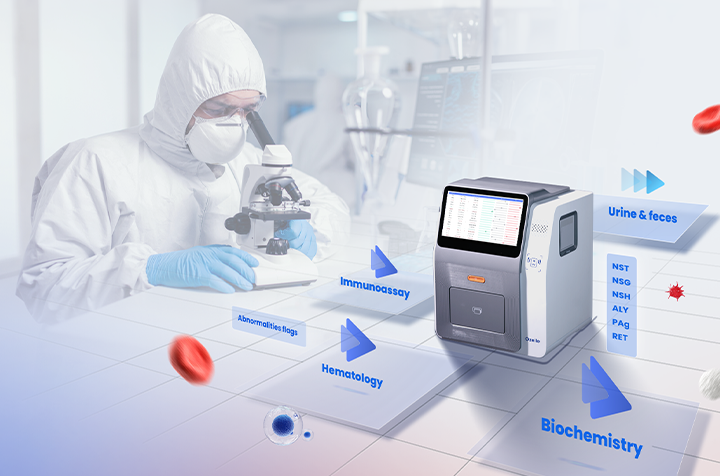
Les analyseurs hématologiques vet alimentés par l'IA fonctionnent grâce à trois systèmes intégrés :
Pilier 1 : Expert Brain (moteur d'apprentissage profond)
Les réseaux neuronaux convolutifs formés sur plus de 40 millions d'échantillons sanguins réels apprennent les schémas morphologiques plutôt que de s'appuyer sur des algorithmes codés en dur. Contrairement aux systèmes traditionnels, l'intelligence artificielle s'améliore continuellement avec chaque échantillon analysé. Le système détecte automatiquement les manifestations de maladies rares, les variations morphologiques subtiles indiquant un début de maladie, les modèles cellulaires spécifiques aux espèces, essentiels pour les animaux exotiques, et les marqueurs de maladies que les systèmes traditionnels ne peuvent pas identifier.
Pilier 2 : yeux de précision (imagerie optique avancée)
Les objectifs personnalisés, optimisés pour la Suisse, capturent des détails en immersion dans l'huile avec une résolution de 4 mégapixels et 50 images par seconde. L'imagerie multispectrale combine la lumière visible et l'imagerie à bande étroite, tandis que la technologie Z-Stack brevetée permet de capturer des cellules en 3D, avec une précision équivalente à celle de la microscopie manuelle et une cohérence numérique.
Pilier 3 : Mains de technicien (précision robotique)
Un bras mécanique entièrement automatisé avec une précision de positionnement inférieure à 1 micromètre assure le chargement, la dilution, la coloration et le mélange automatiques des échantillons. Des systèmes de réactifs scellés empêchent la contamination tout en éliminant la variabilité humaine inhérente à la préparation manuelle des échantillons.
Le résultat intégré : Analyse morphologique complète en 6 minutes, sans aucune étape d'interprétation manuelle, sans aucune dépendance à l'égard de l'opérateur et avec des résultats cohérents 24 heures sur 24, 7 jours sur 7 et 365 jours par an, quel que soit le niveau de compétence du technicien.
Précision clinique : Ce que montrent les preuves
Les paramètres de performance qui sous-tendent les analyseurs d'hématologie vétérinaire modernes sont extraordinaires :
- Précision de la classification cellulaire : 97%+ pour tous les types de cellules sanguines standard
- Coefficient de variation : ≤6,0%, indiquant une précision et une répétabilité exceptionnelles.
- Corrélation Gold-Standard : R² ≥0,98 pour les paramètres de la formule sanguine, des globules rouges et des plaquettes.
- Validation des espèces : Éprouvé pour les espèces canines, félines, équines et exotiques.
Les capacités de détection de maladies spécifiques démontrent également leur supériorité :
- Neutrophiles immatures : La détection automatique du NST/de la bande cellulaire capture le stress de la moelle osseuse et indique une infection bactérienne précoce.
- Réticulocytes : Évalue la capacité de régénération de la moelle osseuse à la suite d'une maladie ou d'une chimiothérapie.
- Anomalies morphologiques : Identifie les schistocytes, les cellules en goutte d'eau et les sphérocytes, marqueurs d'hémolyse ou de maladie grave.
- Détection de parasites : Identification automatique d'organismes infectieux que les systèmes traditionnels ne parviennent pas à détecter.
Les résultats de la recherche sont convaincants : Les algorithmes d'apprentissage profond sont plus performants dans la détection de maladies spécifiques - atteignant une précision de 92% dans l'hémorragie pulmonaire équine induite par l'exercice, contre 76% pour les experts humains. L'IA réduit les erreurs de diagnostic de 15-20% par rapport aux systèmes automatisés traditionnels, tout en égalant les performances de professionnels de laboratoire très expérimentés.
Avantages spécifiques à l'espèce : Résoudre le défi des pratiques mixtes
Le problème fondamental des analyseurs traditionnels
L'une des limites les plus critiques des analyseurs hématologiques vétérinaires traditionnels apparaît immédiatement dans les cabinets mixtes : les caractéristiques des cellules sanguines diffèrent fondamentalement d'une espèce à l'autre. Le nombre de basophiles et d'éosinophiles canins diffère considérablement des valeurs félines. La taille et la morphologie des GR des oiseaux et des reptiles nécessitent des approches algorithmiques totalement différentes. Les analyseurs traditionnels à algorithme fixe appliquent une logique de taille unique, ce qui fausse systématiquement l'interprétation des échantillons de sang des animaux exotiques. Cette limitation conduit à des diagnostics erronés, à des protocoles de traitement inutiles et à des diagnostics corrects dangereusement retardés, ce qui compromet directement les résultats pour les patients.
Capacités de diagnostic spécifiques aux chiens
Les analyseurs d'hématologie vétérinaire alimentés par l'IA excellent dans la détection des maladies spécifiques aux chiens. L'identification précoce des infections permet de détecter le parvovirus (CPV), le distemper canin (CDV) et les maladies transmises par les tiques avant que les symptômes cliniques n'évoluent. La distinction entre les bactéries et les virus se fait par la reconnaissance des profils de GB spécifiques à l'espèce. Les marqueurs de la réponse immunitaire - réponses au stress, réactions aux vaccins, suppression immunitaire - deviennent immédiatement apparents. La surveillance du cancer permet une détection précoce des tumeurs malignes hématologiques, y compris la leucémie et le lymphome. La classification de l'anémie distingue les modèles régénératifs des modèles non régénératifs, ce qui permet de prendre des décisions précises en matière de traitement.
Supériorité diagnostique spécifique aux félins
Les diagnostics félins représentent un domaine dans lequel les analyseurs alimentés par l'IA apportent une valeur clinique transformatrice. La détection de l'antigène FeLV atteint une précision de 98%+, dépassant largement les tests rapides traditionnels de 86-93%. La détection des anticorps du FIV atteint une sensibilité de 100% et une spécificité de 97%+ dans les études de validation clinique. L'analyse des enzymes pancréatiques spécifiques à l'espèce permet d'identifier les marqueurs de la pancréatite grâce à la mesure de la PLI féline. La chimie et l'hématologie intégrées permettent un dépistage complet de l'hyperthyroïdie chez les chats gériatriques. Le suivi automatisé des marqueurs de maladie permet de surveiller la progression de la réponse au traitement de la leucémie féline, éliminant ainsi la variabilité de l'interprétation manuelle.
Impact clinique des algorithmes spécifiques aux espèces
L'IA élimine les erreurs de diagnostic dues à une application inappropriée des algorithmes. Les cliniques mixtes peuvent en toute confiance traiter simultanément des chiens, des chats, des oiseaux et des animaux exotiques, chacun recevant une analyse adaptée à son espèce. Le délai de diagnostic passe de 24-48 heures (laboratoire de référence) à 6 minutes (en clinique), ce qui permet une intervention thérapeutique immédiate. Les résultats du traitement s'améliorent considérablement grâce à l'identification précise de la maladie spécifique à l'espèce, ce que les analyseurs génériques ne peuvent pas faire. Les praticiens acquièrent une confiance diagnostique qui nécessitait auparavant la consultation d'un laboratoire de référence ou l'examen d'un spécialiste en pathologie vétérinaire.
Médecine d'urgence : Comment 6 minutes sauvent des vies
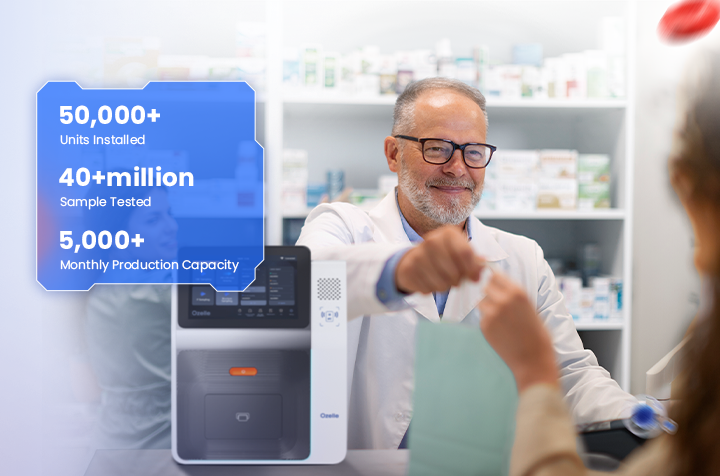
La réalité de la septicémie est brutale : la mortalité augmente de 4-9% par heure de retard dans le diagnostic. Le délai d'exécution des laboratoires traditionnels est de 2 à 4 heures ; les laboratoires de référence ont besoin de 24 à 48 heures.
Les analyseurs d'hématologie vétérinaire alimentés par l'IA fournissent des résultats en 6 à 10 minutes, ce qui permet de prendre des décisions diagnostiques immédiates, ce qui est impossible avec les méthodes traditionnelles.
L'identification de la septicémie par l'augmentation du nombre de globules blancs et le déplacement vers la gauche (neutrophiles immatures) déclenche des décisions immédiates en matière d'antibiotiques. Impact dans le monde réel : le délai entre la porte et l'administration d'antibiotiques est passé de 45 à 15 minutes.
Applications d'urgence spécifiques :
- Septicémie/infection : Une numération rapide de la formule sanguine + différentiel + marqueurs inflammatoires (CRP, SAA) confirment l'infection bactérienne.
- Hémorragie aiguë : l'évaluation de l'hémoglobine guide les décisions de transfusion
- Anaphylaxie : L'évaluation des basophiles/éosinophiles indique une réponse allergique systémique.
- Évaluation des traumatismes : L'analyse du sang total permet d'évaluer l'état de choc
- Surveillance postopératoire : Le suivi rapide de la réponse immunitaire permet d'identifier les complications
Les données cliniques démontrent que les services d'urgence qui mettent en œuvre une NFS rapide au point de service présentent des temps d'administration d'antibiotiques significativement plus courts, une réduction de la mortalité associée au sepsis (20-68% de mortalité sans diagnostic rapide contre 80% de survie avec traitement rapide), une meilleure conformité à l'ensemble des mesures relatives au sepsis, et une prise de décision clinique plus rapide.
Considérez ceci : les animaux septiques sans diagnostic rapide sont confrontés à une mortalité de 20-68%. Avec un diagnostic au point d'intervention et un traitement immédiat, le taux de survie passe à 80%. Une vie sauvée est incommensurable, sans compter la satisfaction des propriétaires et l'impact sur la réputation de l'hôpital.
Rentabilité et efficacité opérationnelle
Au-delà des avantages cliniques, les analyseurs d'hématologie vet alimentés par l'IA offrent des avantages opérationnels et financiers substantiels.
Efficacité de la main-d'œuvre :
La conception sans maintenance élimine le fardeau du contrôle de qualité quotidien. L'analyse automatisée réduit considérablement la charge de travail des techniciens. Un seul opérateur traite efficacement 8 à 10 échantillons par heure avec une formation minimale.
Optimisation des consommables :
Les cartouches uniques tout-en-un intègrent les tests de NFS, d'immunodosage et de chimie. Les kits de tests individuels évitent la contamination croisée. Le stockage à température ambiante élimine les coûts de réfrigération, tandis que la durée de conservation de 2 ans minimise les déchets.
Consolidation des équipements :
Un seul analyseur multifonctionnel permet de consolider 3 à 4 instruments distincts, ce qui réduit l'espace du laboratoire de 60-70% et libère de l'espace précieux pour les soins aux patients.
Coût total de possession sur 5 ans :
Les petites pratiques (10-50 échantillons/jour) atteignent des périodes de récupération de 24 mois. Les pratiques moyennes (50-150 échantillons/jour) atteignent des périodes de retour sur investissement de 18 mois. Les économies typiques comprennent une réduction de 40 à 50% du coût par test, une réduction de 30 à 40% des heures de travail, une diminution de 50 à 70% de l'externalisation du laboratoire de référence, et une élimination des coûts du laboratoire de référence de $15 000 à $30 000 par an.
Les propriétaires d'animaux de compagnie paient volontiers des 15-25% primes d'honoraires pour des diagnostics avancés, ce qui offre des opportunités de revenus substantielles pour les pratiques positionnées comme équipées d'IA.
Études de cas réels
Cas #1 : Infection bactérienne précoce
Un Labrador âgé de 8 semaines s'est présenté léthargique avec de la fièvre (102,8°F). Résultat de l'analyseur traditionnel : “GB 13 000/µL - signification clinique indéterminée”. Résultat de l'analyseur AI : NFS 13 200/µL + 18% NST + drapeau de décalage à gauche automatisé. L'administration immédiate d'antibiotiques a permis d'éviter un retard potentiellement fatal.
Cas #2 : Diagnostic spécifique à l'espèce
Clinique mixte présentant simultanément un chat et un chien fébriles. Système traditionnel : Les deux sont marqués comme “élévation de la formule sanguine”. Système IA : Le chat présentait un antigène FeLV ; le chien présentait un modèle de maladie transmise par les tiques. Des diagnostics différents ont permis des traitements différents et appropriés.
Cas #3 : Intervention d'urgence en cas de septicémie
Chien présentant un ulcère gastro-intestinal perforé avec suspicion de péritonite septique. Délai traditionnel : délai total de 3 heures pour la confirmation de la septicémie. Délai de l'IA : résultat en 6 minutes, protocole de septicémie immédiat, antibiotiques dans les 20 minutes. Réduction du délai de diagnostic de plus de 2 heures ; le propriétaire estime que le diagnostic rapide a sauvé la vie de son chien.
Regarder vers l'avenir : Limites et orientations futures
Les analyseurs d'hématologie vétérinaire alimentés par l'IA complètent - et ne remplacent pas - l'expertise vétérinaire. L'interprétation clinique nécessite l'évaluation d'un vétérinaire expérimenté. Un biais algorithmique reste possible si les ensembles de données d'entraînement manquent de diversité dans certaines conditions. Une validation et un contrôle de qualité continus sont essentiels. Les barrières de coût dans les marchés émergents persistent, bien qu'elles diminuent rapidement.
Les capacités émergentes comprennent l'intégration moléculaire combinant la morphologie et les marqueurs génétiques, l'analyse prédictive prévoyant les résultats cliniques, l'intégration de la télémédecine permettant l'examen pathologique à distance, et des bibliothèques d'algorithmes élargies pour les espèces exotiques.
Questions fréquemment posées
Q1 : L'hématologie assistée par IA nécessite-t-elle une formation spécialisée pour le personnel vétérinaire ?
Non. Les analyseurs modernes sont dotés d'interfaces intuitives à écran tactile nécessitant une formation minimale. Dans la plupart des cabinets, le personnel est opérationnel en 1 à 2 jours. La conception sans entretien du système élimine les routines complexes d'étalonnage quotidien.
Q2 : Les résultats de l'IA sont-ils fiables pour toutes les espèces animales ?
Oui. Les systèmes AI sont validés pour les espèces canines, félines, équines et exotiques à l'aide d'algorithmes spécifiques à chaque espèce. Contrairement aux analyseurs traditionnels à algorithme fixe, l'IA s'adapte aux caractéristiques uniques des cellules sanguines de chaque espèce, garantissant ainsi des résultats précis dans l'ensemble de votre pratique.
Q3 : Comment la précision de l'IA se compare-t-elle aux résultats des laboratoires de référence ?
Les analyseurs alimentés par l'IA atteignent une précision de 97%+ avec une corrélation R²≥0,98 avec les méthodes de référence de l'étalon-or. Les études montrent que l'IA surpasse les spécialistes humains dans la détection de maladies spécifiques - atteignant une précision de 92% contre 76% pour les experts humains dans le diagnostic des hémorragies équines.
Q4 : Quel est le délai de retour sur investissement ?
Les petits cabinets sont généralement rentabilisés en 24 mois ; les cabinets de taille moyenne le sont en 18 mois. La réduction des coûts provient d'une diminution de 40 à 50% des coûts par test, d'une réduction de 30 à 40% des heures de travail et de l'élimination de $15 000 à $30 000 dépenses annuelles du laboratoire de référence.
Q5 : Les résultats alimentés par l'IA peuvent-ils se suffire à eux-mêmes, ou les vétérinaires doivent-ils encore les interpréter ?
L'IA complète l'expertise vétérinaire - elle ne remplace jamais le jugement clinique. Les analyseurs fournissent des données morphologiques objectives et des images de cellules réelles, permettant une interprétation fiable en clinique tout en réduisant le risque d'erreur de diagnostic et la dépendance à l'égard des laboratoires de référence.
Conclusion
Les analyseurs d'hématologie vétérinaire alimentés par l'IA représentent la nouvelle norme de soins en matière de diagnostic vétérinaire, et non un luxe.
Précision jusqu'à 97% dans la classification des cellules, validée pour les principales espèces d'animaux de compagnie. Le délai d'exécution de six minutes permet des interventions d'urgence impossibles avec les laboratoires traditionnels. Des algorithmes spécifiques à chaque espèce permettent de résoudre les problèmes critiques posés par les pratiques mixtes. La rentabilité et l'amélioration des résultats justifient l'investissement en capital. Les attentes des propriétaires d'animaux de compagnie s'alignent de plus en plus sur les diagnostics avancés.
Les responsables vétérinaires devraient considérer les analyseurs alimentés par l'IA comme une infrastructure de diagnostic essentielle. Les premiers à les adopter bénéficient d'un avantage concurrentiel significatif. Les résultats pour les patients s'améliorent immédiatement. La satisfaction du personnel augmente avec l'automatisation. Les propriétaires d'animaux de compagnie récompensent les pratiques avancées en les fidélisant et en leur versant des primes.
Les cabinets qui investissent aujourd'hui dans cette technologie seront à la pointe de leur marché tout en fournissant des capacités de diagnostic supérieures qui améliorent directement les résultats en matière de santé animale et la satisfaction des propriétaires.
Visiter https://ozellemed.com/en/ pour découvrir comment les analyseurs d'hématologie vétérinaire alimentés par l'IA transforment la médecine vétérinaire.