
 English
  Français
  Русский
  Español
  Deutsch
  Português
  العربية
  Italiano
1. Introduction: A New Era of Emergency Blood Diagnostics
It’s 3:47 AM in a busy metropolitan ambulance. A 58-year-old patient presents with fever, chills, and confusion—classic sepsis indicators. In traditional emergency response, paramedics would transport the patient to the hospital, initiate oxygen and IV fluids, then wait 2–4 hours for critical blood work results. During those hours, bacterial infection spreads unchecked, mortality risk escalates with every minute of delayed antibiotics.
Instead of moving in diagnostic uncertainty, the team immediately initiates aggressive fluid resuscitation and transmits the digital morphology reports directly to the receiving hospital. This ‘pre-arrival notification’ allows the Emergency Department to activate their Sepsis Bundle protocols and prepare targeted antimicrobial therapy in advance. By the time the patient reaches the ER, the ‘door-to-antibiotic’ clock has been slashed, transforming the ambulance from a simple transport vehicle into a high-precision diagnostic frontline that effectively extends the hospital’s life-saving capabilities into the field.But today’s ambulance carries something revolutionary: an AI-powered point-of-care (POC) blood analyzer. Within 6 minutes of blood draw, the paramedic team has complete blood count results showing elevated white blood cells and immature neutrophils—unequivocal sepsis signals. They initiate broad-spectrum antibiotics immediately, pre-notifying the emergency department of suspected sepsis and critical findings. The patient arrives at hospital having already started life-saving therapy, with diagnostic confirmation in hand rather than diagnostic uncertainty.
This scenario represents the fundamental transformation reshaping emergency diagnostics: the shift from laboratory-centric testing to patient-centered, real-time analysis. AI-powered POC blood analyzers are literally moving the lab from hospital basements to ambulances, clinic waiting rooms, and rural health posts. This democratization of sophisticated diagnostics is rewriting the timeline of emergency care, expanding diagnostic access to underserved populations, and fundamentally changing how healthcare systems think about testing and treatment.
2. From Central Labs to the Point of Care: Why Change Was Needed
2.1 The Traditional Laboratory-Centric Model
For over a century, blood diagnostics centered on the hospital laboratory. Phlebotomists collected samples, placed specimens in collection tubes with specific anticoagulants and additives, then routed samples through a complex logistics chain: transportation to the lab, specimen accessioning, batching with other samples, analysis on centralized instruments, quality control review, physician verification, and finally result reporting—typically 2–6 hours later for routine testing, often 24–48 hours in resource-limited settings.
This centralized model required highly specialized staffing: phlebotomists, laboratory technicians, hematologists, and quality assurance specialists. Each collected sample traveled 100+ meters from collection site to instrument. Batching meant urgent samples waited for routine samples to complete. Transportation created pre-analytical variables—temperature fluctuations, sample agitation, processing delays—that degraded specimen quality and analytical accuracy.
The system worked adequately for chronic disease management and routine screening. But for acute emergencies where every minute determines survival, centralized laboratory testing proved fundamentally inadequate. Sepsis mortality increases 7–9% with each hour of delayed antibiotics. Acute myocardial infarction outcomes worsen with each minute of delayed reperfusion therapy. Hemorrhagic shock demands transfusion decisions within minutes, not hours of diagnostic uncertainty.
2.2 Clinical and Operational Pain Points
Consider the sepsis presentation: a patient arrives with fever and clinical sepsis suspicion. The emergency physician recognizes sepsis criteria and understands antibiotics must start immediately. But without diagnostic confirmation—elevated WBC? left shift? elevated lactate?—initiating broad-spectrum antibiotics seems premature. So the physician waits for blood culture and CBC results. Two hours later, positive cultures and confirmed elevated white blood cells justify the antibiotic therapy that should have started immediately.
Meanwhile, the emergency department overflows with waiting patients. Bed management coordinators hold patients in hallways pending lab results. The 4-hour typical ED length of stay stretches to 6+ hours while diagnostic bottlenecks cascade. Patient satisfaction plummets. Operational efficiency crumbles. Staff frustration mounts.
The inequity burden falls heaviest on resource-limited regions. In sub-Saharan Africa, a febrile patient awaiting CBC results might wait 48+ hours while infection overwhelms their immune system. In rural Latin America, a pregnant woman with suspected preeclampsia delays hospital transport pending blood chemistry confirmation. In Southeast Asian clinics, trauma patients with uncertain bleeding status make transfusion decisions through clinical judgment alone, without hemoglobin verification.
3.What Is an AI-Powered Point-of-Care Blood Analyzer?

3.1 Core Concept and Capabilities
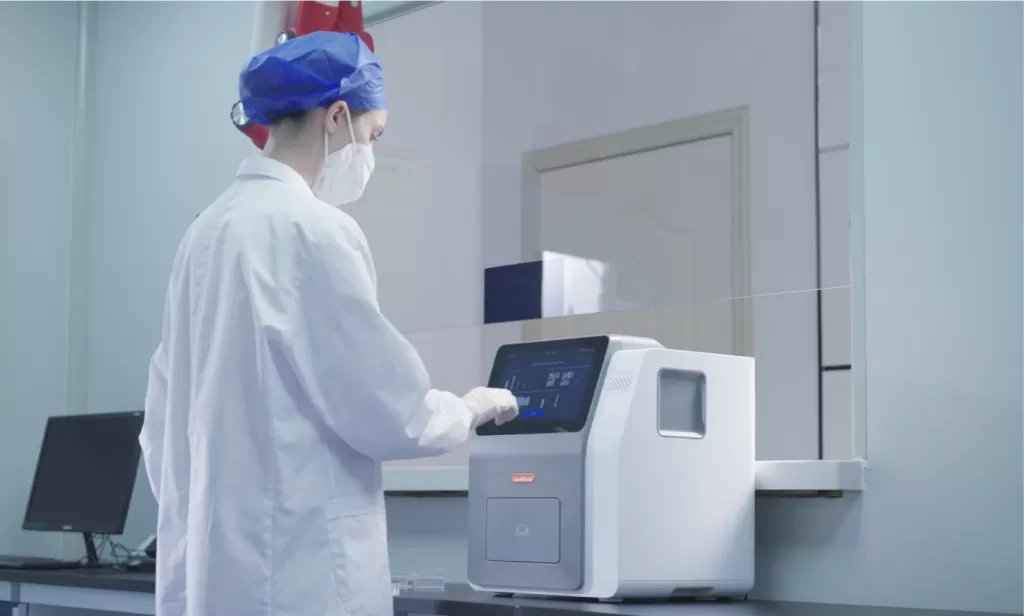
A point-of-care blood analyzer is a sophisticated instrument miniaturized for bedside deployment. Unlike traditional laboratory analyzers requiring dedicated climate-controlled rooms, specialized infrastructure, and highly trained technicians, POC analyzers operate from standard electrical outlets in emergency departments, ambulances, and clinic corners.
The fundamental advantage: speed. Traditional hematology analyzers require approximately 500 microliters of blood, automated staining protocols lasting 20–30 minutes, image capture from thousands of cells, and analytical processing before result reporting—total time 2–6 hours including pre-analytical processing.
POC blood analyzers deliver complete blood count results in 6–10 minutes using just 30 microliters of blood—1/16th the sample volume. The compact cartridge-based design automates sample loading, staining, mixing, and imaging within an integrated disposable system. Results print directly to the device or transmit electronically to the hospital information system.
The typical POC test menu includes:
- Complete Blood Count (CBC): white blood cell count, red blood cell count, hemoglobin, hematocrit, mean corpuscular volume (MCV), mean corpuscular hemoglobin (MCH), mean corpuscular hemoglobin concentration (MCHC), platelets
- 7-Differential Analysis: neutrophils, lymphocytes, monocytes, eosinophils, basophils, immature neutrophils (NST), nucleated red blood cells (NRBC), reticulocytes (RET)
- Abnormal Cell Flagging: detection of atypical lymphocytes, schistocytes, spherocytes, and other morphologically significant cells
- Derived Parameters: neutrophil-to-lymphocyte ratio (NLR), platelet-to-lymphocyte ratio (PLR), immature neutrophil percentage (NEUTIM)
Some advanced POC platforms integrate additional modules for blood gas analysis, electrolyte measurement, or basic immunoassays, creating mini-laboratory platforms that perform comprehensive testing from a single sample at the point of care.
3.2 The Role of AI in Modern Hematology and POC Testing
Traditional hematology analyzers use impedance-based counting: blood cells flow through an electrical field, creating resistance proportional to cell volume. This physics-based counting accurately quantifies cell numbers but provides minimal morphologic information. Abnormal cells that fall within expected size ranges pass undetected. Immature cells indistinguishable by size alone escape identification.
AI-powered POC analyzers employ radically different technology. High-resolution digital microscopy captures detailed images of individual blood cells—similar to traditional microscopy but at automated scale analyzing thousands of cells per second. Deep learning neural networks trained on millions of annotated cell images recognize cellular characteristics with pathologist-level accuracy.
The AI system identifies not just cell categories but subtle morphologic features: nuclear-to-cytoplasmic ratio indicating cell immaturity, chromatin texture suggesting abnormal differentiation, cytoplasmic inclusions indicating specific pathologies. Machine learning algorithms flag cells requiring human review, creating a hybrid system combining automated efficiency with quality assurance.
Practical benefits of AI:
- Improved accuracy in abnormal populations: Traditional impedance-based counting struggles with severe anemia, extreme leukocytosis, or malignant cell populations. AI-driven morphology maintains accuracy across the full pathologic spectrum.
- Reduced manual workload: Traditional hematology requires technicians reviewing manual smears for flagged samples. AI-powered systems perform preliminary morphologic assessment automatically, reserving human review for genuinely abnormal findings.
- Consistent interpretation across expertise levels: AI models trained on expert hematologists’ annotations provide consistent morphologic interpretation regardless of local expertise. A nurse in a rural clinic receives the same diagnostic quality as a pathologist in a tertiary center.
- Sepsis detection assistance: AI algorithms integrate CBC parameters with clinical context, generating sepsis risk scores and alerting clinicians to immature neutrophil patterns indicating bacterial infection.
- Inside the Ambulance: POC Blood Analyzers in Emergency Medical Services
4.1 A Day in the Life of an Ambulance Team Using POC Analyzers
Loading the sample into the POC analyzer, they initiate testing. For 6 minutes they manage the patient—supplemental oxygen, cardiac monitoring, IV fluid considerations—while the analyzer completes its automated protocol. No need to wait until arriving at the hospital to begin testing; immediate point-of-care assessment provides diagnostic guidance during transport.
Result notification: white blood cell count 14,800 (elevated), hemoglobin 7.8 g/dL (moderate anemia), mean corpuscular volume 92 (normal), platelets 245,000 (normal). The immature neutrophil detection shows elevated NST percentage—clear bacterial infection signal.
Interpretation: Acute anemia with infection. Most likely diagnosis given the clinical presentation: pneumonia with sepsis.
The paramedics transmit the POC results to the receiving hospital. “Bringing in a 72-year-old with acute dyspnea, sepsis vitals, POC CBC showing WBC 14.8K with elevated immature neutrophils, hemoglobin 7.8. Patient is hemodynamically stable, ETA 12 minutes.”
The emergency physician, armed with this diagnostic information, alerts blood bank and infectious disease consultation. The patient arrives with diagnostic data already in hand, enabling rapid triage and appropriate clinical decision-making.
4.2 Clinical Use Cases in Pre-Hospital Care
Suspected Sepsis and Infection:
POC CBC parameters identify infection patterns rapid enough to guide pre-hospital intervention. Elevated WBC (>11,000), immature neutrophil flagging (NST >5%), left shift (elevated band neutrophils), and elevated lactate (in integrated biochemistry platforms) provide objective sepsis confirmation. Paramedics initiate broad-spectrum antibiotics based on objective findings rather than clinical judgment alone, reducing door-to-antibiotic time from typical 45 minutes to <15 minutes. This acceleration of antimicrobial therapy directly improves sepsis survival.
Acute Chest Pain and Cardiac Assessment:
Cardiac troponin remains the gold-standard myocardial infarction marker, but POC CBC provides supporting information. Low hemoglobin (<8 g/dL) raises anemia concern; elevated white blood cell count suggests inflammatory response. In integrated POC platforms combining CBC with cardiac troponin, paramedics receive diagnostic information enabling informed decision-making about destination hospital selection and pre-arrival notification to activate cardiology consultation.
Trauma and Acute Hemorrhage:
Massive transfusion protocols depend on rapid hemoglobin assessment guiding transfusion decisions. POC CBC providing immediate hemoglobin values enables paramedics to initiate damage control resuscitation—rapid whole blood or packed red cell transfusion—during transport. Platelet count assessment guides coagulation resuscitation to prevent dilutional coagulopathy.
4.3 Evidence and Feasibility Data
Published feasibility studies demonstrate paramedic competency with POC blood analyzers. Research from European emergency medicine systems shows paramedics reliably obtain samples, operate analyzers, and interpret results after 4–8 hours of initial training. Analytical performance matches traditional laboratory values (correlation coefficients >0.98), indicating no accuracy degradation from ambulance deployment.
The primary challenges identified: workflow integration with hospital laboratories, result verification protocols, and training standardization. Departments successfully implementing prehospital POC analyzers created clear protocols for specimen handling, device operation, and result transmission. They integrated POC results into electronic health records for continuity with hospital-based diagnostics. They established quality assurance protocols and technician-reviewed result verification.
5. Key Technologies Enabling Mobile and POC Deployment

5.1 Hardware and Design Innovations
POC blood analyzers designed for ambulance deployment must withstand environmental challenges that would destroy standard laboratory instrumentation. The device operates within an ambulance experiencing constant vibration, temperature fluctuations (from 0°C winter cold to 45°C summer heat), and physical impacts from road conditions.
Ruggedized design specifications:
- Vibration resilience: Isolated optical and mechanical components prevent vibration-induced drift. Shock-absorbing mounting systems protect sensitive imaging apparatus. Sealed cartridge design eliminates moving parts vulnerable to vibration.
- Temperature stability: Integrated thermal management maintains analyzer performance across 0–40°C operating range. Room-temperature-stable reagents stored in cartridges eliminate cold-chain requirements. Unlike traditional hematology requiring precise temperature control (±1°C), POC systems tolerate broader temperature ranges.
- Compact footprint: Emergency vehicle cargo space is precious. POC analyzers measure approximately 40 × 20 × 50 cm and weigh <5 kg—similar to a laptop computer. This enables mounting on equipment racks or portable deployment to multiple vehicles.
- Power efficiency: Compact devices consume minimal power—48–100 watts—enabling operation from ambulance electrical systems, portable power inverters, or even battery backup. Traditional laboratory analyzers require 500+ watts, incompatible with mobile deployment.
Cartridge-based disposable systems:
Rather than reusable cuvettes and cleaning protocols, POC systems employ single-use cartridges containing pre-loaded reagents, stains, and optical surfaces. After sample analysis, the cartridge discards into biohazard waste. Each run starts with fresh reagents and sterile surfaces.
This design eliminates cross-contamination risks, eliminates quality control complexity, and removes maintenance burden. A paramedic needs no training in analyzer maintenance—just load the cartridge and sample.
5.2 AI Software, Connectivity, and IoT Integration
Modern POC analyzers embed sophisticated AI algorithms locally on the device—what technologists call “edge computing.” The analyzer doesn’t transmit raw cell images to cloud servers for analysis; instead, AI models run directly on the device’s integrated processor. Raw 30-microliter blood sample → automated staining and imaging → local AI analysis → results generated → results transmitted to hospital system.
This architecture provides critical advantages:
- Privacy protection: Raw patient data never leaves the device. Only de-identified results transmit for storage and analysis.
- Connectivity independence: The analyzer functions perfectly without internet connection. Results transmit whenever connectivity becomes available—immediate transmission in urban areas with robust cellular coverage, batch transmission in rural areas with intermittent connectivity.
- Real-time decision support: Results appear on the device screen within 6 minutes, enabling immediate clinical action without waiting for network transmission or cloud processing delays.
Cloud connectivity for integration:
When internet connectivity is available, POC analyzers transmit results to hospital information systems via secure WiFi or cellular networks. This integration creates several advantages:
- Electronic health record integration: POC results populate automatically into patient charts without manual result entry.
- Telehematology consultation: Abnormal results trigger automatic transmission to available hematologists or pathologists. Complex cases receive specialist interpretation within minutes of result generation.
- Aggregate data analytics: Healthcare systems correlating thousands of POC results can identify infection outbreaks, screen for unusual epidemiologic patterns, and track disease surveillance indicators.
6. Democratizing Diagnostics: Impact on Resource-Limited and Remote Settings
6.1 The Diagnostics Gap
Billions of humans live beyond reliable laboratory access. The World Health Organization estimates 3.5 billion people lack access to basic laboratory testing. In sub-Saharan Africa, a single laboratory serves populations of 100,000+. In rural Asia, the nearest laboratory may be 50+ kilometers distant. In many regions, laboratory access exists only through private paying services that impoverish families seeking basic diagnostic confirmation.
The consequences permeate healthcare systems. A pregnant woman with severe headache and elevated blood pressure—classic preeclampsia presentation—cannot access platelet and liver function testing to assess disease severity. She delivers prematurely or risks maternal mortality through preventable seizure or stroke. A child with persistent fever cannot access blood cultures or CBC to guide antibiotic selection. The clinician treats empirically with multiple antibiotics while the child’s infection progresses untreated.
6.2 How POC Blood Analyzers Bridge the Gap
POC analyzers fundamentally change this diagnostic desert. A compact hematology analyzer deployed in a rural clinic or mobile health unit creates laboratory capability where centralized systems cannot reach.
Deployment models:
- Fixed location in rural clinics: Primary health centers serving populations of 5,000–10,000 obtain permanent POC analyzer placement. Nurses trained in basic operation perform CBC testing on-site, eliminating transportation delays and multi-day result turnaround.
- Mobile health units: Dedicated vans equipped with POC analyzers travel to remote villages, performing diagnostic testing from clinic tents. Maternal health programs screen pregnant women for anemia, preeclampsia, and infection. Pediatric vaccination programs assess nutritional status and infection susceptibility.
- Field hospitals and emergency response: Disaster response systems deploy POC analyzers in field hospitals when centralized laboratory access becomes impossible. Earthquake response efforts, infectious disease outbreak investigations, and armed conflict medical support all leverage POC deployment.
Workforce expansion:
POC analyzers enable task-shifting—deploying diagnostic capability beyond specialized laboratorians to nurses, midwives, and community health workers. A nurse at a rural clinic can operate a POC analyzer after 4–6 hours of training. A community health worker at a village health post requires similarly brief orientation. This workforce expansion multiplies diagnostic capability per healthcare dollar invested.
6.3 AI as a Force Multiplier for Limited Expertise
In resource-limited settings, POC analyzers don’t just provide faster testing—they provide consistent interpretation quality despite extreme variation in local expertise. A paramedic in an ambulance with 2 years of medical training receives the same AI-driven morphologic assessment as a pathologist in a tertiary medical center.
This standardization proves transformative. Abnormal cell detection doesn’t depend on technician expertise. Sepsis risk algorithms apply consistently across geographic regions and training levels. Immature neutrophil flagging identifies infection with standard sensitivity and specificity regardless of provider background.
7. Benefits for Healthcare Systems, Clinicians, and Patients
7.1 Clinical Outcomes and Patient Safety
The primary benefit: faster, more accurate clinical decisions. Emergency physicians making sepsis decisions possess diagnostic confirmation within 10 minutes rather than diagnostic uncertainty lasting 2+ hours. Trauma surgeons deciding massive transfusion protocols have hemoglobin values guiding transfusion volume rather than clinical judgment alone.
Published outcomes studies document significant improvements. Healthcare systems implementing POC analyzers in emergency departments show 12–18% sepsis mortality reduction through accelerated antibiotic initiation. Average ED length of stay decreases 45 minutes through elimination of laboratory result delays. Dyspneic patients receive rapid anemia confirmation, enabling targeted transfusion rather than empiric oxygen therapy.
7.2 Operational Efficiency and Cost Considerations
Beyond clinical benefits, POC analyzers generate substantial operational efficiency:
- Reduced ED crowding: Laboratory result delays extend ED stays. Faster diagnostics reduce occupancy times, enabling higher patient throughput.
- Reference laboratory elimination: Many clinics currently send samples for reference laboratory analysis requiring 24–48 hour turnaround and generating ongoing costs. POC deployment eliminates these send-outs entirely.
- Reduced admission rates: Diagnostic uncertainty forces conservative admission decisions. Rapid POC testing enables confident outpatient management of low-risk presentations.
Total cost of ownership analysis reveals POC analyzers typically pay for themselves through operational savings within 12–18 months.
7.3 Equity and Access
Beyond clinical efficiency, POC deployment addresses healthcare equity. Diagnostic capability—previously concentrated in wealthy urban centers with advanced laboratory infrastructure—becomes accessible to rural populations and resource-limited regions.
This expansion of access produces measurable equity improvements. Rural areas previously facing 24–48 hour diagnostic delays now receive same-day confirmation, narrowing outcome disparities. Patients previously unable to afford reference laboratory testing gain access to immediate diagnostics. Resource-limited regions upgrade diagnostic capacity without massive infrastructure investment.
8. Challenges, Risks, and Responsible Implementation
8.1 Technical and Clinical Limitations
POC analyzers excel at complete blood count and basic hematologic assessment but lack the full panel scope of comprehensive laboratory systems. Chemistry analysis, immunology testing, and microbiology culture require more sophisticated systems.
Clinicians must understand POC diagnostic boundaries. Positive sepsis alerts require clinical correlation and confirmation with blood cultures. Abnormal hemoglobin levels need evaluation for chronic anemia versus acute bleeding. Platelet abnormalities warrant peripheral smear review when malignancy or bone marrow dysfunction is suspected.
Environmental factors in mobile settings pose additional challenges. Vibration during transport can compromise optical accuracy; proper device stabilization prevents this. Temperature extremes affect reagent performance; operational limits must be respected. Dust, moisture, and contamination require protective protocols.
8.2 Data, AI Ethics, and Regulatory Considerations
Deploying AI systems requires careful attention to bias and fairness. AI algorithms trained predominantly on samples from wealthy populations may perform differently on genetically diverse populations. Validation studies must explicitly assess performance across different ethnic groups, geographic populations, and disease prevalence patterns.
Data security and patient privacy demand protection. Cloud connectivity creates potential vulnerabilities; robust encryption and access controls protect transmitted results. Local data storage on devices must use secure platforms preventing unauthorized access.
Regulatory approval pathways vary by geography. U.S. FDA clearance requires predetermined approval pathways. European CE marking follows proportionate risk-based frameworks. Low-resource countries often lack structured regulatory oversight; responsible deployment requires self-imposed quality standards and transparent performance validation.
8.3 Training, Change Management, and Workflow Integration
Successfully deploying POC analyzers requires more than device installation. Paramedics need training in sample collection, device operation, result interpretation, and result communication. Nurses require orientation to workflow integration. Physicians need education about POC result reliability and clinical application.
Workflow redesign proves essential. Ambulance teams need clear protocols for result transmission to receiving hospitals. ED teams need procedures for correlating POC results with confirmatory laboratory testing. Clinic teams need documentation standards for POC result recording in medical records.
9. The Road Ahead: Future Directions for AI-Powered Emergency and POC Blood Testing
9.1 Expanding Test Menus and Multi-Analyte Platforms
Current POC analyzers focus on hematology; next-generation platforms integrate additional testing modalities. Compact biochemistry modules enable glucose, electrolytes, and renal function testing from single samples. Integrated immunoassays add cardiac markers, inflammatory proteins, and hormonal assessment.
Future syndromic testing will target specific clinical presentations. Sepsis bundles combining CBC, lactate, inflammatory markers, and biomarkers enable comprehensive sepsis assessment from single POC analysis. Chest pain panels combining troponin, BNP, and hemoglobin guide acute coronary syndrome and heart failure differentiation. Coagulation modules add PT/INR and PTT testing for stroke and bleeding risk assessment.
9.2 Smarter AI and Predictive Analytics
Advanced AI models will move beyond describing findings (elevated WBC, immature neutrophils) toward predicting outcomes. Machine learning algorithms incorporating CBC parameters with vital signs and clinical context will generate sepsis severity scores, mortality risk estimates, and treatment response predictions.
Continuous learning systems will update algorithms using real-world data from thousands of POC analyzers worldwide. As systems accumulate millions of test results, patterns emerge enabling increasingly sophisticated clinical insights.
9.3 Integration into the Wider Digital Health Ecosystem
POC analyzers will integrate with telemedicine platforms, remote monitoring systems, and population health programs. A rural clinic performing POC testing connects seamlessly to tertiary center specialists for remote consultation on complex findings. Aggregate data from distributed analyzers tracks infectious disease patterns, identifies outbreak emergence, and guides public health interventions.
Conclusion: From Hospital Labs to Ambulances—and Beyond
The transformation captured in “from hospital labs to ambulances” represents more than operational convenience—it reflects a fundamental reimagining of where diagnostic capability belongs. For a century, sophistication required centralization. Laboratory experts in specialized facilities using advanced equipment provided diagnostic information to practicing clinicians.
AI-powered POC blood analyzers invert this paradigm. They distribute laboratory-grade diagnostic capability to the point of patient care. Paramedics in ambulances access diagnostic information previously available only in hospital laboratories. Community health workers in rural villages provide testing previously requiring 50-kilometer transportation. Clinic nurses in primary care facilities perform hematology analysis previously requiring specialized technician expertise.
This democratization of diagnostics addresses healthcare’s most fundamental inequity: unequal access to diagnostic confirmation. Billions of humans live beyond reliable laboratory access. POC deployment begins to correct this global injustice.
The clinical impact proves equally significant. Emergency physicians making sepsis decisions possess diagnostic data supporting confident antibiotic initiation. Trauma surgeons guide transfusion decisions through objective hemoglobin assessment. Rural clinicians expand diagnostic capability without massive infrastructure investment.
The journey from hospital labs to ambulances is only beginning. Future innovations will expand testing scope, strengthen AI clinical insights, and integrate POC analyzers more deeply into digital health ecosystems. But the fundamental transformation—moving diagnostics from buildings to patients—has already begun.
This is the new reality of emergency diagnostics: diagnosis doesn’t wait for the patient to reach the laboratory. The laboratory comes to the patient, wherever that patient is: in an ambulance rushing through city streets, in a rural clinic serving remote villages, in a mobile health unit bringing care to underserved populations.
That transformation—from centralized laboratory testing to distributed point-of-care diagnostics—represents genuine progress toward healthcare systems that serve all patients equitably, regardless of geography, wealth, or access to infrastructure. For more information on advanced POC blood analyzer solutions and deployment strategies, visit https://ozellemed.com/en/.