
 English
  Français
  Русский
  Español
  Deutsch
  Português
  العربية
  Italiano
For more than seventy years, hematology analysis has advanced through successive technological breakthroughs. From automated cell counting to multi-parameter flow cytometry and digital morphology, each generation of innovation has expanded how laboratories observe and understand blood.
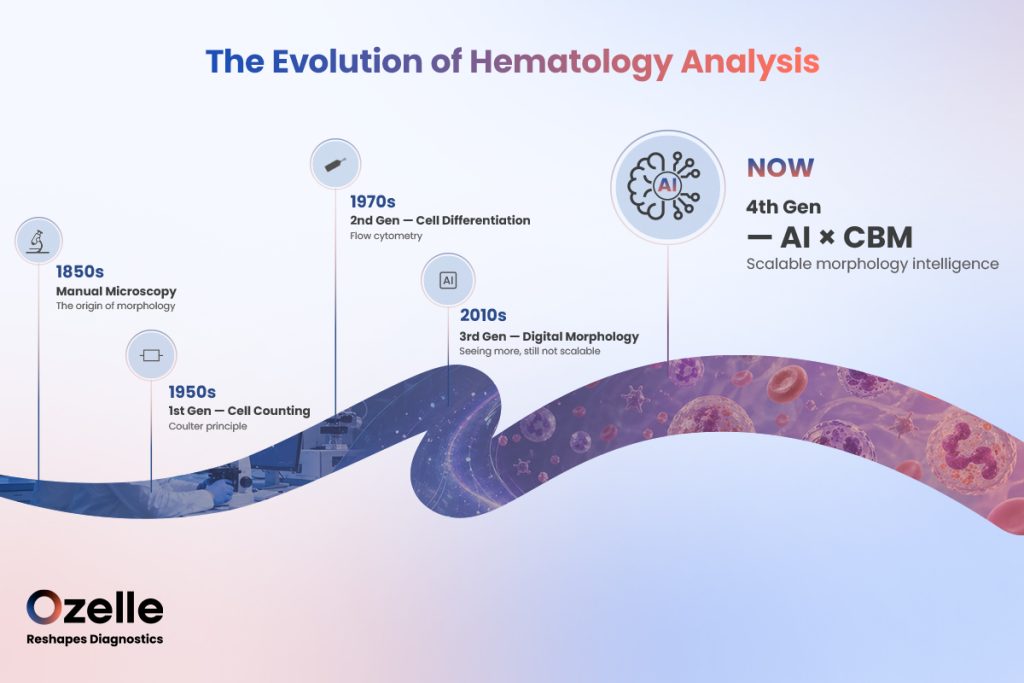
Yet one of the most information-rich dimensions of hematology has remained difficult to scale: cellular morphology. For decades, identifying abnormal cells has relied on the trained eye of experienced specialists. Microscopic review offers deep diagnostic insight, but it is inherently difficult to standardize and extend across modern healthcare systems.
Today, the landscape of healthcare is changing. Diagnostics is no longer confined to centralized laboratories. Across hospitals, clinics, and distributed care networks, diagnostic testing is becoming a high-frequency clinical infrastructure supporting everyday medical decisions. In this environment, diagnostic systems must operate reliably across different clinical settings, varying levels of operator experience, and real-world workloads.
Accuracy alone is no longer sufficient. Diagnostic technologies must also deliver consistency, operational stability, and scalability across healthcare networks. This shift is redefining what diagnostic technology must become. At the same time, another transformation has been taking place: the evolution of artificial intelligence.
Built Alongside the Evolution of Artificial Intelligence
Ozelle was founded in 2014 in a Silicon Valley laboratory during the early wave of deep learning. From the beginning, Ozelle focused on applying machine intelligence to one of the most complex challenges in laboratory diagnostics—cellular morphology analysis.
Between 2014 and 2019, Ozelle pioneered the integration of deep learning with high-resolution cellular imaging, achieving early breakthroughs in automated morphology recognition. This effort brought together a cross-disciplinary team spanning structural biology, imaging science, and computer vision. Among the key contributors were John Wu, PhD, whose expertise in computational structural biology helped translate complex biological structures and cellular patterns into machine-interpretable representations, and G. Cong, PhD, an inventor of multiple U.S. patents in cellular image analysis whose work advanced the algorithmic foundations for automated cell classification.
As artificial intelligence evolved into the era of foundation models and transfer learning, Ozelle extended its research beyond algorithm development toward real-world diagnostic applications. From 2020 onward, under the technical leadership of Jie Du—whose work bridges intelligent hardware, machine vision, and sensor systems—the team developed AI × Complete Blood Morphology (AI × CBM), a framework designed to standardize morphology analysis across instruments, environments, and clinical users. This approach enables consistent, high-precision morphology interpretation validated across real clinical settings.
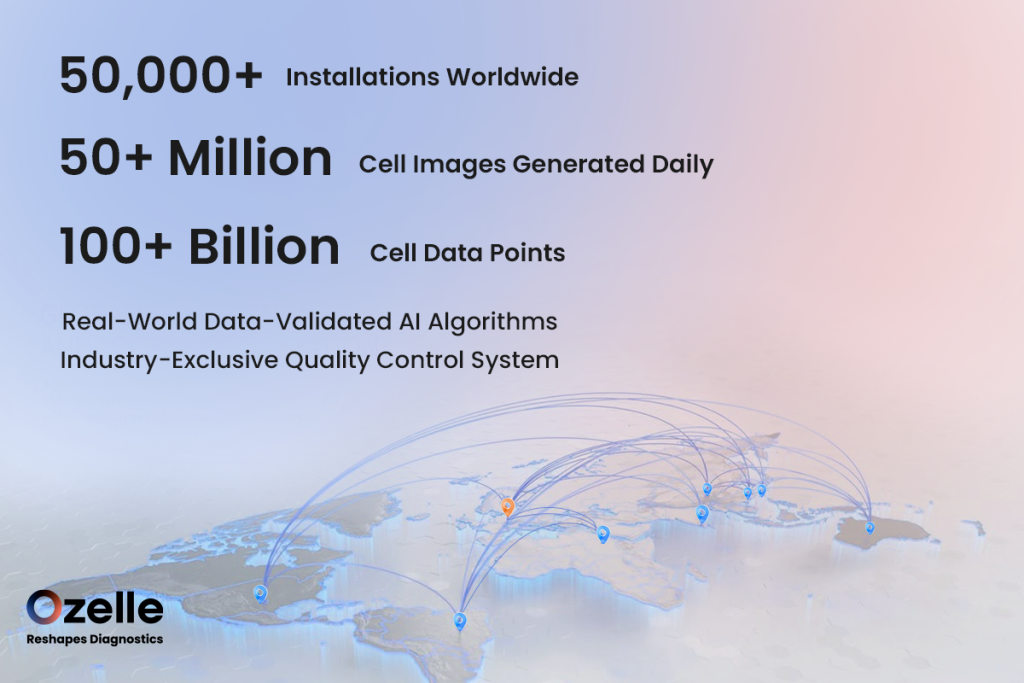
Over the past decade, Ozelle has grown alongside successive waves of artificial intelligence development—transforming advances in machine perception into practical diagnostic capability. Today, Ozelle operates globally, with operations in Frankfurt, Germany, bringing together advanced imaging, machine intelligence, and diagnostic system engineering. Ozelle systems are now deployed worldwide across both medical and veterinary markets.
Turning Morphology Into Scalable Intelligence
Traditional hematology diagnostics provide highly reliable numerical parameters, yet morphology interpretation has largely remained dependent on manual expertise. Ozelle addresses this challenge through AI × CBM. CBM ensures that cellular morphology is captured with consistent imaging quality across samples and instruments. AI then analyzes these morphological features to produce standardized interpretations of cellular patterns.
Together, AI and CBM transform morphology analysis from an individual expert skill into a consistent diagnostic capability that can be applied across laboratories, clinics, and healthcare networks. This transformation marks the beginning of the fourth generation of hematology analysis.
Diagnostics Engineered as a System
Real clinical environments rarely resemble controlled laboratory conditions. Workloads fluctuate, operators vary in experience, and expert review may not always be immediately available. For this reason, Ozelle approaches diagnostics not as standalone instruments, but as integrated systems designed for everyday clinical environments.
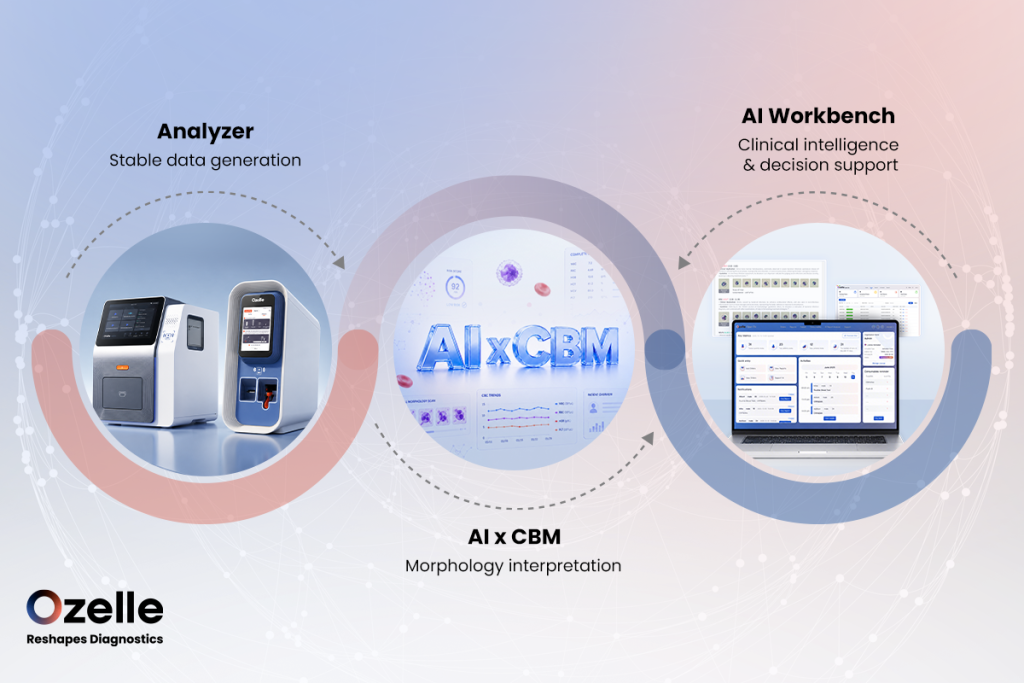
At the foundation are analyzers engineered for stable operation across distributed healthcare environments. Beyond analytical performance, the systems are designed for long-term measurement consistency, minimal maintenance, and reduced operator dependency.
Built on this foundation is AI × CBM, which converts cellular morphology into structured, machine-interpretable information. By combining standardized imaging with AI-powered interpretation, morphology insights can be generated consistently across instruments and clinical sites.
Supporting the workflow is the AI Workbench, an integrated platform that organizes diagnostic data, highlights abnormal cellular findings, and presents clear morphological evidence to clinicians and laboratory professionals. As diagnostic testing expands beyond specialized laboratories, clinicians must interpret growing volumes of diagnostic data while access to morphology experts remains limited. Rare or atypical cellular patterns may appear only occasionally in routine practice, making consistent recognition difficult across different clinical settings.
The AI Workbench addresses this challenge by embedding intelligent analysis directly within the diagnostic workflow. Rather than replacing clinical expertise, the system helps surface atypical patterns, reduce the risk of overlooked findings, and support more consistent diagnostic evaluation. Through this architecture, diagnostic testing evolves from isolated measurements into structured clinical intelligence integrated within routine workflows.
Designed for Everyday Clinical Practice
Ozelle systems are designed to integrate seamlessly into routine clinical environments. Through maintenance-efficient system design, AI-assisted reporting, and intelligent data integration, clinicians can achieve faster diagnostic turnaround, clearer interpretation of complex biological data, and more consistent results across users and locations.
The goal is simple: Bring advanced diagnostic intelligence into everyday clinical practice—without increasing operational complexity.
The Future of Diagnostics
Ozelle’s mission is straightforward yet ambitious: to make intelligent diagnostics work reliably in the real world. By transforming complex laboratory workflows into integrated AI-powered systems built on AI × CBM, Ozelle enables expert-level hematology analysis to become accessible, scalable, and trusted across everyday clinical environments worldwide.