
 English
  Français
  Русский
  Español
  Deutsch
  Português
  العربية
  Italiano
Introduction: Why Labs Are Rethinking Hematology Analyzers
Many hospital laboratories, clinical labs, and primary care facilities are under pressure to deliver faster complete blood count (CBC) results while controlling costs and staff workload. Traditional hematology analyzers often require complex maintenance, multiple consumables, and specialized training, which makes scaling CBC services challenging. At the same time, clinicians expect more than basic counts because they need morphology insight and reliable abnormal cell flags to support decision-making.
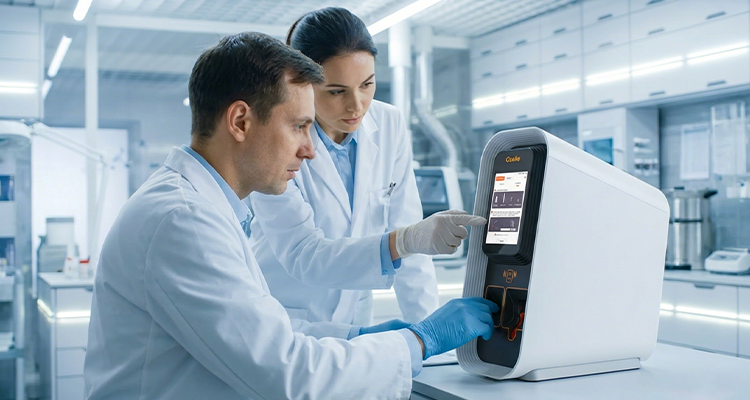
AI-powered analyzers are reshaping how labs approach CBC testing by combining lab-grade accuracy, high automation, and simplified workflows. Among these solutions, the Ozelle EHBT‑75 auto hematology analyzer is designed for professional laboratory use and provides 7-diff CBC with deep cell morphology from a compact, cartridge-based system. Labs that want to understand the wider product context can review Ozelle’s hematology solutions to see how AI-powered CBC systems are positioned for clinical use.
How CBC Technology Has Evolved in the Lab
For more than a century, CBC testing has moved through several generations of technology, with each stage solving some problems while introducing new limitations.
- In 1852, microscopy became the standard approach, relying on manual observation of stained blood smears under the microscope.
- In the 1950s, the impedance method was introduced, counting cells by measuring voltage pulses as they passed through an aperture, which increased automation but provided limited morphology detail.
- In the 1970s, flow cytometry added hydrodynamic focusing and laser light scattering, enabling multi-parameter analysis using fluorescence and scatter signals.
- Since around 2017, AI-driven cell morphology has created a new generation of image-based CBC systems that combine high-resolution imaging with deep learning algorithms.
The EHBT‑75 belongs to this latest generation because it uses high-resolution imaging and AI-based Complete Blood Morphology (CBM) instead of relying only on impedance or scatter plots. By working with real cell images, the analyzer can deliver both numerical results and visual morphology support within routine CBC workflows. More product details are available on the official EHBT‑75 auto hematology analyzer page.
What “Lab-Grade” Performance Means in EHBT‑75
When evaluating a hematology analyzer for lab use, “lab-grade” should refer to clear standards in parameter depth, accuracy, and clinical relevance. The EHBT‑75 7-diff auto hematology analyzer is positioned as a professional instrument for laboratories that need deeper CBC analysis without adding separate morphology equipment.
Parameters and 7-Diff Capabilities
According to Ozelle’s technical materials and comparison content, EHBT‑75 is built around cell morphology for CBC and photoelectric colorimetry for hemoglobin, with 37 hematology parameters designed for advanced diagnostic support. Typical parameters include:
- White blood cells and differential:
- WBC, NEU, LYM, MON, EOS, BAS
- Advanced subsets such as NST, NSG, NSH, and abnormal lymphocytes (ALY), which help characterize infection and inflammatory responses.
- Red blood cells and indices:
- RBC, HGB, HCT, MCV, MCH, MCHC
- RDW-SD and RDW-CV for anisocytosis assessment.
- Platelets and indices:
- PLT, MPV, PDW, PCT, P-LCR, P-LCC
- Platelet aggregates (PAg), which help capture platelet clumping and large platelet populations.
- Reticulocytes and ratios:
- RET and RET%
- Ratios such as NLR and PLR that support inflammation-related interpretation.
These parameters allow EHBT‑75 to provide a richer CBC profile than basic 3-diff systems, which is especially useful in specialized diagnostic laboratories and hospital hematology departments. Technical buyers can use the official EHBT‑75 product page to review the parameter framework in one place during evaluation.
Accuracy, Correlation, and Quality of Reports
Clinic reports generated from EHBT‑75 show detailed numerical results with reference ranges, along with histograms for WBC, RBC, and PLT volume distributions. Internal validation data demonstrate strong correlation to established reference analyzers for key parameters such as WBC, RBC, PLT, and HGB. This level of consistency supports integration into existing quality management systems and external quality assessment programs in hospital labs.
Inside EHBT‑75: CBM Image-Based AI
Modern AI hematology analyzers are more than counters because they combine optics, imaging, and algorithmic analysis in one compact instrument. The Ozelle EHBT‑75 is built on the company’s CBM platform, which is designed to bring morphology into routine CBC testing. For labs evaluating image-based workflows, the EHBT‑75 auto hematology analyzer page explains how its optical system and AI engine work together in routine lab settings.
AI Trained on Large-Scale Clinical Image Data
CBM uses a large database of real blood cell images collected from extensive clinical samples that cover tens of millions of cases. Deep learning models based on convolutional neural networks (CNNs) analyze these images and learn subtle morphological differences between normal and abnormal cells. This approach enables EHBT‑75 to flag immature neutrophils, hypersegmented neutrophils, abnormal lymphocytes, platelet aggregates, and other atypical features in a standardized way.
Advanced Optics and Multispectral Imaging
EHBT‑75 uses a high-precision optical system with SwissOptic lenses and multispectral imaging to capture fine cellular details at high resolution. Patented Z-stack technology supports multi-layer scanning of the sample and creates three-dimensional image stacks that help the AI engine identify cells even when they overlap or sit on different focal planes.
The imaging pathway combines visible light, narrowband multispectral channels, and photoelectric signal detection to classify WBC, RBC, and PLT populations more effectively. EHBT‑75 then converts these image findings into numerical parameters and visual galleries that laboratory professionals can review when needed.
Fully Automated Workflow From One Drop of Blood
EHBT‑75 is designed to behave like an all-in-one station for a single blood sample: it accepts a micro-volume of whole blood, processes it in a closed single-use cartridge, performs liquid-based staining, captures images, and generates a full CBC and morphology-aware report. Typical operation uses about 30–60 µL of blood and delivers a complete 7-diff CBC with morphology report in roughly 6 minutes per sample.
This combination of small sample volume, short turnaround time, and morphology support helps labs obtain more diagnostic value from each CBC run without adding extra manual steps.
Maintenance and Cost of Ownership: Why EHBT‑75 Is Maintenance-Free
When labs adopt new analyzers, the purchase price is only one part of total cost of ownership. Long-term maintenance, consumables, downtime, and staff time often have a greater impact on budget and workflow. EHBT‑75 is designed to minimize these factors through a maintenance-free, cartridge-based approach.
Single-Use Cartridges With Room-Temperature Storage
Instead of traditional multi-bottle reagent systems and complex fluidics, EHBT‑75 uses single-use test kits that integrate reagents and waste handling in one closed cartridge. These cartridges are engineered for room-temperature storage with long shelf life, which simplifies logistics and reduces waste from expired reagents. This design also removes the need for external liquid systems and rinsing cycles that often create downtime in conventional analyzers.
No Liquid Pipeline and Sealed Waste Management
The instrument architecture is built around a no-liquid-pipeline concept, which means there is no internal liquid circuit that needs routine flushing or cleaning. All waste liquids from the test process remain inside the cartridge, improving bio-safety and reducing operator exposure to biological material. As a result, EHBT‑75 is effectively maintenance-free in daily use and limits service needs to periodic checks rather than continuous preventive maintenance.
One-Key Operation and Simplified Training
From a workflow perspective, EHBT‑75 emphasizes simple operation with one-key start, guided on-screen prompts for cartridge placement, and an intuitive touch interface. Because there is no sample pre-treatment and the consumable is pre-configured, staff training is more straightforward and less dependent on highly specialized skills. Labs reviewing implementation details can refer to the official EHBT‑75 specifications and product overview before procurement and installation.
Practical Criteria: When EHBT‑75 Is the Right Choice for Your Lab
To decide whether EHBT‑75 matches your lab’s needs, it helps to translate its technical features into practical selection criteria.
Clinical and Analytical Requirements
- You need 7-diff CBC with extended parameters such as NST, NSG, NSH, ALY, RET, NLR, and PLR to support complex hematology, infection, and inflammation cases.
- You want automated abnormal cell detection, including immature neutrophils, hypersegmented forms, abnormal lymphocytes, and platelet aggregates, to reduce manual smear review.
Workflow and Throughput
- Your lab requires rapid turnaround, and EHBT‑75 typically delivers a full 7-diff CBC with morphology support in around 6 minutes per sample.
- Throughput around 10 samples per hour is sufficient for your lab volume, especially when EHBT‑75 is used as a dedicated CBC and morphology analyzer.
Sample Volume and Patient Mix
- You often work with patients where micro-volume sampling is important, such as pediatrics or fragile patients; EHBT‑75 uses about 30–60 µL of blood per test.
- You need a device that handles routine CBCs while also supporting more complex morphology review when necessary.
Maintenance and Staffing
- Your lab wants to minimize downtime linked to fluidic blockages, reagent lines, and regular maintenance cycles.
- You prefer a maintenance-free, cartridge-based system that reduces reliance on highly specialized operators.
Space, Power, and Connectivity
- Bench space is limited, and EHBT‑75 has compact dimensions around 415 × 203 × 483 mm, making it suitable for both central labs and satellite locations.
- You need flexible connectivity, such as USB, Ethernet, Wi‑Fi, or Bluetooth, to integrate with LIS or hospital networks.
If these criteria align with your environment, EHBT‑75 is positioned as a strong candidate for upgrading your lab’s hematology capability. Procurement teams can use the official EHBT‑75 page as a reference for specifications, workflow fit, and installation planning.
CBC Technology Options Compared
The table below summarizes the main CBC approaches a lab might compare, with EHBT‑75 representing the image-based AI category.
| Method | Principle | Morphology detail | Automation level | Visualization | Typical role in lab |
| Manual microscopy | Visual inspection of stained smears | Highest detail but subjective | Low, labor-intensive | Full slide images | Reference and complex differential cases |
| Electrical impedance | Voltage pulse counting and sizing | Limited, mainly size-based | High | No cell images | Basic CBC analyzers |
| Flow cytometry | Laser scattering and fluorescence | Marker-based, limited direct morphology | High, high throughput | No cell images | Advanced analyzers and special testing |
| Image-based AI (EHBT‑75) | High-resolution imaging plus CNN classification | High morphological detail with automation | High, fully automated | Full cell images | Modern AI CBC with built-in morphology support |
EHBT‑75 combines the automation of advanced analyzers with morphology insight that is closer to manual microscopy, making it suitable for labs that want deeper analysis without adding separate imaging systems.
Example Scenario: Upgrading a Hospital Lab With EHBT‑75
Imagine a hospital laboratory that currently relies on a basic impedance analyzer for CBC and performs manual smear review whenever abnormal flags appear. As patient volume grows and case complexity increases, the lab experiences longer turnaround times and rising staffing demands for microscopic review.
By introducing the EHBT‑75 7-diff auto hematology analyzer, the lab can automate both CBC counting and morphology pre-classification within a single cartridge-based system. The analyzer’s one-key operation, maintenance-free design, and fast 6-minute report enable technicians to process more samples per shift without adding training burden. At the same time, clinicians receive richer reports that combine full 7-diff CBC, morphology parameters, and inflammation-related ratios, improving decision support in emergency and inpatient care. Labs considering this upgrade path can review the official EHBT‑75 auto hematology analyzer page for product-level details before purchase.
Conclusion
Choosing a hematology analyzer for your lab is ultimately about balancing diagnostic depth, workflow simplicity, and long-term cost. The EHBT‑75 7-diff auto hematology analyzer shows how image-based AI, maintenance-free cartridges, and micro-volume sampling can work together to deliver lab-grade CBC and morphology without adding daily burden to technicians. By reviewing the official EHBT‑75 product page together with Ozelle’s broader hematology solutions, labs can make a more informed decision about upgrading to an AI-powered CBC workflow that supports both current clinical needs and future growth.