
 English
  Français
  Русский
  Español
  Deutsch
  Português
  العربية
  Italiano
In a busy urban cat clinic, every delayed blood result can mean a delayed diagnosis and a worried pet owner waiting in the lobby. As more clinics move CBC testing in‑house, AI‑powered hematology platforms like those from the Ozelle official website help vets deliver faster, more precise care for feline patients. Instead of relying on outsourced labs, a modern cat blood analyzer lets you complete feline CBC testing within minutes, while keeping workflow simple for your team.
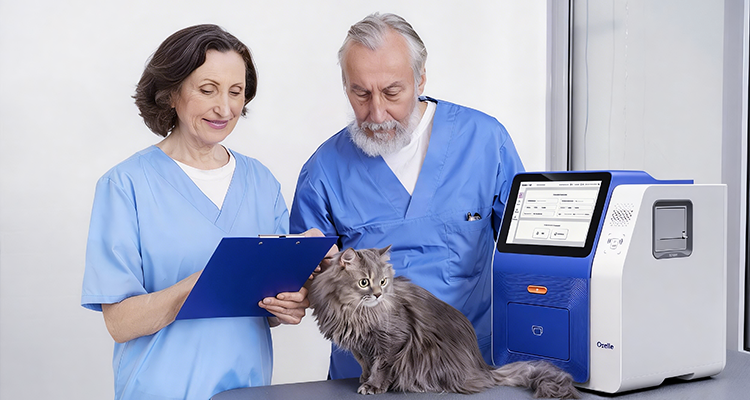
What a Cat Blood Analyzer Actually Does
A dedicated cat blood analyzer is an automated device that measures a complete blood count (CBC) and related hematology parameters from feline blood. It replaces manual microscopy and subjective reading of smears with standardized, repeatable measurements generated by an automated workflow.
Typical feline CBC outputs include:
- White blood cells and differential (WBC, neutrophils, lymphocytes, monocytes, eosinophils, basophils).
- Red blood cells and indices (RBC, hemoglobin, hematocrit, MCV, MCH, MCHC, RDW).
- Platelets and indices (PLT, MPV, PCT, PDW, PLCR).
Advanced analyzers go beyond simple counts and add morphological flags and images, helping you identify abnormal cell forms in cats that might be missed by basic 3‑part systems.
Why Feline Hematology Needs Species‑Specific Technology
From reference ranges to cell morphology, cats differ significantly from both humans and dogs, which is why using human‑only analyzers or generic systems can compromise diagnostic accuracy. Feline neutrophils, lymphocytes, and platelets can present differently on smears and in measurement patterns, making species‑specific calibration crucial.
Veterinary‑optimized analyzers are configured with:
- Dedicated feline reference ranges and decision thresholds.
- AI models trained with cat blood cell images, improving morphology classification performance.
- Low sample volume requirements that keep fragile or underweight cats safer during phlebotomy.
This combination makes it easier for general practitioners to monitor chronic feline diseases—such as CKD, hyperthyroidism, and chronic inflammation—with lab‑grade confidence.
Inside an AI Cat Blood Analyzer: From CBC Counter to Multi‑Functional Vet Mini Lab
Today’s cat blood analyzers are no longer just CBC counters; they function as compact multi‑functional vet laboratories. Ozelle’s EHVT‑50 veterinary hematology analyzer, for example, is designed for dogs and cats and combines CBC, immunoassay, urine, and fecal analysis in one device.
According to Ozelle’s product information, the EHVT‑50 veterinary hematology analyzer offers:
- 7‑diff CBC for cats and dogs with 38+ parameters, including maturation flags like NST, NSG, and NSH.
- AI‑powered cell morphology with real cell images appearing in the report.
- Automated urine sediment analysis to detect crystals, casts, epithelial cells, and microbes.
- Fecal analysis for parasite eggs, protozoa, and inflammatory markers, along with key immunoassay panels such as feline SAA, CRP, and infectious disease markers.
For a single cat with weight loss, diarrhea, and lethargy, this type of analyzer can generate CBC, urinalysis, and fecal results in‑clinic, supporting a comprehensive differential diagnosis before the owner goes home.
Example Scenario: Emergency Feline Anemia in a City Clinic
Consider a cat that arrives collapsed, pale, and tachycardic in the middle of a hectic day. Rapid differentiation between acute blood loss, hemolytic anemia, and non‑regenerative anemia is essential.
With a modern cat blood analyzer:
- You can obtain CBC parameters such as RBC, HGB, HCT, and indices within minutes, confirming the severity of anemia.
- Reticulocyte counts (RET#, RET%) help you distinguish regenerative from non‑regenerative patterns.
- Morphology images highlight schistocytes, spherocytes, or abnormal RBC shapes suggestive of hemolysis or microangiopathic processes.
Faster in‑house results support decisions on transfusion, hospitalization, and further diagnostics, and they reduce the time you and the pet owner spend waiting for external lab reports.
Operational Benefits of In‑Clinic Cat CBC Testing
From a management perspective, adding a cat blood analyzer changes your clinic’s economics and workflow. Common benefits for cat‑focused practices include:
- Shorter turnaround time – CBC and related tests finish in minutes rather than hours or days.
- Reduced outsourcing and courier costs – routine feline CBCs can be handled in‑house instead of at reference labs.
- Higher perceived quality of care – pet parents see you as a clinic with “full lab capabilities.”
- Simplified daily routine – systems like EHVT‑50 use single‑use cartridges and maintenance‑free designs to minimize downtime and training demands.
Because cartridges are pre‑calibrated and sealed, they also enhance biosafety and consistency versus open reagent systems.
To compare feline and human CBC solutions or explore other models, clinics can also review Ozelle’s broader hematology analyzer & CBC machine portfolio.
Example CBC Parameter Set for Cats
The exact parameter list depends on the system, but a multi‑functional veterinary analyzer similar to EHVT‑50 typically offers an extensive feline CBC panel.
| Parameter Group | Example Parameters (Feline) | Clinical Use |
| WBC & Differential | WBC, NEU, LYM, MON, EOS, BAS, NST, NSG, NSH | Evaluate infection, inflammation, and stress responses |
| RBC & Indices | RBC, HGB, HCT, MCV, MCH, MCHC, RDW‑CV, RDW‑SD, RET#, RET% | Classify anemia, assess regeneration and red cell size |
| Platelets | PLT, MPV, PDW, PCT, PLCR, PAg EHBT-75-V1-9.22. | Investigate thrombocytopenia, platelet activation trends |
| Ratios & Derived Metrics | NLR, PLR and others | Support risk assessment and inflammatory profiling |
These parameters are presented together with histograms and image panels, making it easier to correlate numerical changes with morphology for feline patients.
Choosing the Right Cat Blood Analyzer for Your Clinic
When evaluating cat blood analyzers for a busy urban clinic, it is helpful to focus on several decision factors that directly affect feline care and workflow.
Key criteria include:
- Species optimization – cat‑specific calibration, reference ranges, and AI morphology models.
- Low sample volume – suitable for kittens and fragile adult cats.
- Integrated testing – CBC, urine, feces, and immunoassay in a single footprint for space‑constrained practices.
- Maintenance and consumables – cartridge‑based, maintenance‑free systems reduce hidden operating costs.
- Quality and regulatory backing – CE‑marked analyzers from manufacturers specializing in AI‑driven hematology.
For clinics that serve both feline and canine patients, exploring a multi‑functional unit like the EHVT‑50 veterinary hematology analyzer can simplify equipment planning while still respecting feline‑specific diagnostics
FAQs: Cat Blood Analyzer
Q1. Can one analyzer serve both cats and dogs?
Yes. Many veterinary analyzers, such as multi‑species platforms from Ozelle, are designed to support both cats and dogs with species‑specific settings.
Q2. How much blood is needed from a cat?
Modern systems are optimized for low volumes—often tens of microliters—making them suitable for kittens and geriatric cats; exact requirements depend on the specific analyzer model.
Q3. Are AI‑based cat blood analyzers difficult to operate?
No. Cartridge‑based devices with touchscreen interfaces are built for daily use by clinic staff, typically requiring one‑click testing and minimal sample pre‑treatment.
Q4. Do we still need manual microscopy if we use AI morphology?
For many routine feline cases, AI morphology and image capture provide sufficient detail, though complex or atypical cases may still warrant expert microscopic review.
Q5. Where can I learn more about veterinary hematology solutions for cats?
You can explore Ozelle’s AI veterinary hematology portfolio, including EHVT‑50 and related CBC systems, directly through their hematology analyzer hub and product pages.
Bringing AI Cat Blood Analysis into Your Daily Feline Workflow
In a crowded urban practice where cat owners expect fast answers, adopting an AI‑enabled cat blood analyzer helps you move from “send out and wait” to truly in‑clinic diagnostics. By combining feline‑optimized CBC analysis, morphology images, and multi‑modal testing in one system, you can deliver clearer treatment decisions and a smoother experience for both cats and their owners.
If you are exploring how to upgrade feline diagnostics in your clinic, visiting the Ozelle AI‑powered hematology platform is a practical first step toward choosing the right veterinary cat blood analyzer for your needs.