
 English
  Français
  Русский
  Español
  Deutsch
  Português
  العربية
  Italiano
Dr. Lee had been seeing patients back-to-back for almost nine hours.
The last appointment of the day was a young man with low-grade fever, fatigue and a vague “I just don’t feel right” complaint. The history was non‑specific, the physical exam subtle. The fingerstick sample was quickly run on a traditional cbc testing machine, and the report looked “more or less fine”. But Dr. Lee’s clinical instinct said something else.
“His eyes don’t look as relaxed as this report suggests,” Dr. Lee thought.
The patient kept glancing at his phone, then back at the doctor: “Can I know what’s going on today, or do I need to come back again?”
In many primary care clinics, a cbc testing machine provides some of the earliest and most important objective clues for clinical decision‑making, alongside history and physical examination. Yet when tests are split across multiple devices, tubes and even external labs, the information available at the exact moment when time and reassurance matter most can be fragmented rather than complete.
The Hidden Cost of Fragmented Testing
For most community and primary care settings, everyday diagnostics still look like this:
- One device for CBC, another for CRP or SAA, another for glucose, lipids and liver or kidney function.
- Some panels cannot be done on-site at all and must be sent to a reference lab, with turnaround measured in days, not minutes.
- Nurses and clinicians spend valuable time bouncing between “manual loading – waiting – printing – typing – uploading – interpreting”, leaving less time to sit with patients and explain what the results actually mean.
From a technical perspective, each instrument—including a conventional cbc testing machine—may perform its own task correctly and within specification. The challenge is that each device sees only a narrow slice of the patient’s clinical picture, and those slices arrive at different times and in different formats.
The real problem is this:
The speed and format in which diagnostic information reaches the clinician no longer match the pace and complexity of modern primary care.
When a febrile patient is told to “come back tomorrow when the rest of the results are ready”, or when a chronic disease follow-up is delayed because the lab schedule is full, clinicians feel very clearly that this is not just a “workflow issue”. It shapes clinical quality, continuity of care, and patients’ confidence in the system. Over time, these delays and fragments accumulate into missed opportunities for early intervention and more personalized management.
A New Kind of CBC Testing Machine: Turning a Mini Lab into a Desk Companion
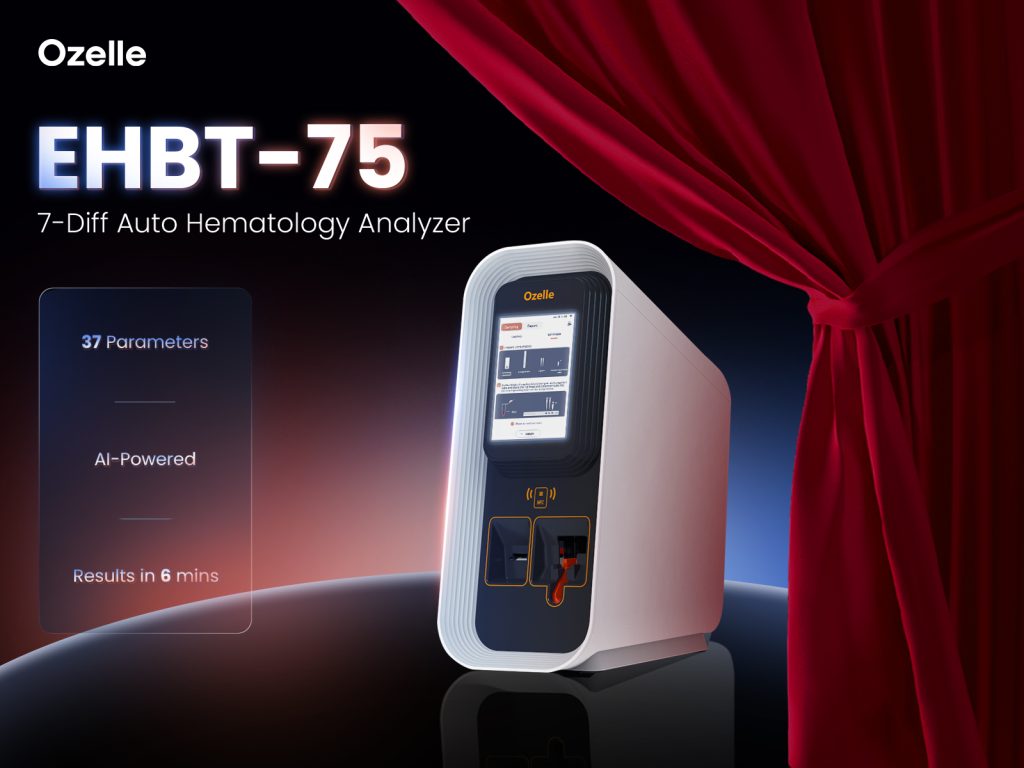
Ozelle was created in response to realities like these. Originating from a laboratory in Silicon Valley, Ozelle focuses on AI‑ and IoT‑powered digital diagnostics for primary healthcare. Today, the company has over 50,000 devices deployed worldwide and AI cell morphology algorithms trained on more than 50 million real clinical samples—spanning different age groups, disease states and geographies. These models have been recognized at international AI conferences and are continually updated through Auto‑ML pipelines to stay robust as clinical practice evolves.
Among its portfolio, the EHBT‑50 Mini Lab represents a new generation of cbc testing machine—one that goes far beyond CBC counting.
- A single compact device combines 7‑part differential CBC with advanced cell morphology, immunoassay and dry‑chemistry biochemistry, as well as urine and fecal testing, in one integrated workflow.
- The CBC module not only reports standard parameters such as WBC, RBC, HGB, HCT, MCV, MCH, MCHC, PLT, MPV and RDW, but also extended indices such as NST, NSG, NSH, RET, NLR, PLR, PAg and PLCC, providing deeper insight into inflammatory response, bone marrow activity and platelet behavior.
- One small whole‑blood sample—around 30–40 μL for testing—and one disposable cartridge can deliver lab‑grade reports in about six minutes, with analytical performance that shows strong correlation with central laboratory hematology analyzers across major CBC parameters.
Under the hood, the EHBT‑50 applies cell morphology imaging rather than relying solely on impedance or flow cytometry. A customized high‑resolution optical system, liquid‑phase Wright–Giemsa staining and high‑speed full‑field scanning allow the device to capture detailed images of blood cells comparable to traditional smear microscopy, but fully automated and standardized.
For clinicians like Dr. Lee, this AI‑powered cbc testing machine feels less like a standalone analyzer and more like a desktop mini lab. It compresses what used to be multiple instruments, multiple samples and multiple visits into one blood draw, one run and one meaningful discussion with the patient—without requiring a full laboratory infrastructure or a dedicated lab team on site.
Letting AI “Look Twice” at Blood Cells
Back to the young man with fever and fatigue.
On a conventional cbc testing machine, the output might be a mildly elevated white blood cell count with no clear red flags in the basic differential. For a busy clinic seat, it can be tempting to label that “probably viral” and move on—while still feeling that something is not being fully explained.
On the EHBT‑50, Dr. Lee selected a combined panel including CBC and inflammation markers like CRP and SAA. In that single six‑minute run, the Mini Lab:
- Used an AI‑driven cell morphology engine, built on over 40 million annotated cell images and convolutional neural networks, to classify parameters such as NST (stab neutrophils), NSG (segmented neutrophils), NSH (hypersegmented neutrophils), ALY (atypical lymphocytes) and RET (reticulocytes), and to flag abnormal cell populations with high‑resolution images on screen.
- Employed a Swiss‑designed high‑resolution lens, multi‑spectral imaging and full‑field scanning to capture morphology at oil‑immersion‑like quality, without manual slide preparation or microscope handling.
- Reported inflammation markers such as CRP, hs‑CRP and SAA from the same sample and cartridge via fluorescence immunoassay, allowing the physician to see both “how strong the inflammatory response is” and “what pattern it looks like” in the same report.
From the clinician’s perspective, AI is not there to replace clinical judgment, but to organize complexity and highlight what matters most in limited time:
- It draws attention to subtle morphological changes—such as a left shift in neutrophils (elevated NST), hypersegmented neutrophils (NSH) or abnormal platelet populations (PAg)—that would otherwise require a trained morphologist and a microscope.
- It groups related parameters and, where appropriate, attaches structured interpretive comments that indicate when combinations of CBC indices and inflammatory markers may be consistent with early bacterial infection, viral infection, immune suppression, stress response or chronic inflammatory processes.
- It places cell images, numeric results, histograms and reference ranges side‑by‑side in a single view, so that the clinician can move from raw data to a prioritized differential, and then to a management decision, within minutes rather than days.
In short, this is a cbc testing machine that not only “counts cells”, but also “looks at them” and “helps the doctor think”—by combining imaging, AI pattern recognition and multi‑marker panels in one automated workflow.
Beyond the Box: When a CBC Testing Machine Is Connected to a Cloud Brain
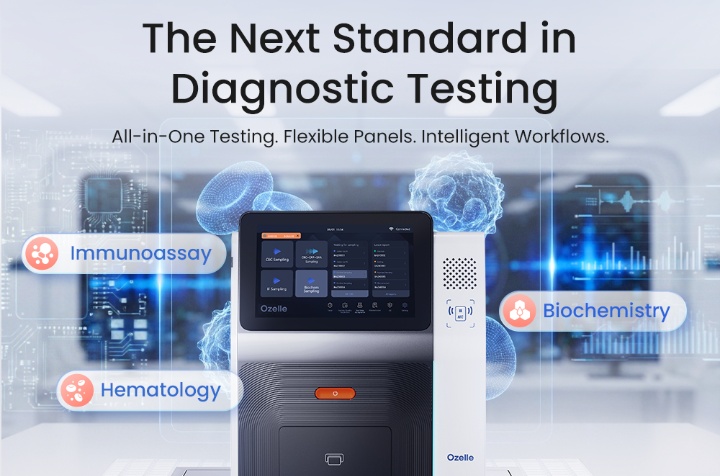
In many clinics, the most frustrating thing about a traditional cbc testing machine is not what it can measure, but what happens after the measurement:
- Results remain siloed inside the device, requiring manual transcription into HIS or LIS systems, with all the risks of delay and transcription error.
- Longitudinal trends for chronic patients are difficult to reconstruct quickly, especially when results come from different instruments or laboratories over time.
Ozelle designed its Mini Lab to be part of a larger smart IoT ecosystem from day one:
- Every result from the cbc testing machine can be sent automatically to Ozelle’s cloud‑based sample and data management platform, where it is stored, organized by patient and visit, and integrated with existing LIS/HIS systems through standard interfaces.
- The platform supports device and reagent management, quality control tracking and performance dashboards, helping clinics monitor analytical consistency and instrument status without adding extra manual work.
- For chronic care, clinicians can instantly review graphical trends and patterns across multiple visits—CBC indices, inflammatory markers, biochemistry—turning repeated tests into a coherent clinical story rather than a pile of isolated printouts.
As connected functions expand, de‑identified data and images from the device can be securely shared with higher‑level centers or partners where appropriate, supporting cross‑institution collaboration, second opinions and the development of regional diagnostic networks. Step by step, the Mini Lab becomes less of a “box in the corner” and more of a well‑integrated node in an intelligent diagnostic ecosystem.
For many users, the shift feels simple but profound:
“It used to be me chasing reports. Now the reports come to me—organized, visualized and ready for discussion.”
Looking Ahead: What the Next CBC Testing Machine Should Look Like
Zooming out, ageing populations and rising chronic disease burdens are reshaping the role of primary care worldwide. More care is shifting closer to patients’ homes, and more decisions are being made in settings with limited staffing and infrastructure.
In this context, a cbc testing machine that only returns isolated numbers is no longer enough for regular follow‑up, risk stratification and proactive health management.
Ozelle’s R&D efforts are moving along several key directions:
- Using 7‑diff deep cell morphology to embed richer information about immune status, bone marrow response, dysplasia and inflammatory patterns into every CBC, bringing insights that traditionally required manual smear review into the primary care setting.
- Continuously expanding immunoassay and biochemistry menus so that a single fingerstick can cover infections, cardiovascular risk, metabolic status, endocrine function, kidney and liver function, and more—reducing the need for multiple visits and multiple phlebotomy events.
- Exploring less invasive, more patient‑friendly sampling approaches, especially for children, elderly patients and those with chronic conditions, to make “getting tested” feel gentler and more acceptable.
- Leveraging aggregated, anonymized data from thousands of devices (where permitted) to refine AI models, identify new biomarker patterns and support more predictive, preventive approaches to population health.
Every simplification of the workflow is designed to give clinicians back what matters most: time for clinical reasoning and conversation.
Every earlier and more precise detection creates an opportunity to quietly add healthy, high‑quality years to a patient’s life.
Back to Dr. Lee’s Clinic: Turning “Something’s Off” into a Clear Plan
In the end, we return to Dr. Lee and the young patient who “just didn’t feel right”. In the corner of the exam room, the AI‑powered cbc testing machine runs quietly. Within minutes, a report appears that combines CBC, inflammation markers and key cell morphology insights in one view.
This time, Dr. Lee does not have to say, “Let’s wait for the rest of the results and talk tomorrow.”
Instead, the doctor can sit down with the patient—during the same visit—and walk through the images and numbers together:
- Which parameters are outside the healthy range, and by how much.
- Whether the pattern looks more like early bacterial or viral infection, or whether another process should be considered.
- What the next step should be: watchful waiting with safety‑net advice, empiric medication, further imaging or a timely specialist referral.
For the device, it is just another structured report.
For the doctor and the patient, it is a chance to finally put words—and a clear, shared plan—to that feeling that “something is off”.