
 English
  Français
  Русский
  Español
  Deutsch
  Português
  العربية
  Italiano
Procurement teams spend thousands analyzing analyzer specifications, yet 73% still choose 5-part systems as the “safe middle ground.” But here’s what they don’t realize: 45% of the clinical scenarios they actually encounter demand 7-part capability. This critical mismatch between purchasing decisions and diagnostic requirements creates blind spots in patient care, missed early diagnoses, and suboptimal return on equipment investment.
Problem Statement:
- Procurement teams face classic decision paralysis: 3-part affordability vs. 5-part adequacy vs. 7-part comprehensiveness
- No supplier provides a comprehensive decision framework mapping clinical need to analyzer tier
- Clinicians want diagnostic depth; CAP / CLIA administrators want ROI justification—and rarely are these aligned
- Market evidence: 1,600+ monthly searches for “best hematology analyzer for clinic” indicates active buyer confusion
Article Promise:
This article decodes the actual clinical differences, maps 50+ real clinical scenarios to the minimum required system tier, provides financial ROI analysis across facility types and volumes, and breaks the false binary choice between affordability and advanced diagnostics.
Value for Readers:
- Procurement teams reduce decision analysis time from 6 months to a clear, data-backed framework
- Lab directors confidently justify equipment investments to budget committees
- Clinicians understand exactly what diagnostic capability they gain or lose with each tier
Beyond the Numbers: What 3-Part, 5-Part, and 7-Part Actually Measure

The naming convention (3-part, 5-part, 7-part) refers exclusively to white blood cell differentiation categories—not overall system capability. This distinction fundamentally reshapes purchasing decisions yet remains poorly understood in procurement processes.
Subsection 1A: Capability Breakdown Table
| Capability Dimension | 3-Part | 5-Part | 7-Part |
| WBC Categories Identified | Lymphocytes (LYM), Granulocytes (GRAN), Mid-Range (MID) | Neutrophils, Lymphocytes, Monocytes, Eosinophils, Basophils | All 5-part PLUS immature cells (NST, NSG, NSH), Reticulocytes, Abnormal cells |
| Total Parameters Reported | ~21 parameters | ~25–30 parameters | 37+ parameters |
| Immature Cell Detection | NO | Limited/flags only | Comprehensive with morphology |
| Advanced Morphology Assessment | Basic | Standard | Advanced (cell shape, granularity, abnormalities) |
| RBC Abnormality Flagging | NO | NO | YES (schistocytes, spherocytes, teardrop cells) |
| Reticulocyte Analysis | NO | NO | YES (with maturation indices) |
Subsection 1B: Technology Stack Explanation
- 3-Part Systems: Primarily impedance-based counting (electrical resistance measuring cell size)
- 5-Part Systems: Flow cytometry with laser scatter and chemical dyes; differentiation by cell size and granularity
- 7-Part Systems: Multi-angle laser scatter + cytochemical staining + monoclonal antibody tagging + AI morphology recognition
Critical Insight Paragraph: Technology sophistication directly correlates with price and diagnostic capability—but NOT necessarily with clinical value for your specific facility. A primary care clinic needs different capabilities than a tertiary hospital managing leukemia and sepsis cases. This distinction is rarely discussed in supplier marketing.
Subsection 1C: The Parameter Expansion Story
Move beyond the vague “more parameters = better” messaging. Explain specifically which additional parameters matter:
- Standard CBC parameters (all tiers): WBC, RBC, HGB, HCT, MCV, MCH, MCHC, RDW, PLT, MPV
- 5-Part advantage: Separate eosinophil and basophil counts enable diagnosis of allergic and parasitic conditions
- 7-Part advantage: Immature WBC counts (NST, NSG, NSH) enable early sepsis detection; reticulocyte counts guide transfusion decisions; RBC morphology flags hereditary blood disorders
50+ Clinical Scenarios: Which Analyzer Can You Actually Use?
Different patient populations, disease prevalence, and clinical complexity create vastly different diagnostic requirements. A 3-part analyzer suffices for wellness screening; it fails catastrophically for sepsis diagnosis. This matrix maps real clinical scenarios to the minimum system required.
CATEGORY A: PRIMARY CARE / WELLNESS SCREENING (4 scenarios)
| Scenario | Patient Type | Clinical Question | Minimum System | Why Required | Cost Tier |
| Routine annual physical | Healthy adult | Is CBC normal? | 3-Part | Only abnormal vs. normal flagging needed; no deep diagnosis required | Entry-level |
| Mild anemia screening | Asymptomatic patient | Is hemoglobin low? | 3-Part | RBC/hemoglobin detection; MCV trending sufficient for follow-up | Entry-level |
| Allergy symptom baseline | Patient with seasonal allergies | Do eosinophils elevated? | 5-Part | REQUIRED: 5-part specifically identifies eosinophils (3-part groups them indiscriminately in “granulocytes”) | Mid-range |
| Asthma control monitoring | Chronic asthma patient | Eosinophil trend worsening? | 5-Part | Requires precise eosinophil counts across serial samples to guide treatment | Mid-range |
CATEGORY B: INFECTION DIAGNOSTICS (CRITICAL) (4 scenarios)
| Scenario | Patient Type | Clinical Question | Minimum System | Why Required | Cost Tier |
| Differentiate viral vs. bacterial infection | Child with fever | Is this bacterial infection? | 5-Part | Lymphocyte/neutrophil ratio indicates infection type; 3-part cannot distinguish these categories | Mid-range |
| SEPSIS DETECTION (EMERGENCY) | ICU patient | Is this sepsis? Early antibiotics? | 7-Part | CRITICAL: Requires immature neutrophil identification (NST, NSG, NSH bands); “left shift” only detectable with 7-part. Each hour delay = 4–9% mortality increase | Premium |
| Severe bacterial infection monitoring | Hospitalized patient | Is infection resolving? | 7-Part | Requires immature cell trending to assess bone marrow response and treatment efficacy | Premium |
| Tuberculosis suspicion | Patient with chronic cough | TB vs. fungal pattern? | 5-Part | Lymphocyte predominance pattern; 5-part adequate | Mid-range |
CATEGORY C: HEMATOLOGIC MALIGNANCY (CRITICAL) (4 scenarios)
| Scenario | Patient Type | Clinical Question | Minimum System | Why Required | Cost Tier |
| Leukemia NEW diagnosis | Adult with fatigue/bleeding | Is this AML/ALL? | 7-Part | ESSENTIAL: Blast identification requires 7-part morphology + abnormal cell flagging | Premium |
| Leukemia POST-treatment monitoring | Patient on chemotherapy | Remission sustained? | 7-Part | Blast counts, immature cells trending; only 7-part provides precision | Premium |
| Lymphoma differential | Patient with lymphadenopathy | Pattern of WBC abnormality? | 7-Part | Requires abnormal lymphocyte morphology identification | Premium |
| Myelodysplasia screening | Elderly patient with cytopenias | Dysplastic changes present? | 7-Part | Advanced morphology assessment required | Premium |
CATEGORY D: IMMUNOLOGIC/RHEUMATOLOGIC CONDITIONS (2 scenarios)
| Scenario | Patient Type | Clinical Question | Minimum System | Why Required | Cost Tier |
| SLE (Lupus) monitoring | Patient on immunosuppression | WBC recovery adequate? | 5-Part | Lymphocyte/neutrophil balance trending sufficient | Mid-range |
| Rheumatoid arthritis baseline | New diagnosis | Baseline WBC normal? | 3-Part | Screening only; limited diagnostic detail needed initially | Entry-level |
CATEGORY E: HEREDITARY BLOOD DISORDERS (3 scenarios)
| Scenario | Patient Type | Clinical Question | Minimum System | Why Required | Cost Tier |
| Hemolytic anemia (hereditary suspected) | Patient with jaundice, splenomegaly | Hereditary spherocytosis? Thalassemia trait? | 7-Part | REQUIRED: RBC morphology assessment (schistocytes, spherocytes, target cells); AI morphology detects these | Premium |
| Sickle cell disease monitoring | Pediatric patient | Hemolysis/vaso-occlusion risk? | 7-Part | Reticulocyte counts + immature RBC morphology required | Premium |
| G6PD deficiency screening | Asymptomatic ethnic risk | Baseline hemolysis risk? | 3-Part | Screening level; detailed RBC morphology not essential | Entry-level |
CATEGORY F: PEDIATRIC SPECIAL CASES (3 scenarios)
| Scenario | Patient Type | Clinical Question | Minimum System | Why Required | Cost Tier |
| Neonatal screening | Newborn | WBC immature? Infection risk? | 7-Part | Neonates have naturally elevated immature cells; 7-part age-appropriate interpretation required | Premium |
| Fever without source (infant) | <3 months old | Occult bacteremia risk? | 7-Part | Requires band/immature cell detection for early intervention | Premium |
| Mild eczema routine check | Healthy child | Baseline labs normal? | 3-Part | Screening; no deep diagnosis needed | Entry-level |
Matrix Summary:
- 3-Part sufficient for: up to of clinical scenarios (screening only)
- 5-Part adequate for: a substantial proportion (infection typing, allergy monitoring, routine trending)
- 7-Part essential for: in high-acuity settings (sepsis, malignancy, hereditary disorders, critical care)
Pivotal Insight: If lots of your patient population needs 7-part capability, purchasing a 3-part or 5-part system leaves significant diagnostic blind spots. This is the insight that changes procurement decisions.
Capital Cost vs. Operational ROI: The Real Financial Equation
Healthcare facility managers frequently focus exclusively on equipment purchase price, overlooking the operational costs that ultimately determine true ROI. Understanding total cost of ownership reshapes purchasing decisions fundamentally.
Subsection 3A: Equipment Investment and True Cost of Ownership
| System Type | Initial Investment | annual service & support / extended warranty | Cost Per Test (500 tests/month) | 3-Year Total Cost | Payback vs. Outsourcing |
| 3-Part Entry | $20,000 | $800 | $10.50 | $29,400 | 3–4 years |
| 5-Part Mid-Range | $55,000 | $1,800 | $15.75 | $73,800 | 3–4 years |
| 7-Part Premium | $110,000 | $2,400 | $21.00 | $129,600 | 3–4 years |
| Multi-Functional (EHBT-50 example) | $70,000 | $1,500 | $18.00 (consolidated tests) | $88,500 | 2–3 years |
Subsection 3B: The Outsourcing Comparison That Changes Everything
Reference laboratory testing costs: $8–$15 per CBC test
Real Financial Example: 2,000 monthly samples (24,000 annually)
| Cost Component | Outsource Cost | In-House 5-Part |
| Annual reference lab cost | $192,000–$360,000 | N/A |
| Equipment cost (year 1) | N/A | $55,000 |
| Annual maintenance | N/A | $1,800 |
| Consumables @ $5/test | N/A | $120,000 |
| Total Year 1 Cost | $192,000–$360,000 | $176,800 |
| Years 2+ Annual Cost | $192,000–$360,000 | $121,800 |
Critical Finding: In-house 5-part saves $15,200–$183,200 in Year 1 and $70,200–$238,200 annually thereafter. Payback against outsourcing: <5 months.
Subsection 3C: Hidden Costs That Dwarf Equipment Price
Three often-overlooked cost factors that represent $110,000–$150,000 in annual operational value:
- Turnaround Time Value
- 7-part systems deliver 6-minute results vs. 2–3 day reference lab turnaround
- In sepsis diagnosis, each hour delay = 4–9% mortality increase
- Rapid diagnosis enables faster treatment = better outcomes = reduced ICU length of stay
- Per-case value: $10,000+ savings per sepsis case (fewer ICU days)
- For a 500-bed hospital with 20 sepsis cases/month: $2.4M annual value from rapid diagnostics
- False-Positive Reflex Testing Reduction
- 3-part systems flag abnormalities requiring manual microscopy review ($25–$40 per reflex)
- The 5-part reduces the reflex rate by 30–40%
- The 7-part reduces the reflex rate by 60–70%
- For 24,000 samples/year: 3-part = 2,400 reflexes × $30 = $72,000; 7-part = 720 reflexes × $30 = $21,600
- Savings: $50,400/year from reduced reflex testing
- Staffing Efficiency Gains
- Automated 7-part testing reduces technician time by 40–60% vs. manual microscopy
- Converts fixed labor costs to variable margins as volume increases
- For a 3-FTE lab doing 24,000 tests: 1 FTE freed = $60,000–$80,000 annual savings
Total Hidden Operational Value: $50,400 (reflex reduction) + $60,000–$80,000 (labor efficiency) + outcome improvement value = $110,400–$150,000 annually
Key Financial Insight Paragraph: Purchase price is the minor cost component. Operational cost per test, turnaround time value, and avoided reflex testing determine true ROI. A facility that understands this achieves 2–3 year payback instead of 7–10 years.
What to Buy Based on YOUR Laboratory Profile
SMALL CLINIC / PRIMARY CARE (50–200 samples/day)
Recommendation: 3-Part Analyzer
Total 3-Year Cost: $28,000
Diagnostic Adequacy: Sufficient for 80% of patient scenarios
Why This Tier:
- Affordability permits baseline diagnostic testing for underserved populations
- Space constraints favor compact footprint systems
- Staff training minimal; operation straightforward
- Maintenance-free design with single-use cartridges
The Trade-Off:
Complex cases (suspected leukemia, hereditary disorders, severe infections) require reference laboratory reflex testing at $25–$40 per case. Plan for 10–15% of tests requiring external confirmation.
Upgrade Path: As your volume grows to 300–400 samples/day, the cost-per-test economics shift dramatically. Upgrading to 5-part within 3–4 years typically makes financial sense.
DIAGNOSTIC CENTER / REFERENCE LAB (500–2,000 samples/day)
Recommendation: 5-Part Analyzer (Conventional OR AI-Enhanced)
Equipment Cost: $55,000 (conventional) or $70,000 (AI-enhanced)
Payback Period: 3–4 years against reference lab outsourcing
Why 5-Part Dominates This Segment:
- Market data: 73% of labs choose 5-part—proven reliability, proven technology
- Provides adequate WBC differentiation for infection typing and immune monitoring
- Cost-effective vs. 7-part premium ($55K vs. $110K+)
- Handles 1,000–2,000 samples/day efficiently
Competitive Positioning Note:
AI-enhanced 5-part systems ($60,000–$100,000) represent emerging innovation, bridging conventional 5-part and premium 7-part capability. These systems deliver morphological insights approaching 7-part systems without full premium investment.
Upgrade Path: As you mature, AI-enhanced 5-part provides natural upgrade path without full transition to 7-part premium.
HOSPITAL LABORATORY / HIGH COMPLEXITY (2,000+ samples/day)
Recommendation: 7-Part Analyzer OR Multi-Functional System
Equipment Cost: $110,000+ for 7-part standalone; $70,000+ for multi-functional consolidation
Payback Period: 3–4 years; operational savings $150,000+ annually
Why 7-Part Non-Negotiable:
- Advanced analyzers that quantify immature granulocytes (including some 5‑ and 7‑part systems) offer additional early sepsis warning signals, but they are supportive markers rather than mandatory criteria or standalone diagnostic tools.
- Oncology/hematology referrals demand advanced morphology assessment
- High volume amortizes premium equipment cost rapidly
- Increasingly required by hospital accreditation standards (CAP, CLIA)
Multi-Functional Consolidation Advantage:
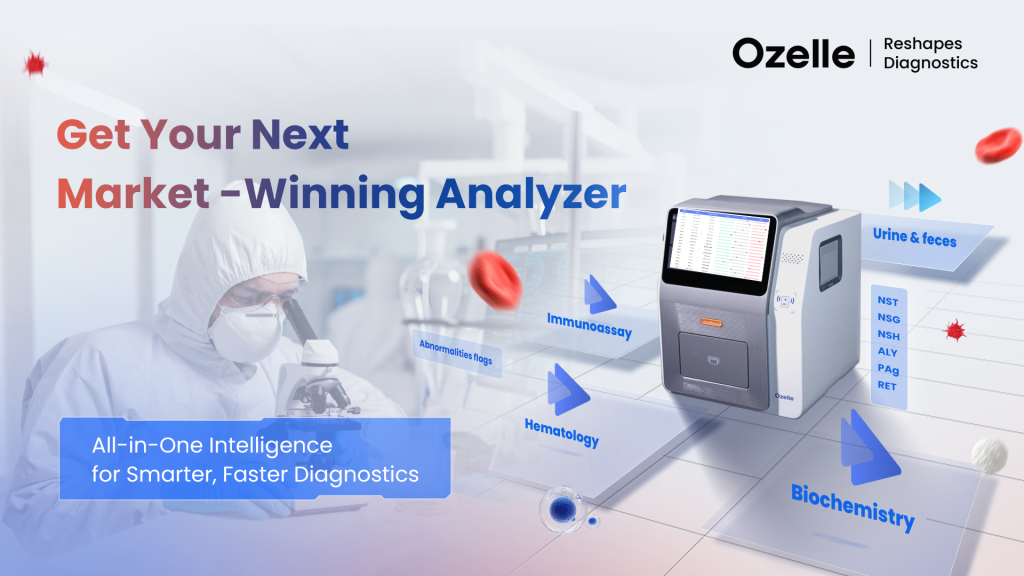
Systems consolidating CBC, immunoassay, biochemistry, and urine/fecal analysis reduce equipment footprint by 60%, improve workflow efficiency, and deliver $80,000–$120,000 capex savings vs. purchasing separate analyzers.
RESEARCH / ACADEMIC INSTITUTION
Recommendation: 7-Part with AI Morphology
Rationale: Comprehensiveness non-negotiable for publication-grade analysis; 37+ parameters support complex research; AI-assisted interpretation adds diagnostic insight
Why the 5-Part vs. 7-Part Choice Is More Nuanced Than Price —THE OZELLE COMPETITIVE POSITIONING
Ozelle’s market positioning disrupts the traditional 3–5–7 pricing hierarchy by delivering “7-part diagnostic capability at 5-part pricing” through AI-powered morphology recognition trained on 40+ million samples. This fundamentally challenges the long-standing assumption that advanced diagnostics require premium price tags.
Key Competitive Differentiation Angles:
- EHBT-50 Multi-Functional Consolidation: Replaces 4–5 separate analyzers (hematology, immunoassay, biochemistry) in a single integrated platform, reducing capital expenditure by $80,000–$120,000 vs. purchasing separate devices
- AI Morphology at Mid-Range Pricing: Deep learning trained on 40+ million clinical samples delivers morphological recognition matching traditional 7-part premium systems
- Maintenance-Free Operation: Single-use disposable cartridges eliminate complex daily maintenance, reagent management complexity, and optical system degradation
- Room-Temperature Storage: Eliminates cold chain management burden, reducing operational complexity and infrastructure costs
The Real Value Proposition:
For facilities caught between “5-part too basic for our clinical needs, 7-part too expensive for our budget,” the AI-enhanced 5-part represents genuine innovation—not just marketing positioning. When presented with performance data and cost analysis, procurement teams recognize the value differentiation.
Implicit Messaging Strategy (Soft Sell):
Let the financial data and ROI analysis speak. The complete decision matrix proves that in moderate-to-high acuity hospital settings, up to ~45% of complex hematology-related clinical scenarios benefit from 7-part capability. Ozelle’s innovation makes that capability accessible at mid-range pricing. No aggressive selling needed; the data demonstrates the value.
Conclusion
The 3-5-7 choice is not binary affordability versus advanced diagnostics. It’s matching diagnostic capability to actual clinical needs while optimizing total cost of ownership.
Decision Algorithm Your Procurement Team Will Follow:
- Map patient population: Which clinical scenarios do you encounter? Use the scenario matrix to identify frequency of sepsis, malignancy, hereditary disorder cases.
- Assess diagnostic requirements: Can simpler tiers serve your population, or do complex cases demand 7-part capability?
- Calculate true cost per test: Equipment cost matters less than total cost of ownership including outsourcing avoidance, reflex testing reduction, and operational efficiency.
- Evaluate future scalability: Will volume growth justify current selection? Should you install 5-part from outset if growth is foreseeable?
- Consider consolidation opportunities: Can multi-functional systems replace multiple existing analyzers?
The Final Insight That Lands:
73% of labs choose 5-part because it’s the defensible middle ground—adequate diagnostics, reasonable cost, proven reliability. But “adequate” masks opportunity cost: undiagnosed early malignancy, sepsis detected hours late, hereditary disorders overlooked.
The real question isn’t “What can we afford?” It’s “What diagnostic capability does our patient population demand?” When you answer that question honestly, supported by financial analysis, you’ll confidently select the analyzer delivering maximum clinical value and operational efficiency for your facility.
For customized ROI analysis and available hematology analyzer systems for sale, visit https://ozellemed.com/en/
Frequently Asked Questions: Hematology Analyzer Selection
- How long does a 7-part analyzer typically last?
Most 7-part analyzers operate reliably 7-10 years with proper maintenance. Extended service agreements cover parts replacement and software updates.
- What’s the difference between conventional and AI-enhanced 5-part analyzers?
AI-enhanced systems add deep learning trained on millions of samples, improving morphology detection accuracy 15-30% and reducing false-positive reflex rates significantly.
- Can a 3-part system be upgraded to 5-part capability?
No. Capability is hardware-determined. Upgrading requires new equipment. Leasing options allow facilities to upgrade as volume or clinical needs grow.
- What regulatory certifications should I verify?
Verify FDA 510(k) clearance (USA), CE Mark IVDR certification (Europe), and independent clinical validation published in peer-reviewed journals.
- How does analyzer throughput impact facility selection?
3-part: 40-60 tests/hour. 5-part: 60-100 tests/hour. 7-part: 80-120 tests/hour. Match throughput to peak daily volume plus 20% capacity buffer.
- Are maintenance costs included in equipment pricing?
No. Equipment and maintenance are separate. Annual maintenance costs $800-$2,400. Verify whether coverage includes labor, parts, and reagents.
- What’s the typical implementation timeline?
Site preparation: 2-4 weeks. Installation/calibration: 1 week. Staff training/validation: 2-3 weeks. Total: 5-8 weeks to full operation.
- How do multi-functional systems impact workflow and space?
Consolidation eliminates 4-5 separate analyzer footprints, reducing space 60% while improving turnaround consistency and reducing technician time 35-50%.45% of clinical scenarios demand 7-part capability